
5 Signs Your Hormones Might Be Off (That Most Doctors Miss)
September 6, 2026
By Dr. Paul Frandsen · September 6, 2026 · 8 min read

Five patterns point to a hormone problem more often than anything else: fatigue that sleep does not fix, brain fog, weight that will not move, mood shifts you cannot explain, and sleep that has quietly got worse. A standard annual panel misses most of them, because it is built to flag disease rather than to measure function.
We hear the same sentence constantly at Foundation Wellness. Your labs look normal. Sometimes that’s true. Often it just means nobody ran the right test.
1. Fatigue That Sleep Does Not Fix
Not the tired that follows a late night. This is bone-deep, and eight hours does nothing for it.
Thyroid is the first thing to rule out. The National Institute of Diabetes and Digestive and Kidney Diseases lists fatigue first among hypothyroidism symptoms, alongside weight gain, cold intolerance, joint and muscle pain, dry skin, heavy or irregular periods, a slowed heart rate, and depression. It also makes a point worth repeating: hypothyroidism develops so slowly that you may not notice symptoms for months or even years.
Low testosterone produces the same flatness in men and, at lower levels, in women. Cortisol running high or in the wrong daily pattern does it too.
A TSH and a complete blood count will not settle any of this. Those two tests answer two questions and leave four unasked.
2. Brain Fog That Will Not Lift
You walk into a room and forget why. Words that used to arrive on time show up late.
Perimenopause is the most under-recognized cause in women. The Office on Women’s Health reports that as many as two-thirds of women going through perimenopause say they have problems with memory or trouble focusing. That isn’t a rare complication. That’s the majority.
What the research actually shows is more hopeful than most patients expect. The Study of Women’s Health Across the Nation followed 2,362 women for four years, testing processing speed, verbal memory, and working memory. Women in late perimenopause stopped improving on repeat testing the way premenopausal and postmenopausal women did. Performance then rebounded to premenopausal levels afterwards, which suggests the difficulty is time-limited rather than permanent.
Thyroid compounds it. The American Thyroid Association includes “forget things easily” in its plain-language symptom list for an underactive thyroid.
Several patients have told us they were quietly afraid of early dementia. Almost none of them had it.
3. Weight That Will Not Budge
Nothing changed. Your diet held, the gym schedule held, and fifteen pounds arrived anyway over a year or two.
Insulin, cortisol, thyroid, estrogen, and testosterone all influence where fat is stored and how readily it comes off. When they shift, body composition shifts with them, and food logs stop predicting the result.
Here’s the awkward part. A basic metabolic panel measures glucose, not insulin. You can be years into insulin resistance with a normal fasting glucose, because your pancreas is compensating. Fasting insulin is the test that shows the compensation, and it is rarely ordered.
Our article on why weight loss programs fail goes deeper into the biology behind that plateau.
4. Mood Changes You Cannot Explain
Irritability out of nowhere. Anxiety that was not part of your personality before. A low, grey mood that does not quite meet the criteria for anything.
Progesterone, testosterone, estrogen, and thyroid hormones each act on mood through different routes. NIDDK lists depression outright as a hypothyroidism symptom, which is worth knowing before anyone reaches for a prescription pad.
We see patients who were started on an SSRI without a thyroid or sex hormone panel first. Sometimes the antidepressant was still the right call. What bothers us is that nobody checked, because checking is cheap and reversible in a way that years of medication is not.
5. Sleep That Has Quietly Got Worse
You used to sleep well. Now 3 AM arrives with no explanation, or falling asleep takes an hour despite genuine exhaustion.
Progesterone falls during perimenopause and its calming effect on sleep goes with it. Cortisol that peaks at night rather than in the morning produces the same wide-awake pattern. In men, low testosterone fragments sleep and untreated sleep apnea then drives testosterone lower still.
That last loop is the one to catch early. Poor sleep worsens insulin resistance, raises cortisol, and pushes sex hormones down, which in turn worsens sleep.
Which Tests Actually Catch a Hormone Problem?
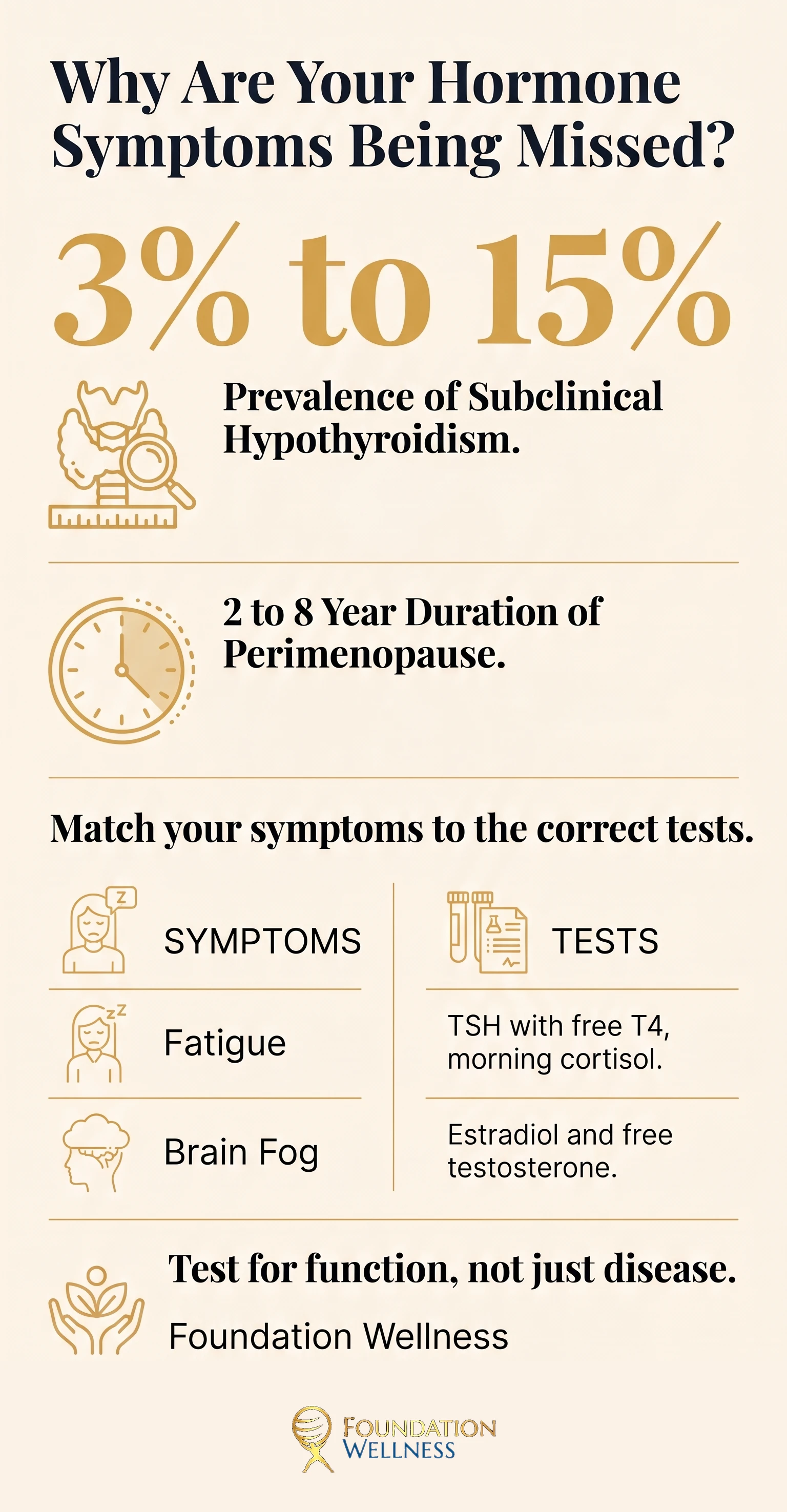
Match the symptom to the panel. This is roughly how we build a first round of labs.
| What you feel | Hormones worth checking | The tests that show it |
|---|---|---|
| Fatigue that rest does not fix | Thyroid, testosterone, cortisol | TSH with free T4, total and free testosterone, morning cortisol |
| Brain fog | Estrogen, thyroid, testosterone | Estradiol, free T4, free testosterone |
| Weight that will not move | Insulin, thyroid, cortisol | Fasting insulin, TSH with free T4, cortisol pattern |
| Low mood or new anxiety | Progesterone, testosterone, thyroid | Progesterone timed to cycle, free testosterone, free T4 |
| Broken sleep | Progesterone, cortisol, testosterone | Progesterone, evening cortisol, free testosterone |
The American Thyroid Association names TSH and free T4 as the two main blood tests for thyroid function, and adds that T3 testing is not often needed. Free T4 is the one most commonly missing from a standard panel.
Why Did My Doctor Say My Labs Are Normal?
Because on the tests they ran, you probably were. The gap sits in which tests got ordered.

A typical annual physical covers a basic metabolic panel, a complete blood count, and sometimes a TSH. Free testosterone, estradiol, progesterone, DHEA-S, fasting insulin, free T4, and cortisol timing are not part of that package.
Subclinical hypothyroidism shows the problem cleanly. StatPearls defines it as normal thyroxine levels with an elevated TSH, and puts prevalence between 3% and 15% depending on the population. A panel that reports a normal T4 and stops there reads as reassuring while missing it.
There is a fair counterargument, and it deserves airtime. Not every borderline number needs treating. StatPearls notes that when TSH sits under 10 mIU/L with a normal free T4, bloodwork should be repeated in three to six months, because almost half of those patients resolve on their own. Retesting before prescribing is good medicine, not delay.
When Should You Get Tested?
Two or more of the five signs above, developing gradually over a year or two, is the threshold we use. One sign in isolation is usually worth watching first.
Age gives useful context. The Office on Women’s Health puts perimenopause at an average of four years, ranging from two to eight, usually beginning in a woman’s mid to late 40s. Symptoms routinely start well before periods become irregular. Our guide to perimenopause symptoms covers what that looks like month to month, and perimenopause versus menopause explains where the line falls.
For men, the parallel workup starts with two early morning testosterone draws. We cover that process in what TRT actually is.
What Happens at a Hormone Evaluation?
A first visit at Foundation Wellness runs about an hour, in American Fork or by telehealth across Utah. We take the history properly, because the timeline usually tells us more than any single value.

Labs come next, chosen against your symptoms rather than a fixed template. Results get interpreted in context: where you sit inside the reference range, how that compares to your own previous results, and whether the pattern matches how you feel.
Treatment is a separate conversation. Sometimes it is thyroid support, sometimes hormone therapy, sometimes sleep and iron and nothing hormonal at all. If replacement is on the table, bioidentical versus synthetic HRT explains the options and hormone replacement therapy in Utah covers how the program runs.
Normal and optimal are not the same word. Neither is normal and untested.
Key Takeaways
- Five signs cluster together: unrefreshing fatigue, brain fog, stalled weight, unexplained mood change, and worsening sleep.
- NIDDK lists fatigue and weight gain among hypothyroidism symptoms, and warns the condition develops slowly enough to go unnoticed for years.
- As many as two-thirds of women in perimenopause report memory or concentration trouble, per the Office on Women’s Health.
- SWAN followed 2,362 women and found perimenopausal cognitive dips rebound to premenopausal levels afterwards.
- Subclinical hypothyroidism means normal T4 with elevated TSH, at a prevalence of 3% to 15%, so a normal T4 alone proves little.
- A TSH under 10 mIU/L with normal free T4 warrants a repeat in three to six months before treating, since almost half resolve.
- Foundation Wellness runs full hormone panels in American Fork and by telehealth across Utah.
Sources
- National Institute of Diabetes and Digestive and Kidney Diseases, Hypothyroidism (Underactive Thyroid) - niddk.nih.gov.
- American Thyroid Association, Hypothyroidism - thyroid.org.
- Subclinical Hypothyroidism, StatPearls, National Center for Biotechnology Information - ncbi.nlm.nih.gov.
- Greendale et al., effects of the menopause transition and hormone use on cognitive performance in midlife women, Neurology 2009 - pmc.ncbi.nlm.nih.gov.
- Office on Women’s Health, menopause symptoms and relief, and menopause basics - womenshealth.gov.
This page is general information rather than medical advice for your situation. Bring your symptoms and any recent labs to a clinician who can see the whole picture.
Dr. Paul Frandsen
September 6, 2026 · 8 min read