
Andropause Treatment: What Works and What Comes First
October 26, 2026
By Dr. Paul Frandsen, MD · October 26, 2026 · 9 min read
Medically reviewed by Dr. Paul Frandsen, MD

Andropause treatment starts with a diagnosis, not a prescription. A physician confirms low testosterone with symptoms plus at least two early morning blood tests. Then they treat anything reversible, such as excess weight or a medicine that lowers testosterone. For men with confirmed low testosterone and symptoms, testosterone therapy with regular monitoring is the main option. The diagnosis and treatment are the same at any age.
How Does Andropause Treatment Work?
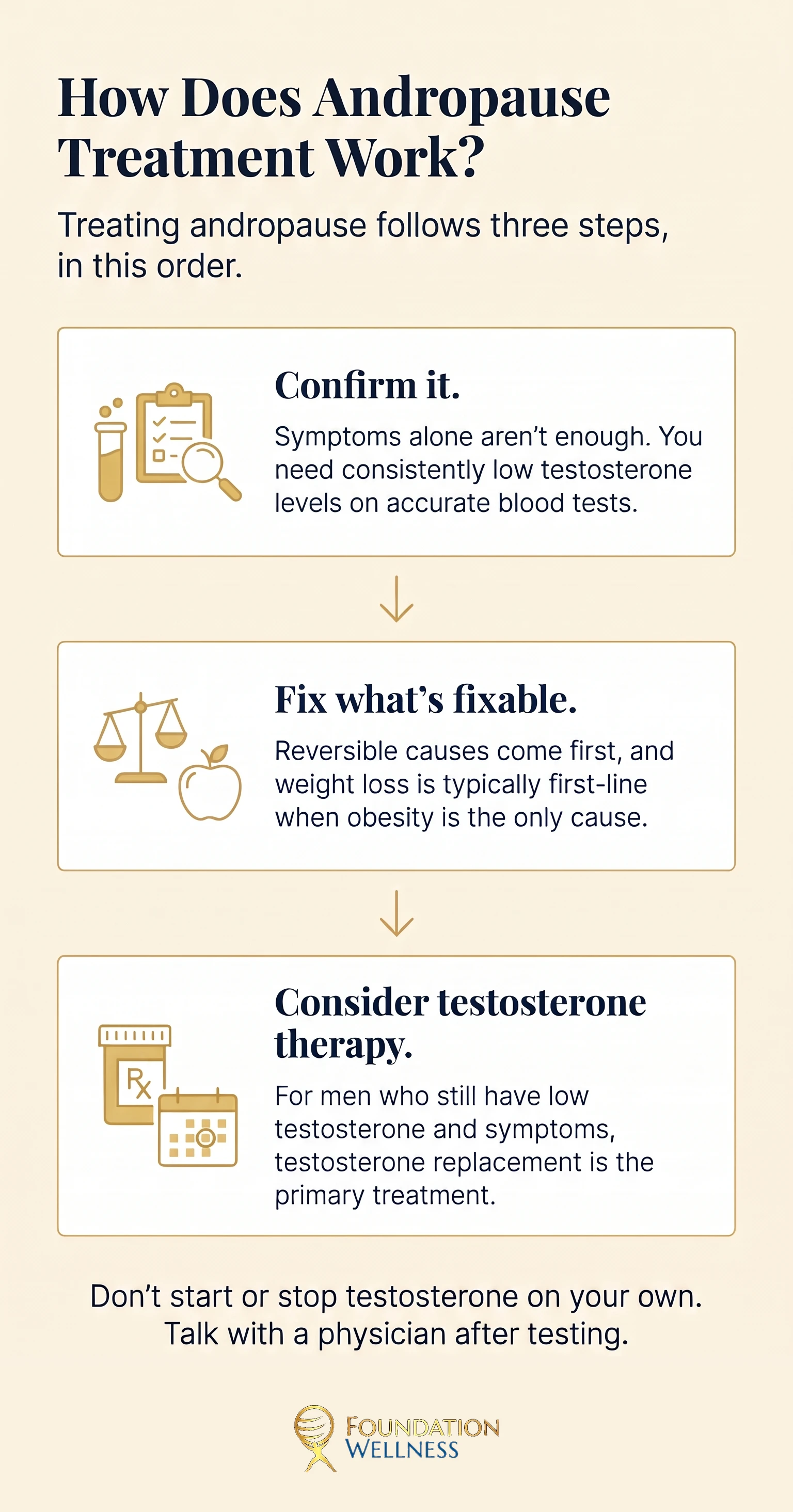
Treating andropause follows three steps, in this order.
- Confirm it. Symptoms alone aren’t enough. You need consistently low testosterone levels on accurate blood tests.
- Fix what’s fixable. The Endocrine Society’s patient guide to hypogonadism says some causes, such as obesity, can be reversed without testosterone therapy and should be addressed before it’s considered.
- Consider testosterone therapy. For men who still have low testosterone and symptoms, testosterone replacement is the primary treatment.
That third step works. In a 2026 statement, the Endocrine Society said testosterone replacement therapy at a dose similar to what a man would normally make has clear benefits. That’s for men with appropriately diagnosed hypogonadism. But the same statement says physicians must weigh those benefits against the risks.
Wondering whether this applies to you? Fair question. Our Men’s Health and TRT team in American Fork starts with exactly that first step: finding out what your hormone levels really are.
What Is Andropause (Male Menopause)?
Andropause goes by several names. MedlinePlus lists male menopause, testosterone deficiency, low T, androgen deficiency of the aging male and late-onset hypogonadism. They all describe the same thing: declining testosterone with age, and the symptoms that can come with it.
It’s a slow decline. Testosterone falls by about 1% a year after age 30 and doesn’t severely deplete, even in advanced age, according to the Endocrine Society. MedlinePlus says levels may start to slowly decrease around age 30 to 40. A 2004 review in Reviews in Urology makes the same point: unlike female menopause, the male version is a slowly progressive condition. For typical ranges, see our guide to testosterone levels by age.
Doctors debate the term itself. The Endocrine Society says labels like “age-related” and “late-onset” hypogonadism are hard to define and blur the line between treatable disease and normal aging. Its approach to diagnosis is the same for a man of any age.
The FDA’s position has shifted too. In February 2025, in its class-wide labeling changes, it kept a “Limitation of Use” for age-related hypogonadism on testosterone labels. According to the FDA’s testosterone information page, in June 2026 the FDA requested label updates that remove that limitation. The same page still says testosterone products are approved only for men with low testosterone along with an associated medical condition.
Low testosterone is common. How common? The Endocrine Society estimates about 35% of men over 45, and 30% to 50% of men with obesity or type 2 diabetes, have hypogonadism.
Is Andropause the Same as Menopause?
No. The names sound alike, but the hormonal changes are very different.
| Menopause (women) | Andropause (men) | |
|---|---|---|
| Main hormone | Estrogen | Testosterone |
| How it changes | Estrogen levels decrease significantly | Falls gradually, about 1% a year after 30 |
| Does it run out? | Estrogen drops after menopause | Doesn’t severely deplete, even in advanced age |
| What doctors call it | Menopause | Age-related or late-onset hypogonadism |
| Treatment | Hormone replacement therapy has long been standard for symptoms | Testosterone therapy only after a confirmed diagnosis |
Sources: MedlinePlus, Endocrine Society, Reviews in Urology 2004.
That slow pace is what makes andropause hard to spot. The Reviews in Urology overview notes that the onset is gradual. And many symptoms mirror medicines or diseases common in older men. So a clinical diagnosis can be difficult.
What Are the Symptoms of Andropause?

Andropause symptoms come from low testosterone. The Endocrine Society and MedlinePlus list:
- Lower sex drive.
- Erectile dysfunction and fewer spontaneous erections.
- Lower sperm count.
- Less energy.
- Less muscle size and strength.
- More body fat.
- Bone loss.
- Irritability, trouble concentrating and depressed mood.
- Sleep problems.
- Hot flashes, when testosterone levels are very low.
Here’s the catch, and it’s the part people miss. The Endocrine Society says symptoms alone don’t diagnose hypogonadism. Low energy, low libido and mood changes are common in aging men, and they have many causes. MedlinePlus adds that some symptoms are a normal part of aging. Others can come from conditions such as high blood pressure or diabetes.
Mood deserves its own attention. Feeling flat for weeks is hard, honestly. If you’re feeling down, get support for your mental health alongside any hormone care. Our guide on whether low testosterone can cause depression goes deeper.
How Do Doctors Confirm Low Testosterone Before Treatment?
Good andropause treatment depends on good testing. And testing is easy to get wrong.
The Endocrine Society’s 2026 statement says diagnosis needs symptoms plus consistently low, accurately measured total and free testosterone. A provider should base it on at least two early morning, fasting testosterone tests. A common clinical threshold is near 300 ng/dL. The Endocrine Society’s patient guide puts the window at 7 to 10 AM. Why so early? Testosterone is usually highest in the morning.
Lab quality matters. The statement warns that non-standardized tests can read the same blood sample as “low” or “normal” depending on the lab. Which is frustrating when you just want a straight answer. Tests certified by the CDC’s HoST program give more consistent results.
Your physician will also:
- Take a full history of your symptoms, medicines and health changes.
- Do a physical exam.
- Look for the cause of low testosterone levels, sometimes with more blood tests or imaging.
Worth saying: the Endocrine Society doesn’t recommend screening men who have no symptoms. Testing is for men with symptoms that point to testosterone deficiency.
Can Lifestyle Changes Raise Testosterone Production?
Sometimes, yes, and that’s often the first treatment.
When low testosterone is caused by being overweight or obese (a BMI over 27) with no other cause found, the Endocrine Society says weight loss is typically the first-line therapy. Its patient guide lists other things that can lower testosterone production, some temporarily:
- Opioid painkillers and corticosteroids.
- Sleep disorders.
- Chronic diseases such as liver and kidney disease and type 2 diabetes.
- Too much exercise, poor nutrition and severe illness.
Treating these can improve your hormone levels and your overall health. In practice, regular activity, good sleep and care for your mental health all support that work.
What about supplements? A 2020 study of 50 “testosterone booster” products found 109 unique ingredients, and only 24.8% of those ingredients had published data showing a rise in testosterone. If a hormone imbalance is behind your symptoms, it’s worth finding out properly before buying anything.
Is Testosterone Replacement Therapy the Right Andropause Treatment?

For men with confirmed low testosterone and symptoms, testosterone replacement therapy is the primary treatment, according to the Endocrine Society. Raising testosterone levels can improve sexual concerns, bone health, muscle and anemia.
Forms. The FDA’s approved forms include topical gel, a skin patch, a buccal system applied to the gum and testosterone injections. The Endocrine Society also lists pellets placed under the skin and a nasal gel. Which one’s right? It depends on the cause, your preferences, cost, how well you tolerate it and fertility plans. Compare them in our guide to injections vs pellets vs gel, and see TRT explained for the basics.
Not an anti-aging treatment. The Endocrine Society notes that boosting testosterone isn’t FDA approved to treat or prevent problems associated with aging.
“Bioidentical” labels. You may see bioidentical hormone replacement therapy or bioidentical hormones marketed to men. Nothing in the medical guidelines cited here says that label makes testosterone safer or more effective. Ask your physician exactly what’s prescribed and how it will be monitored.
Fertility. Testosterone from outside the body signals the brain to cut back its own hormones. That lowers sperm production, a 2020 review in F&S Reviews explains. The Endocrine Society guideline recommends against starting testosterone in men planning fertility in the near term. For these men, physicians may use medicines that raise the body’s own testosterone, such as clomiphene (a SERM) or hCG (a gonadotropin). These are used off label: neither is FDA approved for treating hypogonadism.
Give it time. MedlinePlus says that if symptoms haven’t changed after 3 months, TRT is less likely to help.
Is Testosterone Therapy Safe for Older Men?
Testosterone therapy has real benefits and real risks. Both deserve a clear look.
Heart. The TRAVERSE trials followed more than 5,200 men. They found no meaningful increase in heart attack and stroke over 1 to 4 years, the Endocrine Society says. The FDA reports major cardiovascular events in 7.0% of men on testosterone gel and 7.3% on placebo.
Clots and fractures. Those same trials showed about a 50% relative increase in pulmonary embolism, and more bone fractures, in men on testosterone.
Blood pressure. In 2025, the FDA required new labeling after studies confirmed that all testosterone products raise blood pressure.
Prostate. Long-term safety, including for prostate cancer, isn’t established. So the Endocrine Society says risk assessment before starting and careful monitoring during treatment remain essential.
Testosterone therapy isn’t for men with prostate or breast cancer, a high red blood cell count or untreated sleep apnea. It also isn’t for men with plans to have children soon, a heart attack or stroke in the last 6 months, or blood clots. The Endocrine Society guideline asks physicians to monitor symptoms, side effects, testosterone, hematocrit and prostate cancer risk during the first year of hormone therapy. Our TRT side effects guide covers more.
Andropause Treatment at Foundation Wellness in American Fork
Foundation Wellness offers andropause treatment at our clinic at 456 E State Street, Suite 1400, American Fork, UT 84003, with telemedicine visits across Utah. We start with your symptoms, your history and morning bloodwork. We look for anything reversible first. If low testosterone is confirmed, we talk through testosterone treatment, its risks and the monitoring plan together. That way you can decide with the full picture. Learn more about TRT in Utah and what affects TRT cost.
Foundation Wellness accepts many insurance plans. Coverage depends on your plan, so check with our office first. Call us at (800) 983-1974.
Key Takeaways
- Andropause, or male menopause, is a gradual testosterone decline of about 1% a year after 30; doctors call it late-onset hypogonadism.
- Treatment starts with a diagnosis: symptoms plus at least two early morning, fasting testosterone tests.
- Reversible causes come first, and weight loss is typically first-line when obesity is the only cause.
- Testosterone therapy helps men with confirmed low testosterone, with monitoring for blood pressure, clots, fractures and prostate risk.
- Don’t start or stop testosterone on your own. Talk with a physician after testing.
Sources
- Endocrine Society, Statement on Testosterone Replacement Therapy (2026).
- Endocrine Society, Hypogonadism in Men.
- Endocrine Society, Testosterone Therapy for Hypogonadism Guideline Resources.
- Journal of Clinical Endocrinology and Metabolism, Testosterone Therapy in Men With Hypogonadism: An Endocrine Society Clinical Practice Guideline (PMID 29562364).
- Journal of Urology, Evaluation and Management of Testosterone Deficiency: AUA Guideline (PMID 29601923).
- MedlinePlus, Low testosterone.
- MedlinePlus, Aging changes in hormone production.
- FDA, Testosterone Information.
- FDA, FDA issues class-wide labeling changes for testosterone products (2025).
- Reviews in Urology, Testosterone Replacement in Men with Andropause: An Overview (PMC1472881).
- F&S Reviews, Exogenous testosterone replacement therapy versus raising endogenous testosterone levels: current and future prospects (PMC7894643).
- World Journal of Men’s Health, ‘Testosterone Boosting’ Supplements Composition and Claims Are not Supported by the Academic Literature (PMID 31385468).
October 26, 2026 · 9 min read