
Bioidentical Hormones vs Synthetic HRT: The Real Difference
August 3, 2026
By Dr. Paul Frandsen · August 3, 2026 · 8 min read

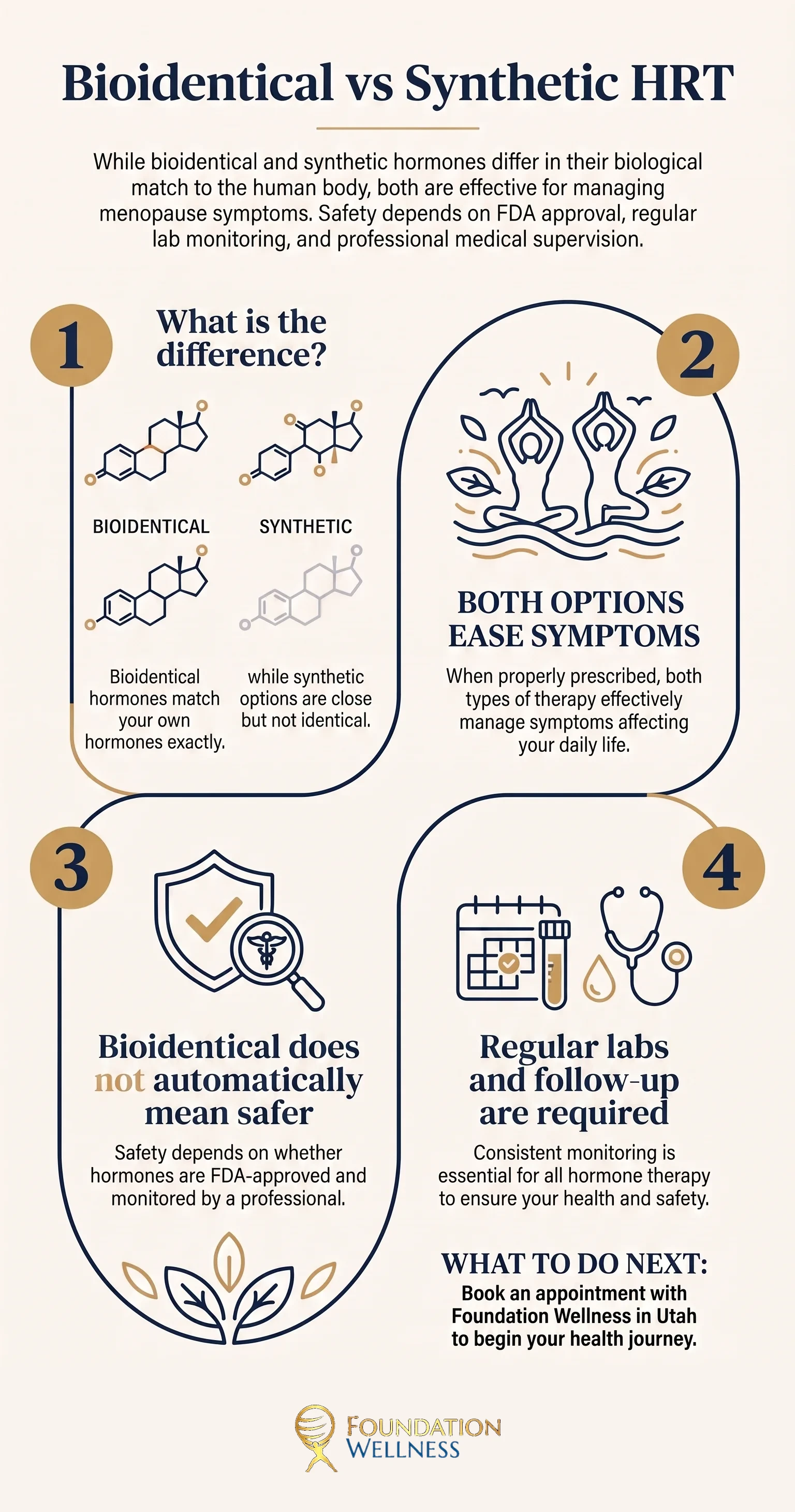
Bioidentical hormones have the same shape as the ones your body makes. Synthetic hormones are close, but not exact copies. Both ease menopausal symptoms well. The label alone doesn’t tell you which is safer. What matters more is whether the product is FDA approved, and whether a doctor checks your hormone levels as you go.
What Are Bioidentical Hormones?
Bioidentical hormones match what your own body used to make. Same molecule. Same shape. Estradiol and progesterone are the two you’ll meet most often.
Most are built in a lab from plant starch. Yam or soy, as a rule. That part is surprising to most people who bring it up with us. Natural hormones from a plant still have to be made by a chemist. Your body can’t read a yam.
Shape is what counts. Because it matches, your cells respond the way they always did. It acts like a human hormone. In shape, it is one.
You’ll see this called bioidentical hormone replacement therapy. Or bioidentical HRT, for short. Some clinics say bioidentical hormone therapy. They all mean the same thing.
What Are Synthetic Hormones?

The synthetic kind is close to yours, with the molecule changed on purpose. Some changes help the drug get through your gut. Others stretch out how long it lasts.
Conjugated estrogens are the classic case. Premarin is made from equine estrogen, collected from the urine of pregnant mares. Medroxyprogesterone acetate is a synthetic progestin. Both carry decades of research behind them. That track record counts for a lot.
Traditional hormone therapy tends to mean this group. Traditional hormones are not bad medicine. They’re just built in a different way. And your body deals with them in a different way too.
Bioidentical vs Synthetic HRT: How Do They Compare?
Both aim at the same target. They bring your hormone levels back into a healthy range, so symptoms settle down. Here they are side by side.
| Feature | Bioidentical hormone | Synthetic hormone |
|---|---|---|
| Molecular structure | Identical to your own | Close, but altered |
| Common examples | Estradiol, micronized progesterone | Conjugated estrogens, medroxyprogesterone |
| Source | Plant starch, built in a lab | Plant or animal source, then altered |
| FDA approved versions | Yes, many | Yes, many |
| Compounded versions | Common, none FDA approved | Rare |
| Research depth | Strong for approved products | Decades, including large trials |
| Lab monitoring needed | Yes | Yes |
Look at that last row. Monitoring never changes. Whatever molecule you use, the dose gets checked against your labs and your symptoms.
Are Bioidentical Hormones Safer Than Synthetic Ones?
Not automatically. This is where marketing runs ahead of the science.
Our patients ask about this more than any other part of the topic. It usually arrives in one form: “Is the bioidentical one the natural one?” The honest answer takes a few minutes, so we give it a few minutes.
The word natural sounds gentle. It isn’t a safety rating. A hormone that matches your own can still be dosed too high. A synthetic hormone can be dosed just right. The dose does the work, not the label.
One real difference is worth knowing. Micronized progesterone is bioidentical progesterone. It may carry a smaller breast cancer signal than the older progestins. That evidence comes from studies that follow women over time. It does not come from randomized trials. So treat it as promising. Not as settled.
The honest framing isn’t bioidentical versus synthetic. It’s approved and monitored versus neither.
What Does FDA Approved Mean Here?
Here’s where most of the confusion sits. Plenty of people assume bioidentical means not approved. That’s simply wrong.
FDA approved bioidentical hormones have sat on pharmacy shelves for years. Estradiol patches, gels, sprays, and pills. Progesterone capsules. Bioidentical testosterone gels, approved for men. Each one is tested for purity, potency, and dose. You get the same thing at every refill.
Compounded bioidentical hormones are a different story. A pharmacy mixes them to order, for one patient. According to the U.S. Food and Drug Administration, compounded drugs are not approved. Nobody checks them for safety, quality, or how well they work before they reach you.
In 2020, the National Academies looked at compounded bioidentical menopausal hormone therapy at the agency’s request. The panel found the evidence too thin to back routine use. The British Menopause Society landed in the same place.
Compounded hormones still have a role. React to a dye or a filler? Need a dose no drug maker sells? Then compounding solves a real problem. It just shouldn’t be the default.
| Question to ask | FDA approved bioidentical hormones | Compounded bioidentical hormones |
|---|---|---|
| Reviewed by the FDA | Yes, for safety, purity, and dose | No |
| Dose in each refill | The same every time | Varies by pharmacy and by batch |
| Forms you can get | Patch, gel, spray, pill, capsule | Cream, capsule, troche, hormone pellets |
| Insurance | Often covered | Rarely covered |
| Best fit | First choice for most women | A filler allergy, or an unusual dose |
What About Hormone Pellets?

Hormone pellets deserve their own warning. A pellet sits under the skin. It gives off hormone for months at a time.
The convenience is real. So is the catch. Compounded pellets often drive levels far above the normal range. And you can’t dial them back once they’re in. According to the Menopause Society, once the North American Menopause Society, compounded pellets should be avoided for that reason.
Does a clinic lead with pellets? Ask two things. What is the dose? And how do we change it if I feel wrong by week three?
In our experience, questions about pellets turn urgent only after the pellet is already in, when the dose can’t be walked back. So we cover the dose and the timeline first, before anyone commits to one.
What Does the Research Say About Breast Cancer?
This comes up in nearly every consult, and it is usually the part people are most worried about. Here’s the straight version.
The Women’s Health Initiative published its first big result in 2002. It changed practice overnight. One group took conjugated estrogens plus a synthetic progestin. In that group, invasive breast cancer rose by about 8 extra cases per 10,000 women each year. Small in absolute terms. Huge in headlines.
The estrogen only arm told a different story. Those women had all had a hysterectomy. They took estrogen by itself, and they showed no such rise.
Two details get dropped in the retelling. The average age in that trial was 63. That’s well past the age when most women start hormone replacement therapy. And it tested one specific synthetic mix. Not every product on the shelf.
For healthy women under 60, or within 10 years of menopause, the Menopause Society holds that the benefits of hormone replacement therapy usually outweigh the risks.
Which Type Is Right for You?
There’s no single winner here. The right answer rests on your symptoms, your history, and your hormone levels.
Bodies vary more than the labels do. One patient settles on a dose that leaves the next person still awake at 3 in the morning. That is why the plan gets built around your labs and your symptoms, not around an average.
For most women starting out, FDA approved bioidentical hormones are the sensible first choice. The dose is known. The supply is steady. The research is solid.
Your symptoms steer the rest. Hot flashes and night sweats respond to systemic estrogen. Vaginal health and sexual health often need a local product too. Sleep and mood tend to track with progesterone. And if a hormone imbalance turns out to sit in your thyroid, hormone therapy won’t fix it. We’ll tell you so.
How Foundation Wellness Approaches Hormone Therapy
Our team starts with full bloodwork. Never a symptom quiz alone. We read your numbers next to how you actually feel. Then we pick a product, usually an FDA approved bioidentical one, at a dose we can defend.
Then we recheck. Six to eight weeks in, we test again and adjust. Hormonal balance isn’t a one time script. It’s an ongoing talk with your labs.
Our testing runs on blood, not saliva. According to the Endocrine Society, salivary hormone tests are not reliable for guiding a dose. So we go by blood work and by how you feel.
Somewhere along the way we learned to ask about sleep and temper before anyone brings up a molecule. That is where the change tends to show up first, well before a lab slip explains it.
A hormonal imbalance rarely shows up as one clean symptom. It looks like bad sleep. A short fuse. A body that quit playing along. Weighing bioidentical HRT against traditional hormone therapy? That’s the talk to have at a consult.
Learn more on our hormone replacement therapy in Utah guide. Or see the whole program on our women’s health and hormone services page. Not sure where you sit in the change? Our guide to perimenopause vs menopause sorts that out. For the money side, see HRT cost in Utah. We serve American Fork and all of Utah, in person and by telehealth.
Key Takeaways
- Bioidentical hormones match your own molecule exactly. The synthetic kind is close, but altered.
- Both types treat menopause symptoms well when the dose is right and the labs get checked.
- Bioidentical doesn’t mean safer by default. Approved and monitored is what counts.
- Many bioidentical hormones are FDA approved. Compounded versions and pellets are not.
- The 2002 trial risk applied to one synthetic mix, in women averaging 63 years old.
- Every plan needs repeat labs at six to eight weeks, then steady follow-up.
- Foundation Wellness serves American Fork and all of Utah, in person and by telehealth.
Sources
- The Menopause Society (formerly the North American Menopause Society) - menopause.org
- U.S. Food and Drug Administration (FDA) - fda.gov
- National Academies of Sciences, Engineering, and Medicine, 2020 review of compounded hormone therapy - nationalacademies.org
- Women’s Health Initiative, National Heart, Lung, and Blood Institute (NIH) - nhlbi.nih.gov
- Endocrine Society - endocrine.org
Dr. Paul Frandsen
August 3, 2026 · 8 min read