
Brain Fog Treatment: Causes, Tests, and What Helps
September 12, 2026
By Dr. Paul Frandsen, MD · September 12, 2026 · 10 min read
Medically reviewed by Dr. Paul Frandsen, MD

Brain fog treatment works best when it starts with the cause. Brain fog is a common name for slow, cloudy thinking, poor focus and forgetfulness. It’s a symptom, not a diagnosis. Poor sleep, stress, low mood, thyroid problems, low vitamins, medicines and hormone changes can all play a part, and most of them can be checked.
What Is Brain Fog?
Brain fog is an everyday way to describe a foggy brain. You walk into a room and forget why. You read the same email three times and still couldn’t say what it asked. A word you use every day just won’t come, and the harder you chase it, the further it slips. Annoying? Very. A little scary sometimes, too.
Doctors don’t diagnose “brain fog” on its own. Some call it mental fog or mental cloudiness, and in medical writing you may see the broader term cognitive dysfunction. These are all ways of saying your thinking isn’t as sharp as it usually is.
One point matters early. MedlinePlus notes that normal aging doesn’t lead to dramatic memory loss. So a big change in how you think isn’t something to accept as “just getting older.” It’s a reason to look for a cause.
What Are Common Brain Fog Symptoms?
Brain fog symptoms vary from person to person, but most people describe a mix of these:
- Difficulty concentrating, or losing your place halfway through a task.
- Trouble finding the right word.
- Short-term memory slips, like missed appointments or lost keys.
- Slow thinking, as if your mind needs extra time to load.
- Mental fatigue that sets in early in the day.
- A general loss of mental clarity that comes and goes.
Each symptom on its own is common. What matters is the pattern. Notice when the fog is worst. Is it after a short night, during a stressful week, after a new medicine, or around your period? Do other people notice it too?
Here’s a simple habit that helps at your visit. Write these cognitive symptoms down for a week or two beforehand. A short log of sleep, stress and fatigue gives your clinician far more to work with than “I just feel off.”
What Causes Brain Fog?

Many medical conditions and daily habits can affect brain function. Chronic stress and depressive symptoms are among them, and your mental health deserves the same attention as your lab work. At our clinic, the Mental Wellness program, Neuronova, takes an integrated approach to anxiety, brain fog and nervous system regulation.
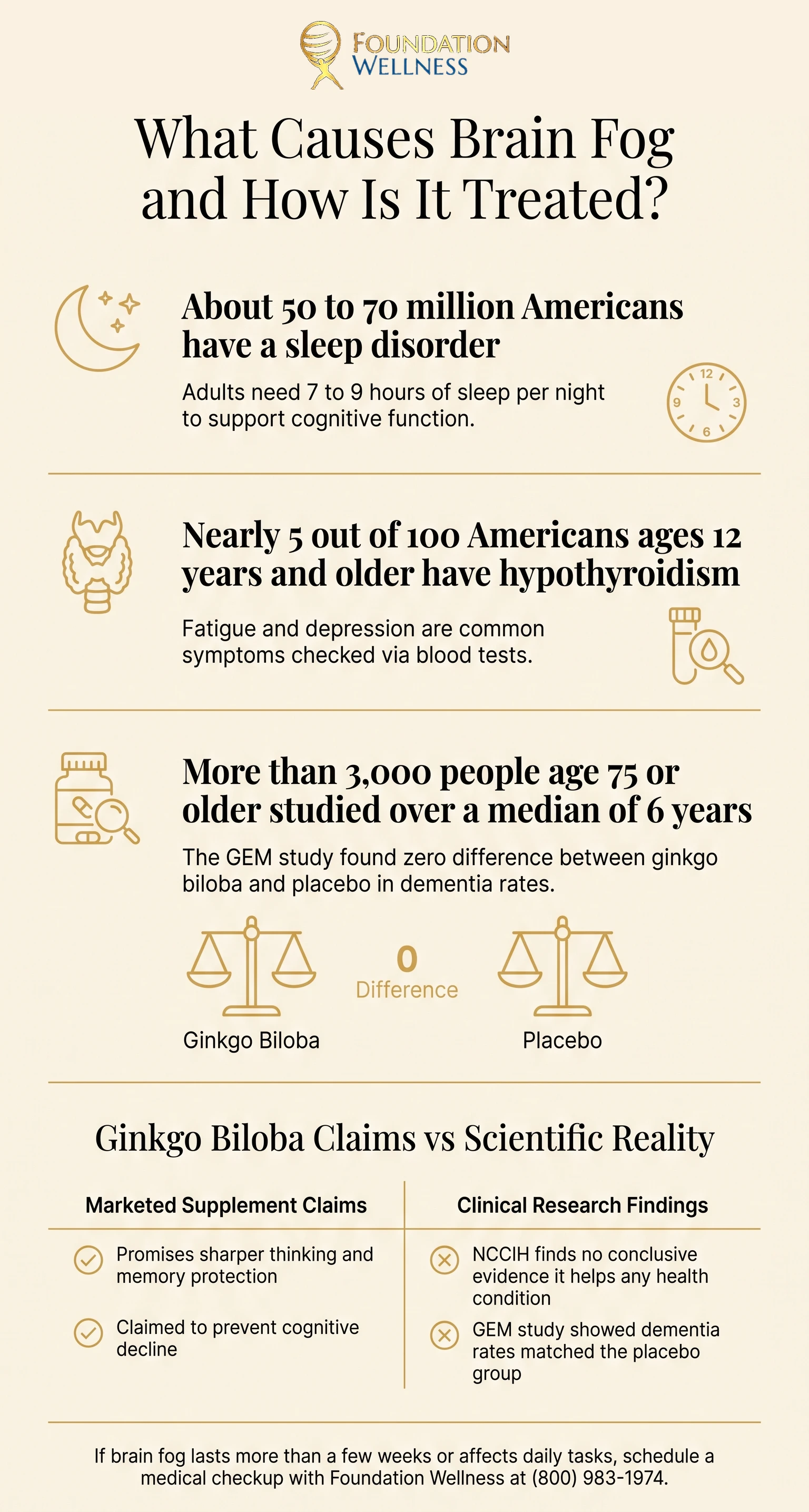
Other common causes are physical conditions. The good news is that many are easy to test. An underactive thyroid is one. Nearly 5 out of 100 Americans ages 12 years and older have hypothyroidism, and fatigue and depression are among its symptoms. MedlinePlus lists low levels of nutrients such as vitamin B1 or B12, along with alcohol and some prescription medicines, as causes of memory trouble.
Cancer treatment is another. According to the National Cancer Institute, memory or concentration problems are sometimes described as a mental fog or chemo brain. Chemotherapy, some radiation therapy to the brain and immunotherapy can cause them.
Chronic illness, chronic inflammation and other long-term conditions can also leave people feeling drained and unfocused. Your brain cells depend on good sleep, steady blood flow and enough nutrients. So a problem almost anywhere in the body can show up as fog.
| Cause | Clues you may notice | What a clinician may check | First steps |
|---|---|---|---|
| Poor sleep or sleep apnea | Trouble concentrating, deciding or remembering | Sleep history, sleep study referral | Aim for 7 to 9 hours, get apnea checked |
| Chronic stress and low mood | Depressive symptoms | Mental health questions | Talk with a clinician |
| Underactive thyroid | Fatigue, depression | Blood tests | Treatment led by a clinician |
| Low vitamin B1 or B12 | Memory trouble | Blood tests | Correct the deficiency with a clinician |
| Medicines or alcohol | Memory trouble | Medicine and alcohol review | Review with your prescriber, never stop alone |
| Cancer treatment (chemo brain) | Memory or concentration problems | Your cancer care team | Tell your care team |
| Hormone changes | Not reported in these sources | Hormone review | Read our menopause brain fog guide |
How Does Poor Sleep Cloud Your Thinking?
Sleep is where many cases of brain fog start. Experts recommend that adults sleep between 7 and 9 hours a night. Be honest with yourself about how often you actually get that. It’s an easier promise to keep in June than in a dark, gray inversion week in Utah County, when getting up and getting outside both feel like more work.
Sleep deprivation adds up, and it can dull your cognitive performance. Poor sleep quality matters too, even when you spend enough hours in bed. If you wake up tired after a full night, pay attention to that.
Sleep apnea tends to get missed. It means your breathing stops and starts while you sleep, often without you knowing. According to the NHLBI, untreated sleep apnea can lead to issues with concentrating, making decisions, remembering things or controlling your behavior. It also notes that about 50 to 70 million Americans have a sleep disorder.
If you often wake up tired, or someone has noticed pauses in your breathing at night, raise it with a clinician. A sleep evaluation can be arranged through a referral. And a sleep problem is one of the first things to rule out when brain functioning slips.
How Is Brain Fog Treated?
There’s no single medical treatment for brain fog, because it isn’t one condition. That can feel frustrating when you just want a fix. Think of the fog as a signal, not the problem itself. It’s a fitting word, actually. Anyone who has driven past Point of the Mountain on a foggy winter morning knows you don’t get through fog by pressing harder on the gas. You slow down, and you deal with the conditions that made it. The goal is to find what’s driving it and treat that. In most cases, the plan to clear brain fog covers a few areas at once:
- Protect your sleep. Keep a steady bedtime and get any snoring or sleep apnea checked.
- Lower the load of stress. Short breaks, time outdoors (a lunchtime walk with Timpanogos in view counts) and support for anxiety or low mood all count.
- Move your body. Regular physical activity is a simple, low-risk part of most plans for brain health.
- Review your medicines and alcohol. Ask your prescriber whether anything you take could affect your cognitive function. Never stop or change a dose on your own.
- Fix what the labs find. A thyroid problem or a low vitamin level is treated under a clinician’s care.
Some clinics use a functional medicine style approach, which simply means looking at the whole person instead of one symptom at a time. Whatever the label, good care for cognitive health checks sleep, mood, medicines and lab work together.
Mental clarity often improves as the causes are treated, but there’s no promised timeline. Be patient with the process (a big ask, we know, when every day feels slow), and keep tracking how your cognitive function changes.
Do Supplements Like Ginkgo Biloba Help?
Many supplements promise sharper thinking. The evidence is thin. Disappointing, if you’ve already got a shelf of bottles at home. Ginkgo biloba is a good example. The NCCIH states plainly that there is no conclusive evidence that ginkgo is helpful for any health condition.
One large test of ginkgo was the GEM study. It followed more than 3,000 people age 75 or older for a median of 6 years, and there was no difference between the ginkgo and placebo groups in the rates at which people developed dementia. That doesn’t support ginkgo as a way to protect cognitive abilities.
Ginkgo also has a safety issue. The NCCIH notes it may raise the risk of bleeding in people who take anticoagulant drugs, such as warfarin. Before you start any supplement, ask your clinician or pharmacist. If the real cause is a low B12 level, a blood test will show it. That beats guessing with supplements.
Can Hormone Changes Cause Brain Fog?
Yes, they can play a part. Many women notice brain fog during perimenopause and menopause, and we cover that in detail in our guide to menopause brain fog.
But it isn’t only women. Men’s hormones change with age too, and that can be worth checking. Our page on testosterone levels by age explains what normal looks like. If you suspect your hormones, these signs your hormones might be off are a useful place to start.
When Should You See a Doctor About Brain Fog?
Book a visit if your brain fog symptoms last more than a few weeks, keep getting worse or make daily tasks hard. Other reasons to get checked:
- Memory problems that family, friends or coworkers have started to notice.
- Memory loss that’s new or sudden.
- Fog that began after a new medicine or a change in dose.
- Fog along with other symptoms, like weight changes, low mood or constant fatigue.
Some changes are urgent. Sudden confusion, weakness or numbness on one side, a drooping face, trouble speaking or a sudden severe headache can be signs of a stroke. Call 911 or go to the nearest emergency room right away.
If you’re worried, know that a checkup doesn’t mean something serious is wrong. Often it’s about ruling things out. A clinician can sort normal forgetfulness from cognitive decline or cognitive impairment that needs a closer look.
Brain Fog Treatment in American Fork

At Foundation Wellness, our team looks at brain fog as a whole-person question. When someone comes to us with brain fog, we don’t assume the problem is purely psychological. We can help you sort through the likely causes, including hormones when they may be part of the picture, and our Mental Wellness service keeps mental health in the same conversation.
That service runs our Neuronova program. It’s built for people whose cognitive or emotional symptoms haven’t responded to the usual approaches, and for people who want to understand the root cause before turning to medication alone. A Neuronova evaluation starts with:
- Comprehensive lab work.
- A detailed neuropsychiatric history.
- A look at hormones, thyroid function, inflammatory markers, nutrient levels and metabolic health.
From there, we build a plan. Depending on what we find, it may include nervous system regulation techniques, hormone care, or targeted supplements only when lab work shows a specific deficiency. It can also link up with our other services, like weight optimization, hormone therapy and onsite recovery care. Our physicians bring combined experience in addiction medicine, emergency medicine and metabolic health, and every treatment plan is overseen by a board-certified physician.
Our clinic is at 456 E State Street, Suite 1400, American Fork, UT 84003. We also offer telemedicine across Utah, alongside in-person visits, and we’re accepting new patients. Same-day appointments are often available.
Foundation Wellness accepts many insurance plans. Coverage depends on your plan, so check with our office first.
If brain fog is getting in the way of your day, you can book a visit or call (800) 983-1974. We’re glad to talk it through with you.
Key Takeaways
- Brain fog is a symptom, not a diagnosis, so treatment starts with finding the cause.
- Adults need 7 to 9 hours of sleep, and untreated sleep apnea can hurt focus and memory.
- Thyroid problems, low vitamin B1 or B12, medicines, alcohol and chronic stress are common causes a clinician can check.
- The research on supplements is thin. The NCCIH finds no conclusive evidence that ginkgo helps any health condition.
- Sudden, worsening or obvious memory changes need a doctor, and stroke signs need 911.
Sources
- MedlinePlus, Memory loss.
- National Heart, Lung, and Blood Institute, How Much Sleep Is Enough?
- National Heart, Lung, and Blood Institute, Sleep Apnea.
- National Institute of Diabetes and Digestive and Kidney Diseases, Hypothyroidism (Underactive Thyroid).
- National Cancer Institute, Memory or Concentration Problems.
- National Center for Complementary and Integrative Health, Ginkgo.
September 12, 2026 · 10 min read