
Can Low Testosterone Cause Depression? What Research Shows
September 15, 2026
By Dr. Paul Frandsen, MD · September 15, 2026 · 8 min read
Medically reviewed by Dr. Paul Frandsen, MD

Yes, low testosterone can cause low mood, irritability and trouble focusing, and depressive symptoms are common in men with low T. But low testosterone is rarely the only cause of clinical depression. A morning blood test and a frank check-in on your mood usually show which one you’re dealing with. Or whether it’s both.
What Is the Link Between Low Testosterone and Depression?
Low testosterone, also called testosterone deficiency or hypogonadism, means low testosterone levels plus symptoms. The Endocrine Society lists depressed mood as one of those symptoms. So can low testosterone cause depression? It can clearly cause depressive symptoms.
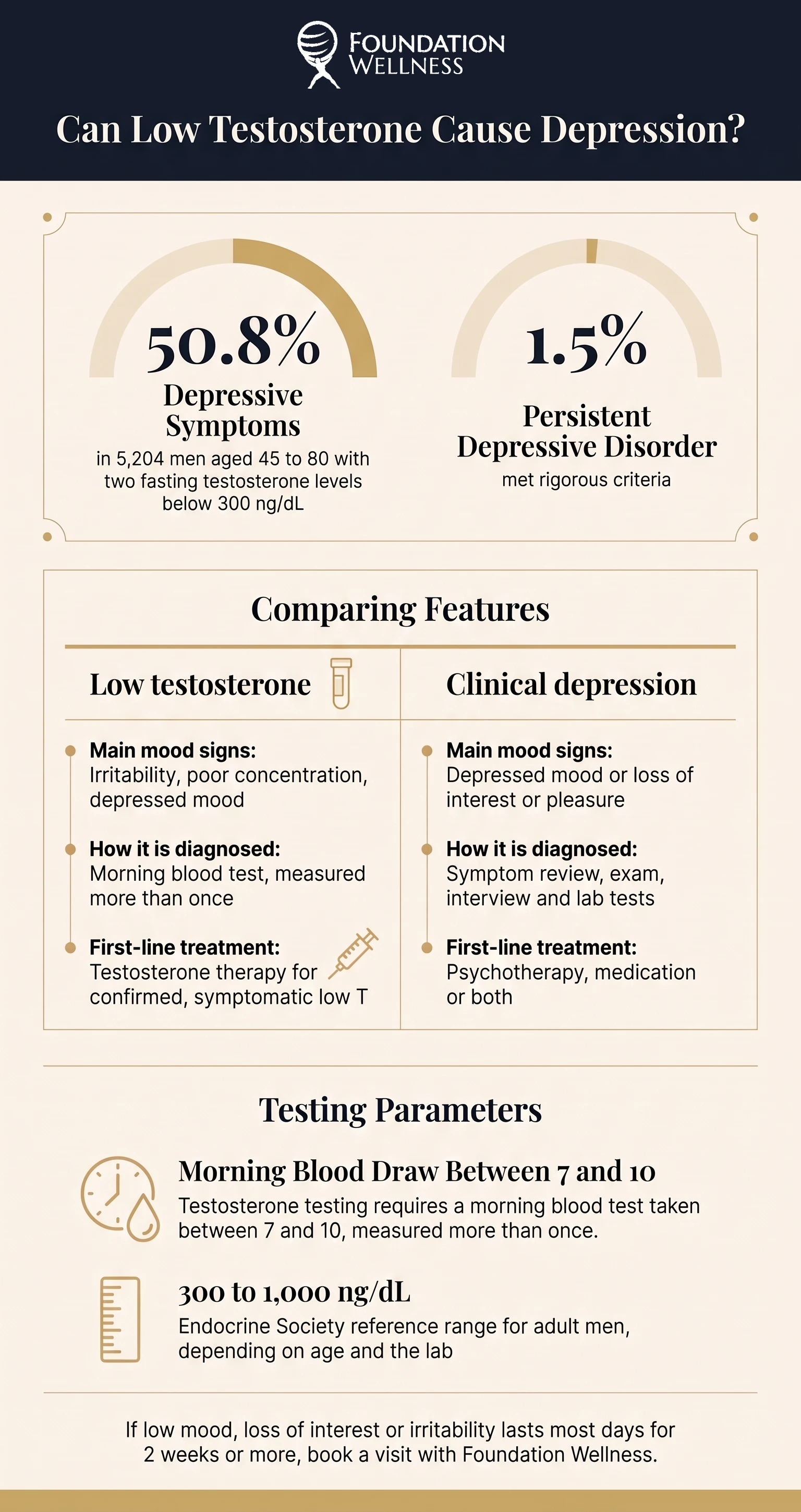
The bigger question is how often low T is the whole story. The TRAVERSE trial studied men aged 45 to 80 with two fasting testosterone levels below 300 ng/dL. Of 5,204 men, 2,643 (50.8%) had significant depressive symptoms, but only 49 (1.5%) met rigorous criteria for a persistent depressive disorder.
That’s a big gap. Honestly, it’s a bit startling. NIMH notes that men may be less likely to recognize, talk about and seek help for their feelings. So their depression is more likely to go undiagnosed. If you’re the kind of guy who’d rather spend a Saturday up American Fork Canyon than talk about feeling low, that probably sounds familiar. Low mood is very common in hypogonadal men, but a true depressive illness caused by hormones alone is uncommon. If you feel flat and tired, both your hormone levels and your mood deserve a look. Our men’s health and TRT team checks hormones and symptoms together.
What Mood Changes Come With Low Testosterone?
The Endocrine Society lists “Increased irritability, inability to concentrate, and depressed mood” among the symptoms of low testosterone. In daily life, that can look like a short fuse, trouble focusing at work or feeling down without a clear reason. Maybe your family notices it before you do, at Sunday dinner or on the drive home from practice. That last one is frustrating, because there’s nothing obvious to point to. It’s tempting to blame a gray January inversion along the Wasatch Front and move on. Sometimes, though, there’s more going on.
These mood changes rarely come alone. Physical symptoms often travel with them, including a drop in libido, erectile dysfunction and reduced energy. Sexual dysfunction and constant fatigue can drag anyone’s mood down, and that’s not a character flaw. So the physical and emotional sides feed each other. Your sexual health is part of the picture, not a separate problem.
Testosterone also drops slowly with age. The Endocrine Society notes that levels “naturally decrease by 1% each year after age 30.” That slow decline is normal. A little humbling, sure, but normal. That’s why symptoms, not age alone, decide whether testing makes sense.
Low Testosterone or Clinical Depression: How Do You Tell?

Truth is, you usually can’t tell by how you feel. The symptoms overlap a lot, and many men have some of both. That’s why a good workup looks at your hormones and your mental health together.
| Feature | Low testosterone | Clinical depression |
|---|---|---|
| Main mood signs | Irritability, poor concentration, depressed mood | Depressed mood or loss of interest or pleasure |
| Sex drive and erections | Drop in sex drive, erectile dysfunction | Problems with sexual desire and performance |
| Energy | Reduced energy | Fatigue, lack of energy |
| How long it lasts | Not reported | Most of the day, nearly every day, at least 2 weeks |
| How it is diagnosed | Morning blood test, measured more than once | Symptom review, exam, interview and lab tests |
| First-line treatment | Testosterone therapy for confirmed, symptomatic low T | Psychotherapy, medication or both |
Sources: Endocrine Society, MedlinePlus and NIMH.
According to the National Institute of Mental Health, a depression diagnosis requires symptoms most of the day, nearly every day, for at least 2 weeks. NIMH also notes that some medical conditions, such as thyroid disorders, can cause the same symptoms. So a provider rules them out with an exam and lab tests. (That’s one reason we check thyroid markers, along with total and free testosterone, in the first workup for low T.)
Clinical depression is a mental health condition with its own care path. NIMH notes that people with moderate or severe depression usually get medication as part of their first treatment. Care for anxiety and other mood disorders may involve psychiatry or therapy. Many antidepressants act on brain chemicals such as serotonin that are involved in mood and stress.
How Is Low Testosterone Tested?
Testosterone testing is a simple blood draw, but timing matters. MedlinePlus explains that the sample is taken in the morning, between 7 and 10, when testosterone levels are usually highest. So plan on an early lab stop, before the drive over the Point of the Mountain or the school run, not a lunch-hour draw.
The Endocrine Society puts normal levels for adult men at 300 to 1,000 ng/dL, depending on age and the lab. It also says testosterone “must be measured more than once.” One low result isn’t a diagnosis. That’s worth remembering if your first number has you worried. Waiting on a second test is frustrating when you just want an answer. It’s still the safer route. And if repeat tests do confirm low testosterone, the next step is finding out why. The Endocrine Society lists causes such as some medications, including opiate painkillers and corticosteroids. Chronic conditions like obesity, sleep disorders and type 2 diabetes are on that list too.
Its clinical guideline asks for symptoms plus “unequivocally and consistently low serum T concentrations,” confirmed by a repeat morning fasting test. In plain terms, your serum testosterone (the testosterone in your blood) has to show low levels on more than one morning test. That protects you from treatment based on one off day.
Did your result come back near the line? Our guide to testosterone levels by age shows where normal testosterone levels sit. It also explains why declining testosterone levels aren’t always low testosterone levels.
Does Testosterone Therapy Help Depression?
A little, in men who truly have low T. It isn’t a cure for depression.
A 2019 meta-analysis in JAMA Psychiatry pooled 27 randomized trials including 1,890 men and found that testosterone treatment was linked to a significant drop in depressive symptoms compared with placebo. The effect size was 0.21, which in plain words is a small effect. Not nothing. But small. The same authors note that antidepressants “are the first-line treatment.”
TRAVERSE found the same pattern. Testosterone replacement therapy “is associated with small improvements in mood and energy in hypogonadal men.” But in the small group with a true persistent depressive disorder, there was no significant difference between testosterone and placebo. That’s a letdown if you were hoping one prescription would fix both. We’d rather say so now than have you find out months in.
Testosterone acts through the androgen receptor, and testosterone replacement is a real medicine with adverse effects. The Endocrine Society lists decreased sperm production, a high red blood cell count, acne, prostate growth and sleep apnea as possible risks.
So testosterone therapy isn’t a depression treatment on its own. Never stop an antidepressant without your prescriber. NIMH notes that antidepressants usually take 4 to 8 weeks to work, so give any plan time and review it with your clinician. For timing, see how long TRT takes to work, and for trial results, see TRT before and after.
When Should You See a Doctor About Low Mood?
If low mood, loss of interest or irritability lasts most days for 2 weeks or more, book a visit. It’s easy to write it off as stress, or as a long Utah winter. Please don’t. Your mental health matters as much as your physical health. Ask for a mood check and a men’s health workup, including a morning testosterone test if you also have low libido or low energy. Mention any fatigue, anxiety or poor sleep too. Hormones are just one piece.
If you are in crisis or thinking about suicide, call or text the 988 Suicide and Crisis Lifeline at 988. In a life-threatening emergency, call 911.
Women can feel low mood with hormone shifts too. NIMH notes menopause brings hormonal changes that can trigger depression in some people. Our guide to hormone replacement therapy in Utah covers that side.
Mood and Hormone Care at Foundation Wellness

Our approach to low testosterone focuses on safety. If you start testosterone replacement therapy, we monitor comprehensive bloodwork, tailor dosing individually, and look at the full picture, including sleep, stress and metabolic health, not just hormone levels on a lab report.
We also offer Mental Wellness through our Neuronova program, an integrated approach to anxiety, brain fog and nervous system regulation.
Our clinic is at 456 E State Street, Suite 1400, American Fork, UT 84003, with telemedicine visits across Utah. That helps if you live in Heber or Spanish Fork and would rather not make the drive every time. We are accepting new patients. Foundation Wellness accepts many insurance plans. Coverage depends on your plan, so check with our office first. Start on our men’s health and TRT page.
Key Takeaways
- Low testosterone can cause low mood, irritability and poor focus.
- About half of men with low T in TRAVERSE had depressive symptoms, but only 1.5% had a true persistent depressive disorder.
- Diagnosis needs symptoms plus repeated morning blood tests.
- Testosterone replacement therapy (TRT) gives small mood gains in men with confirmed low T and does not replace depression treatment.
- Two weeks of low mood is a reason to get checked. In a crisis, call or text 988.
Sources
- JAMA Psychiatry (PMC), Association of Testosterone Treatment With Alleviation of Depressive Symptoms in Men.
- Journal of Clinical Endocrinology and Metabolism (PubMed), Depressive Syndromes in Men With Hypogonadism in the TRAVERSE Trial: Response to Testosterone-Replacement Therapy.
- Endocrine Society, Hypogonadism in Men.
- National Institute of Mental Health, Depression.
- MedlinePlus, Testosterone Levels Test.
- Journal of Clinical Endocrinology and Metabolism (PubMed), Testosterone Therapy in Men With Hypogonadism: An Endocrine Society Clinical Practice Guideline.
September 15, 2026 · 8 min read