
Can You Stop TRT Once You Start? How to Do It Safely
October 30, 2026
By Dr. Paul Frandsen, MD · October 30, 2026 · 12 min read
Medically reviewed by Dr. Paul Frandsen, MD

Can you stop TRT once you start? Yes. Testosterone replacement therapy isn’t a lifelong lock-in. Men do stop. But the testosterone you take turns down your body’s own production, so when you stop, your natural testosterone has to restart. That can take months or longer, and it isn’t guaranteed. Low T symptoms can come back while you wait. The safer way out is under medical supervision, with a plan from your prescribing physician, not quitting on your own.
Can You Stop TRT Once You Start?
Yes, you can. Starting testosterone therapy doesn’t commit you to it forever. A 2016 review on recovery after testosterone use in the Asian Journal of Andrology describes men who simply discontinue treatment to let their own production recover, when their symptoms are manageable without it.
The same review is honest about the catch. Spontaneous recovery after stopping TRT is possible, but it may take several months to several years, and in some cases it may be permanent. Not the slam-dunk answer most men hope for. So the real question isn’t “can I stop?” It’s “how do I stop well?”
That’s where medical supervision comes in. The Endocrine Society guideline asks physicians to follow men on testosterone therapy with a standard monitoring plan: checking symptoms, side effects and whether the treatment is being taken as prescribed, and measuring testosterone and hematocrit. The same kind of follow-up makes sense when treatment ends. Arguably more so, since that’s when levels are moving.
Live in American Fork, Pleasant Grove or anywhere in Utah County, and thinking about a change to your TRT? Our Men’s Health and TRT team in American Fork can review your labs and goals with you before anything changes. In practice, we start with one question: why do you want to stop?
What Does Stopping TRT Do to Your Hormone Levels?

To see why stopping takes planning, it helps to know how your body makes testosterone in the first place.
Your brain and testicles work as a loop, called the hypothalamic-pituitary-gonadal (HPG) axis. The pituitary gland sends out luteinizing hormone (LH), which tells the testicles to make testosterone. It also sends follicle-stimulating hormone (FSH), which supports sperm production. Testosterone inside the testicles runs far higher than in the blood, and both FSH and that high level are needed for normal sperm production.
The loop has a brake. When testosterone is high, the brain turns down the signals that ask for more. The Asian Journal of Andrology review explains that exogenous testosterone, meaning testosterone from outside the body, presses the same brake. It does this in a dose and duration dependent way. The result is less testosterone made inside the testicles, less FSH and a drop in sperm production, sometimes to zero.
While you’re on TRT, you may not notice any of this, because the testosterone you take keeps your blood T levels up. Stopping changes that. The outside supply goes away, but the brain’s signals don’t snap back on at once. Until your own production restarts, your hormone levels can sit lower than they were on treatment. Think of it as a gap between two supplies, one gone and one not back yet. Kind of like hitting construction on I-15: you’ll get there, but nobody can promise exactly when.
That gap is what a physician plans around. It’s also why the answer to “can you stop?” depends so much on how long you’ve been on hormone therapy, your age and your reasons for stopping.
What Low Testosterone Symptoms Can Come Back After Stopping TRT?
If your natural testosterone is slow to restart, the symptoms that led you to treatment can return. MedlinePlus lists these possible symptoms of low testosterone:
- Low sex drive.
- Problems having an erection.
- Low sperm count.
- Sleep problems such as insomnia.
- Decrease in muscle size and strength.
- Bone loss.
- Increase in body fat.
- Depression.
- Trouble concentrating.
MedlinePlus also notes that low T can affect sex drive, mood and changes in muscle and fat. So mood changes are worth watching for, along with energy, sleep and sexual function.
You’ll often see these called testosterone withdrawal symptoms online. The medical sources we checked don’t describe a separate withdrawal illness. What they describe is the return of low testosterone symptoms as levels fall. The Asian Journal of Andrology review notes that many men don’t tolerate stopping, either because of severe hypogonadal symptoms, uncertainty about whether recovery will come, or timing. Which is frustrating, honestly, when you made the choice to stop for a good reason.
Two points keep this in perspective. Some men with low testosterone levels have no symptoms at all. And MedlinePlus points out that symptoms like these can also come from other conditions, such as high blood pressure or diabetes, or simply from aging. So if something changes after you stop, don’t guess, and don’t just tough it out. Tell your physician, who can check your levels and look for other causes.
How Long Does Natural Testosterone Recovery Take?
There’s no single answer, and the sources we checked don’t support a fixed number of weeks. Unfortunately, that’s the part men want most: a date on the calendar. The Asian Journal of Andrology review puts it plainly: recovery after stopping testosterone may take several months to several years, and in some cases may be permanent. It also says data on unassisted recovery after long-term TRT are lacking, so doctors borrow from male contraception studies, where healthy men took testosterone to lower sperm counts and then stopped.
What seems to slow testosterone recovery:
- Older age. A 2017 study in Fertility and Sterility of men treated after stopping testosterone found that increasing age reduced the chance of sperm recovery at 6 and 12 months.
- Longer use. The same study found that a longer duration of testosterone use also reduced the chance of recovery, though age had the more consistent effect.
- Longer acting forms. A large 2006 analysis in The Lancet found higher recovery rates with shorter acting testosterone preparations and shorter treatment.
For sperm, the clearest numbers come from that Lancet analysis of male contraception trials in 1,549 healthy men. The median time to reach 20 million sperm per mL was 3.4 months. Recovery to that level was 67% within 6 months, 90% within 12, 96% within 16 and 100% within 24 months. Encouraging numbers, no doubt. But the review cautions that trial data like these may not match what happens outside a clinical trial, and those were healthy volunteers, not men treated for low T. If fertility is your reason for stopping, our guide to TRT and fertility (linked below) covers sperm recovery and planning in detail.
Whatever form you use, testosterone injections included, the timeline is personal. Your physician tracks it with labs and how you feel.
Can You Quit TRT Cold Turkey?
Physically, yes. Nothing stops you from skipping your next injection or leaving the gel in the cabinet. Plenty of men think about it. But quitting cold turkey on your own means flying blind. The dip in testosterone happens with no one watching your symptoms or your labs, and there’s no backup plan if recovery is slow.
The Asian Journal of Andrology review describes two paths for men coming off testosterone. Some can discontinue TRT and wait for spontaneous recovery, if their symptoms are manageable. Many don’t tolerate that, and a physician may add a medicine to support their own production. The third option, of course, is to stay on treatment. This comparison table puts the options side by side.
| Stopping cold turkey, no plan | Stopping with a physician plan | Staying on TRT | |
|---|---|---|---|
| What happens | Your own production has to restart; low T symptoms can return in the meantime | Same restart, but your physician can add treatment to support recovery if needed | Your testosterone stays in the treated range; your own production stays turned down |
| Monitoring | None unless you arrange it | Labs and symptom checks with your physician | Standard monitoring of symptoms, side effects, testosterone and hematocrit |
| Who it may suit | Not recommended without talking to your physician | Men planning fertility, men with side effects, men who saw no benefit | Men with confirmed low T whose symptoms improved and who tolerate treatment |
| What to know | Recovery may take months to years and isn’t guaranteed | Recovery still varies; support medicines are off label | Long-term safety, including for prostate cancer, isn’t fully established |
You may have read about tapering your dose down over weeks. The sources we checked don’t give a taper schedule for stopping TRT, so we won’t give one here. I know that’s not satisfying. How you come off treatment is a plan your physician makes with you, based on your labs, your symptoms and why you’re stopping, and it usually changes as the results come in.
How Do Doctors Help Men Discontinue TRT?

When waiting for spontaneous recovery isn’t a good fit, a physician has a few tools. The review describes both of the main ones as off label for this purpose, meaning they aren’t FDA approved for restarting testosterone after TRT. Your physician decides whether either makes sense for you. At our American Fork clinic, that call starts with your labs and your reasons for stopping, not a one-size-fits-all protocol.
hCG (human chorionic gonadotropin). hCG is built much like LH, the signal your pituitary uses to tell the testicles to make testosterone. The Asian Journal of Andrology review says that for men who can’t tolerate stopping, gonadotropin treatment like this would treat hypogonadal symptoms and hasten recovery, assuming the problem isn’t in the testicles themselves.
Clomiphene citrate. Clomiphene is a selective estrogen receptor modulator (SERM). It blocks estrogen’s feedback in the brain, so the brain sends more of the signals that drive testosterone production. The review notes clomiphene has been used off label in men since it was first reported for male infertility in 1966.
Does it actually work? The 2017 Fertility and Sterility study followed 66 men with infertility after testosterone use who stopped testosterone and took high-dose hCG with a SERM. Within 12 months, 46 of them (70%) reached the study’s sperm target. Older men and men who had used testosterone longer took longer to recover. So it’s a real result, not a promise. That’s the honest way to read it, and we’d rather give you that than a sales pitch.
One term you may see is “post cycle therapy,” or PCT. That’s a bodybuilding term for people coming off anabolic steroids. Discontinuing TRT prescribed for diagnosed low testosterone is a different situation, and any plan for it should come from your own physician, not a steroid forum or a buddy at the gym.
Why Do Men Stop Testosterone Replacement Therapy?
Men stop TRT for a handful of common reasons. Some are planned, some aren’t. Each one is worth talking through with your physician, because the right next step differs.
Fertility plans. Testosterone therapy lowers sperm production. The Endocrine Society guideline recommends against starting testosterone therapy in men who are planning fertility in the near term. If you’re on TRT and want children, that conversation should happen early. See our TRT and fertility guide.
Side effects. In 2025 the FDA required new labeling after studies confirmed that blood pressure rises with all testosterone products. The Endocrine Society guideline also has physicians measure hematocrit during treatment and lists an elevated hematocrit among the reasons not to start. Our TRT side effects guide covers the full list.
No benefit. MedlinePlus says that if you don’t notice any change in symptoms after 3 months of treatment, it’s less likely that TRT will help you. Stopping, or looking for other causes, may make more sense.
Prostate questions. In a 2026 statement, the Endocrine Society said long-term safety, including for prostate cancer, remains unestablished, and that screening and monitoring are needed if testosterone therapy is started.
Cost and routine. Some men weigh the ongoing cost and follow-up visits. Fair enough, it’s a long-term commitment. Between work, family and everything else on the calendar, another standing appointment is a real ask. Our TRT cost guide explains what affects it.
Do You Have to Stay on Testosterone Therapy Forever?
No. There’s no rule that says you have to take testosterone for life. It’s an ongoing choice you review with your physician, not a one-time decision you’re stuck with.
The Endocrine Society says physicians must weigh the benefits of TRT against the risks. MedlinePlus notes that TRT may relieve or improve symptoms in some men. If it’s helping and your monitoring looks good, staying on it may be reasonable. If your goals change, or the balance of benefit and risk shifts, stopping with a plan is an option.
Our guide on how long TRT takes to work can help you think it through.
Stopping TRT or Continuing Treatment at Foundation Wellness in American Fork
Foundation Wellness offers testosterone replacement at our clinic at 456 E State Street, Suite 1400, American Fork, UT 84003. Pleasant Grove is served from this same American Fork clinic, and if the drive doesn’t work for you, we offer telemedicine visits across Utah. Whether you want to stay on TRT, adjust it or come off it, we start with your bloodwork, your symptoms and your reasons, and we plan any change together. We won’t leave you to wing it. Stopping is a fair thing to want, and our team treats it that way. This guide was written and reviewed by Dr. Paul Frandsen, a Foundation Wellness physician. Learn more about TRT in Utah.
Foundation Wellness accepts many insurance plans. Coverage depends on your plan, so check with our office first. Call us at (800) 983-1974.
Key Takeaways
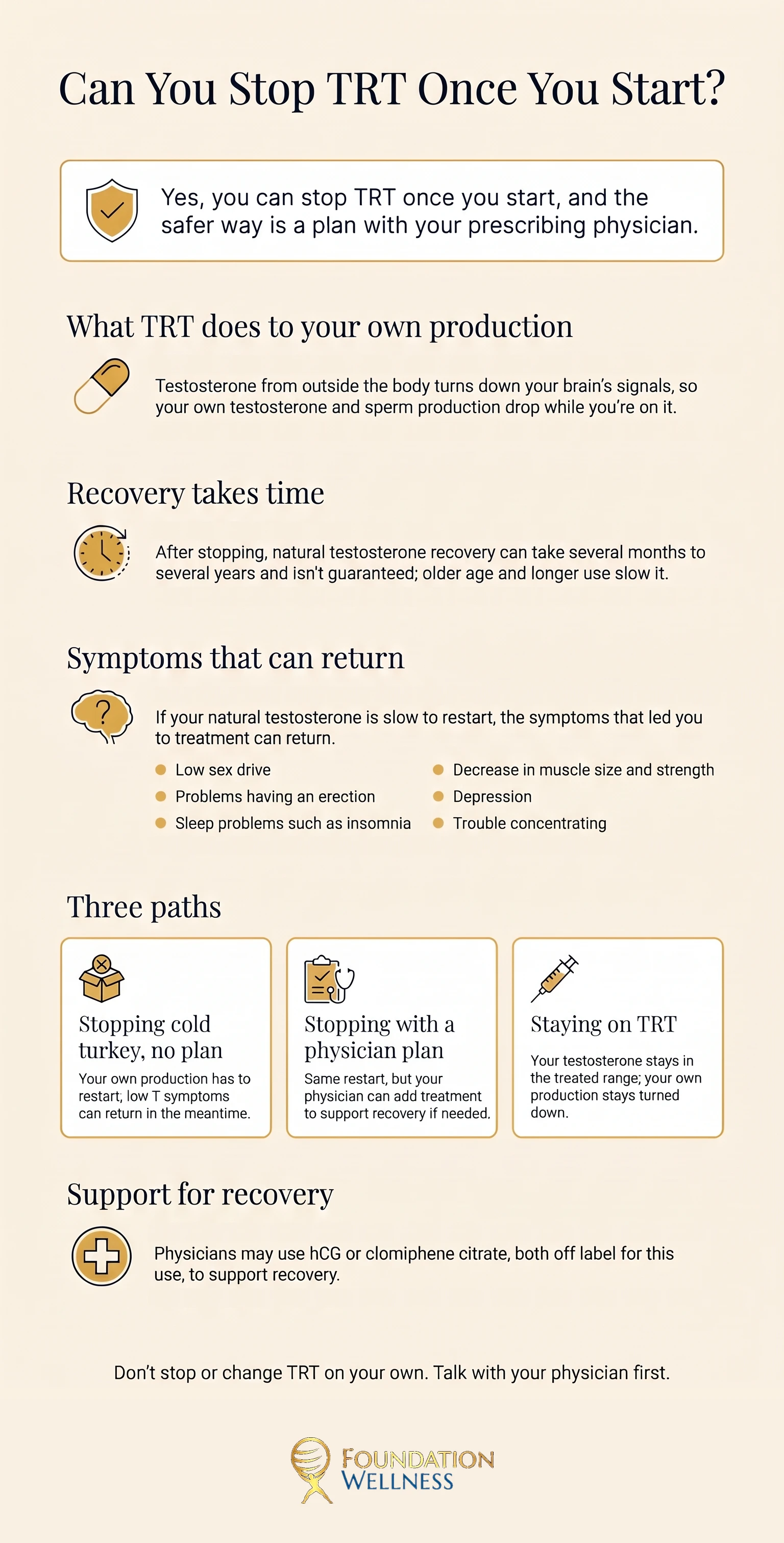
- Yes, you can stop TRT once you start, and the safer way is a plan with your prescribing physician.
- Testosterone from outside the body turns down your brain’s signals, so your own testosterone and sperm production drop while you’re on it.
- After stopping, natural testosterone recovery can take several months to several years and isn’t guaranteed; older age and longer use slow it.
- Physicians may use hCG or clomiphene citrate, both off label for this use, to support recovery.
- Don’t stop or change TRT on your own. Talk with your physician first.
Sources
- Asian Journal of Andrology, Recovery of spermatogenesis following testosterone replacement therapy or anabolic-androgenic steroid use (PMC4854084).
- The Lancet, Rate, extent, and modifiers of spermatogenic recovery after hormonal male contraception: an integrated analysis (PMID 16650651).
- Fertility and Sterility, Age and duration of testosterone therapy predict time to return of sperm count after human chorionic gonadotropin therapy (PMID 27855957).
- Journal of Clinical Endocrinology and Metabolism, Testosterone Therapy in Men With Hypogonadism: An Endocrine Society Clinical Practice Guideline (PMID 29562364).
- Journal of Urology, Evaluation and Management of Testosterone Deficiency: AUA Guideline (PMID 29601923).
- MedlinePlus, Low testosterone.
- Endocrine Society, Statement on Testosterone Replacement Therapy (2026).
- FDA, FDA issues class-wide labeling changes for testosterone products (2025).
- Endocrine Society, Testosterone Therapy for Hypogonadism Guideline Resources.
October 30, 2026 · 12 min read