
Does TRT Cause Hair Loss? What Men Prone to Balding Should Know
October 28, 2026
By Dr. Paul Frandsen, MD · October 28, 2026 · 8 min read
Medically reviewed by Dr. Paul Frandsen, MD

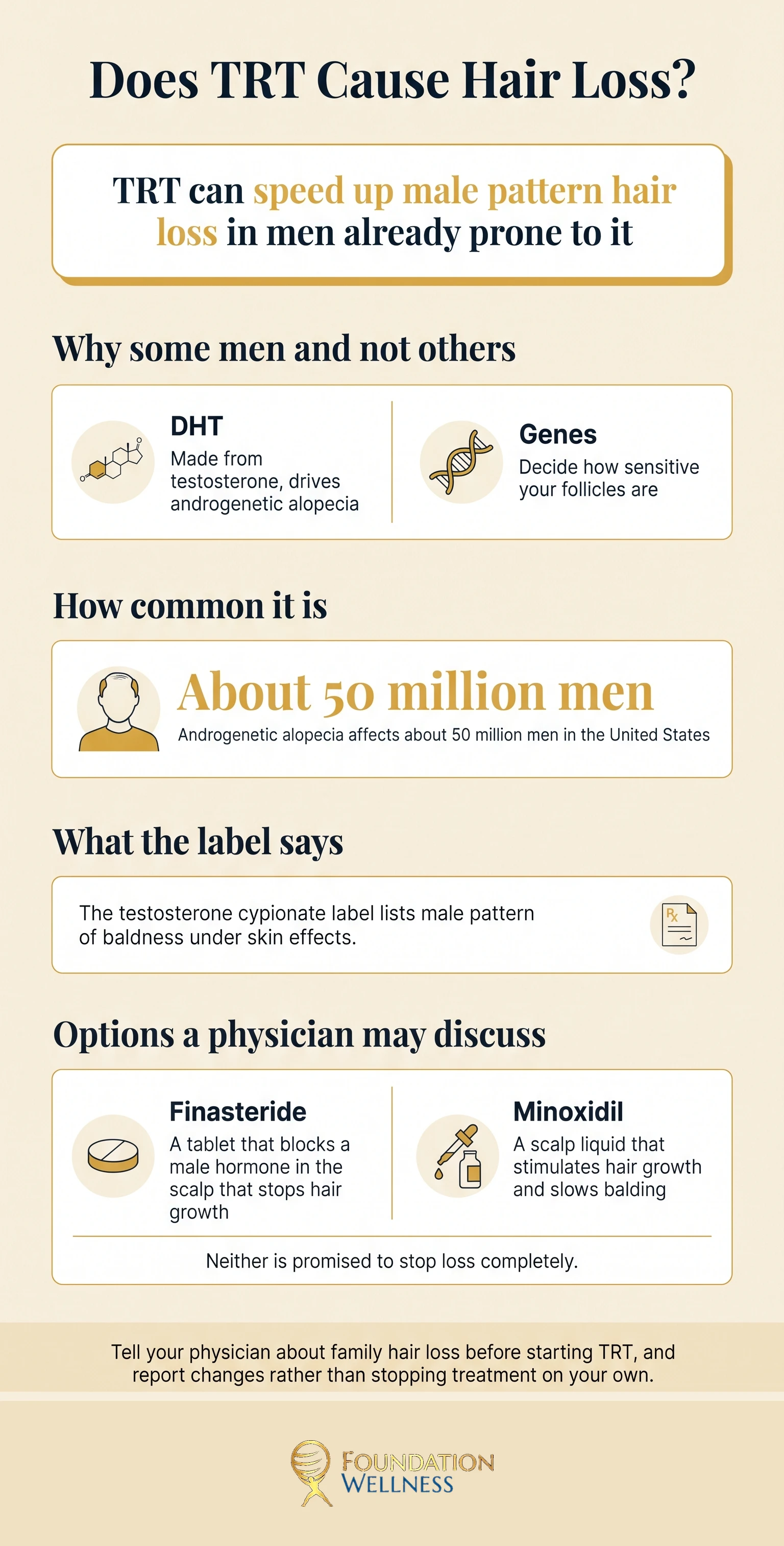
Does TRT cause hair loss? Not in every man, but testosterone replacement therapy can speed up male pattern hair loss in men who are already prone to it. Your body turns testosterone into DHT, the androgen tied to androgenetic alopecia, and your genes decide how sensitive your hair follicles are to it. The testosterone label lists male pattern of baldness as a possible side effect. If balding runs in your family, raise it with your physician before you start.
Does TRT Cause Hair Loss?
The short answer is that TRT can speed up hair loss in men with a built-in tendency toward male pattern baldness. The sources we checked don’t show it causing that pattern in men without the tendency.
MedlinePlus lists male-pattern hair loss among the possible side effects of testosterone injection. And the FDA label for testosterone cypionate lists male pattern of baldness under skin effects. Both point to the same thing: testosterone therapy adds androgens, and androgens are what drive this kind of loss.
If you’re new to TRT, our guide on what every man should know before starting TRT covers the basics. To talk through your own risk, our Men’s Health and TRT team in American Fork can review your history before you begin.
What Is Androgenetic Alopecia?
Androgenetic alopecia, also called androgenic alopecia, is the medical name for male pattern baldness. According to MedlinePlus Genetics, hair loss in men follows a clear pattern. It starts above both temples, and over time the hairline recedes into an “M” shape. Hair also thins at the crown, sometimes leading to partial or complete baldness.
It’s common. Surprisingly common, honestly. MedlinePlus Genetics estimates that androgenetic alopecia affects about 50 million men in the United States, and that more than 50 percent of men over age 50 have some degree of hair loss. It can start as early as the teens, and the risk rises with age. Look around the stands at a BYU game, or the checkout line at the Lehi Costco, and you’ll spot plenty of receding hairlines.
Some shedding is normal. MedlinePlus notes that people lose up to 100 hairs from the scalp every day, and in most people those hairs grow back. Hair thinning becomes a problem when lost hair isn’t replaced. Hair loss can also come from thyroid problems, certain medicines, stress or poor nutrition, so new loss is worth checking rather than blaming on TRT alone. Easier said than done when you’ve just started TRT and you’re staring at the shower drain every morning. Try not to jump to conclusions.
Why Does Testosterone Cause Hair Loss in Some Men and Not Others?

Here’s the short version: it comes down to two things, DHT and genes.
DHT. MedlinePlus Genetics explains that male pattern hair loss is related to androgens, specifically dihydrotestosterone (DHT). A 2017 review in the Journal of the American Academy of Dermatology describes DHT as the potent form of testosterone. The testosterone cypionate label adds that in many tissues, testosterone’s activity depends on its conversion to DHT.
How hair follicles respond. Hair grows from structures under the skin called follicles. Each strand normally grows for 2 to 6 years, rests for a few months, then falls out, and the follicle starts a new hair. Androgens help control this cycle. Too much androgen stimulation of the follicles can shorten the growth period, which leads to shorter, thinner strands. New hair growth to replace shed strands is also delayed. Together, these changes lead to hair thinning or loss.
Genes. This is why two men on the same treatment can have very different results. MedlinePlus Genetics says variations in the AR gene, which makes the androgen receptor, are confirmed to play a role. These variations seem to make receptors in hair follicles more easily stimulated by androgens. The condition also tends to cluster in families, and having a close relative with patterned hair loss appears to be a risk factor. So if your dad and both uncles thinned out early, that’s useful to know. Not a verdict. Just information.
So TRT doesn’t create the tendency. It raises the androgen signal that sensitive follicles respond to. Kind of unfair, honestly. You start TRT to feel more like yourself, and your hairline may have other plans.
What the Testosterone Replacement Label Says About Hair
The FDA label for testosterone cypionate lists these under skin effects: hirsutism, male pattern of baldness, seborrhea and acne. MedlinePlus Genetics uses hirsutism to mean excess hair elsewhere on the body.
Hair is only one part of the picture. For the other effects of testosterone replacement and how they’re monitored, see our full guide to TRT side effects.
TRT and Hair Loss at a Glance: Comparison Table
| Men with a family pattern of hair loss | Men without that pattern | |
|---|---|---|
| Why the risk differs | Follicles more easily stimulated by androgens (AR gene) | No inherited sensitivity described |
| What TRT may do | Can speed up male pattern hair loss | Sources do not show TRT causing this pattern |
| Label listing | Male pattern of baldness is listed | Same label applies |
| What to do | Tell your physician before starting and watch for changes | Report any new shedding or thinning |
Does Testosterone Therapy Make Hair Thicker?
None of the sources we checked say testosterone therapy makes scalp hair thicker or improves hair density. MedlinePlus Genetics notes that androgens help regulate hair growth, and the testosterone label lists hirsutism, excess hair elsewhere on the body, as a possible effect. That’s different from thicker hair on the scalp, where extra androgen activity can work the other way in prone men. We can’t promise any change in facial hair or body hair on TRT.
Is Hair Thinning on TRT Reversible?
The sources we checked don’t say whether hair lost on TRT grows back after stopping treatment, so we won’t promise it. Which is frustrating, we know. What MedlinePlus does say is that for minoxidil, most new hair is lost within a few months after the medicine is stopped. In other words, minoxidil works only while you keep using it.
Don’t stop or change TRT on your own because of hair changes. Bring them to your physician, who can weigh your symptoms, your hair and your goals together. And don’t feel silly raising it. Hair is tied up with how a lot of men see themselves, and watching it thin is no fun. That’s a fair reason to speak up, not a vain one.
Hair Restoration Options a Physician May Discuss
If hair loss is a worry for you, your physician may talk through options. They decide what fits you, and none of these is promised to stop loss completely.
- Finasteride. MedlinePlus explains that this tablet is a 5-alpha reductase inhibitor. It treats male pattern hair loss by blocking the body’s production of a male hormone in the scalp that stops hair growth. Side effects can include lower sexual desire and erection problems, which matters for men on TRT.
- Minoxidil. MedlinePlus says this scalp liquid stimulates hair growth and slows balding. It works best in people under 40 whose hair loss is recent. It has no effect on a receding hairline, and it must be used for at least 4 months before any effect shows.
A 2017 meta-analysis in the Journal of the American Academy of Dermatology found that minoxidil, finasteride and low-level laser light therapy were all better than placebo at promoting hair growth in men with androgenetic alopecia. The studies varied a lot, though. So, encouraging. Not a slam dunk.
MedlinePlus also lists hair restoration, such as a hair transplant, among treatments for hair loss. Healthy hair on TRT starts with knowing your risk early.
What Should You Ask Your Doctor About Hair Loss on TRT?

The Endocrine Society recommends that men on testosterone therapy be monitored with a standardized plan that includes checking symptoms and adverse effects. Hair changes belong in that conversation. In practice, that means bringing a few questions:
- Does my family history put me at higher risk of male pattern hair loss?
- What hair changes should I report, and when?
- Would finasteride or minoxidil make sense for me, and how would they affect my TRT goals?
- How will we track my results and side effects over time?
For timing, see how long TRT takes to work. For the forms of treatment, see injections vs pellets vs gel. Our sources do not show that any one form protects hair health.
Testosterone Replacement Therapy at Foundation Wellness in American Fork
Foundation Wellness offers TRT at our clinic at 456 E State Street, Suite 1400, American Fork, UT 84003, with telemedicine visits across Utah. So whether you’re up in Lehi, over in Pleasant Grove or down toward Provo, a follow-up doesn’t have to mean a drive along the Wasatch Front. Our TRT program is built around safety: we monitor your bloodwork, tailor dosing to you and look at sleep, stress and metabolic health too, not just a number on a lab report. Hair changes fit right into that kind of check-in, and we’d rather hear about them early than have you quietly worry. Learn more about TRT in Utah.
Foundation Wellness accepts many insurance plans. Coverage depends on your plan, so check with our team first. Call us at (800) 983-1974.
Key Takeaways
- TRT can speed up male pattern hair loss in men already prone to it; the sources do not show it causing this pattern in men without that tendency.
- DHT, made from testosterone, drives androgenetic alopecia, and genes decide how sensitive your follicles are.
- The testosterone cypionate label lists male pattern of baldness under skin effects.
- Finasteride and minoxidil are options your physician may discuss; neither is promised to stop loss completely.
- Tell your physician about family hair loss before starting TRT, and report changes rather than stopping treatment on your own.
Sources
- MedlinePlus Genetics, Androgenetic alopecia.
- DailyMed, DEPO-TESTOSTERONE (testosterone cypionate) injection.
- MedlinePlus, Testosterone Injection.
- MedlinePlus, Finasteride.
- MedlinePlus, Minoxidil Topical.
- MedlinePlus, Hair Loss.
- Journal of Clinical Endocrinology and Metabolism, Testosterone Therapy in Men With Hypogonadism: An Endocrine Society Clinical Practice Guideline (PMID 29562364).
- Journal of the American Academy of Dermatology, The effectiveness of treatments for androgenetic alopecia: A systematic review and meta-analysis (PMID 28396101).
October 28, 2026 · 8 min read