
Estrogen Therapy for Hot Flashes: Benefits and Risks
October 29, 2026
By Dr. Paul Frandsen, MD · October 29, 2026 · 11 min read
Medically reviewed by Dr. Paul Frandsen, MD

Yes, estrogen therapy for hot flashes works. ACOG and The Menopause Society both describe systemic estrogen as the most effective treatment for hot flashes and night sweats. But it isn’t the right choice for everyone. The balance of benefits and risks is most favorable for healthy women under 60 or within 10 years of menopause.
The risks also shift with the type of hormone therapy, the dose, how it’s taken and when it’s started. So the decision belongs to you and your physician, and it should be looked at again every year.
What Causes Hot Flashes in Perimenopause and Menopause?
Menopause is the point when your periods stop for good. ACOG puts the average age at 51. The years leading up to it are called perimenopause, and they can start in your 30s or 40s, when the amount of estrogen made by the ovaries begins to rise and fall. Those shifting hormone levels drive many of the familiar menopause symptoms.
ACOG describes a hot flash as a sudden feeling of heat that rushes to the upper body and face. One can last a few seconds. Or several minutes, sometimes longer. Some women get them a few times a month; others get several a day. Hot flashes at night are called night sweats, and they can wake you up and leave you tired and sluggish the next day. Which is frustrating when you’ve already got a full day ahead.
Not sure whether your symptoms fit? Our guides to perimenopause symptoms and perimenopause vs menopause explain the stages.
Does Estrogen Therapy Help Hot Flashes?

Yes. Here’s the main reason many women ask about estrogen therapy in the first place. In its patient guide, ACOG states that systemic estrogen therapy has been shown to be the best treatment for hot flashes and night sweats, with or without progestin. The Menopause Society says hormone therapy is FDA-approved as a first-line therapy for bothersome hot flashes and is the most effective treatment. It also says the benefits outweigh the risks most clearly when it’s used in early menopause.
The 2022 position statement of The North American Menopause Society (now The Menopause Society) reaches the same conclusion for doctors. Menopausal hormone therapy remains the most effective treatment for vasomotor symptoms, according to the statement. That’s the medical term for hot flashes and night sweats. It also notes that hormone therapy helps prevent bone loss.
Still, the benefit comes with risks, which we cover below. So the right answer depends on your age, health history and how much your menopausal symptoms affect your life. At Foundation Wellness, we start our women’s health and hormone care with a full evaluation before any hormone is prescribed.
What Forms of Estrogen Treat Hot Flashes?
Estrogen comes in two broad groups. ACOG explains that systemic estrogen is released into the bloodstream and travels to the organs and tissues that need it. Local estrogen, on the other hand, stays mostly in the vaginal tissue.
| Type | Common forms | What it treats | Route notes |
|---|---|---|---|
| Systemic estrogen (oral) | Pills | Hot flashes, night sweats, vaginal dryness, bone loss | Clot and gallbladder risks are higher with pills |
| Systemic estrogen (transdermal) | Skin patches, gels, sprays | Hot flashes, night sweats, vaginal dryness, bone loss | Clot risk may be lower than with pills |
| Local (vaginal) estrogen | Vaginal ring, tablet, cream | Vaginal dryness | Small doses go into the vaginal tissue; not a hot flash treatment |
For hot flashes, ACOG points to systemic estrogen. Local forms are for women who only have vaginal dryness, and the 2022 position statement recommends low-dose vaginal estrogen for genitourinary symptoms. Easy to mix up, honestly, since both groups include something called a tablet.
The other key question is whether you still have a uterus. ACOG and MedlinePlus both explain that estrogen taken alone makes the lining of the uterus thicken, which raises the risk of endometrial cancer. If you haven’t had a hysterectomy, a progestin is added to lower that risk. If you have, estrogen alone is usually used.
Estradiol is one of the estrogens used in these products; MedlinePlus lists estradiol tablets among the oral estrogens. Curious how bioidentical and synthetic hormones compare? See our bioidentical vs synthetic HRT guide. For what it’s worth, ACOG recommends FDA-approved hormone therapy over compounded hormones.
When Is HRT Appropriate for Menopausal Women?
Timing matters a great deal with hormone replacement therapy. Probably more than most people expect. The Menopause Society’s 2022 position statement says that for women younger than 60 or within 10 years of menopause onset who have no contraindications, the benefit-risk ratio is favorable for treating bothersome hot flashes and preventing bone loss. Start more than 10 years after menopause, or after age 60, and the balance appears less favorable. The reason is greater absolute risks of coronary heart disease, stroke, blood clots and dementia.
The large Women’s Health Initiative trials shaped much of this advice. NHLBI states that hormone therapy shouldn’t be used to prevent heart disease. But it’s still an option for some women early in menopause to relieve moderate to severe symptoms, NHLBI adds. The Menopause Society likewise says the benefits outweigh the risks most clearly in early menopause. Same message, two sources.
Age also changes the choice of form. MedlinePlus advises women 65 or older to talk with their doctor about the risks and benefits of estrogen. It also says older women shouldn’t usually take oral estrogen unless they also take other hormones.
What Are the Risks of Estrogen Therapy for Hot Flashes?
Every benefit of estrogen comes with risks, and they aren’t the same for every woman. The 2022 position statement says the risks differ by type, dose, length of use, route, timing of the start and whether a progestogen is used. That’s a long list. And it’s a big part of why two women of the same age can leave with different advice.
- Blood clots and stroke. ACOG says both combined and estrogen-only therapy carry a small risk of stroke and blood clots, which rises with age, heart disease, kidney disease and obesity. Route matters here. The Menopause Society says clot risk increases with hormones taken by mouth and may be lower with transdermal estrogen, such as a patch, gel or spray. ACOG adds that patches and sprays may pose less risk than pills. The stroke risk goes away soon after you stop.
- Endometrial cancer. Estrogen alone raises this risk if you have a uterus. Adding a progestin lowers it.
- Gallbladder disease. ACOG notes a small increased risk, greatest with pills (one more reason the route question keeps coming up).
Breast cancer. This is often the big worry, and that’s understandable. ACOG says combined estrogen plus progestin therapy is associated with a small increased risk of breast cancer. The Menopause Society says the risk usually doesn’t rise until after about 5 years of estrogen plus progestogen, or after 7 years of estrogen alone. Women with a history of hormone-sensitive breast cancer should try nonhormonal treatment first. For the real numbers, read our guide to HRT and breast cancer risk.
For context, in the Women’s Health Initiative, NHLBI reports that estrogen plus progestin raised the risk of heart disease, stroke, blood clots, breast cancer and dementia, and that estrogen alone raised the risk of stroke and blood clots. That sounds alarming, read on its own. NHLBI also adds that estrogen alone had some benefits for younger women who had a prior hysterectomy.
Who Should Not Take Estrogen for Hot Flashes?
ACOG says systemic hormone therapy usually isn’t recommended if you’ve ever had:
- Breast or endometrial cancer
- A stroke
- A heart attack
- Blood clots
- Liver disease
Hormone therapy also isn’t for women who are pregnant. If estrogen isn’t an option for you, you still have choices. ACOG lists other ways to treat hot flashes, including certain antidepressants, selective estrogen receptor modulators (SERMs), the seizure medicine gabapentin and the blood pressure medicine clonidine. These don’t work in the same way as estrogen, and your physician can explain the trade-offs.
What Side Effects Can Estrogen Therapy Cause?
Most side effects are mild. ACOG lists vaginal spotting or bleeding (which usually stops within 6 months), along with temporary breast soreness, bloating and headaches. Annoying, yes. If a side effect bothers you or lasts longer than expected, talk with your physician about adjusting the dose.
The Menopause Society adds that changing the dose or switching to another form of estrogen therapy may reduce side effects. It also says hormone therapy isn’t associated with weight gain. That’s a common worry for women in midlife, so it’s good to hear.
How Long Can You Take Estrogen for Hot Flashes?

There’s no set end date. ACOG suggests that you and your physician talk every year about whether to continue, based on your symptoms, risks and benefits. Some women need longer therapy if their menopausal symptoms go on for a long time, ACOG notes. The 2022 position statement says longer use should be for documented reasons, such as hot flashes that persist, with shared decision-making and regular reevaluation.
When you do stop, The Menopause Society says there’s no “right” time to do it. Hot flashes may or may not return after you stop. Lowering the dose slowly over months may reduce the chance they come back, though The Menopause Society notes this isn’t proven by studies. Not the tidy answer anyone wants. If bothersome hot flashes return, you and your physician reassess your risks and benefits. Plan the change together so you know what to expect.
When Should I See a Doctor About Perimenopause Hot Flashes?
You don’t have to wait until your periods stop. See a physician when hot flashes or night sweats disrupt your sleep, work or mood, or when they leave you tired and sluggish day after day. Also check in if your bleeding pattern changes in a way that worries you. The same goes if you have a history that may rule out estrogen, such as blood clots or breast cancer. A visit is the place to sort out which symptoms come from perimenopause and which treatments fit your health.
Menopause Hormone Therapy at Foundation Wellness in American Fork
At Foundation Wellness, menopause hormone therapy starts with a full evaluation, not your age or a single lab value. We check detailed bloodwork, including estradiol, progesterone, testosterone, DHEA-S, a thyroid panel and metabolic markers. Hormones are only part of the picture, so we also look at thyroid function, adrenal health and nutrient status. Then there’s the conversation itself: your medical history, what you’re experiencing and what matters most to you. From there our team builds an individualized plan. Doses are adjusted to how you respond rather than a one-size protocol, and we keep monitoring with follow-up labs and check-ins. And if hormone therapy isn’t right for you, we talk through other options.
Been told your labs look normal, but you still don’t feel right? That’s worth a visit too.
Dr. Paul Frandsen, MD, our lead physician, reviewed this article. He earned his medical degree at the University of Utah, he’s board-certified in Emergency Medicine and Addiction Medicine, and hormone replacement therapy is part of his clinical focus. Every treatment plan at Foundation Wellness is overseen by a board-certified physician, with no mid-level handoffs.
Here’s how visits tend to go. Your first visit can run long, because Dr. Frandsen wants to understand how you got here before he writes anything down. Follow-ups are shorter and focused on what’s working, what isn’t and what to change. If weight or mood changes are part of what you’re dealing with, we can coordinate hormone care with our weight management and mental wellness services in the same clinic.
Our clinic is on State Street in American Fork, in north Utah County: 456 E State Street, Suite 1400, American Fork, UT 84003. We’re open Monday to Friday, 9:00 AM to 5:00 PM. Not close by? We offer telemedicine visits across Utah, so whether you’re up in Salt Lake or down in Provo, you don’t have to make the drive for every check-in. Learn more about hormone replacement therapy in Utah.
Foundation Wellness accepts many insurance plans. Coverage depends on your plan, so check with our office first. Call us at (800) 983-1974, or send a message through our contact page and our team typically responds within one business day.
Key Takeaways
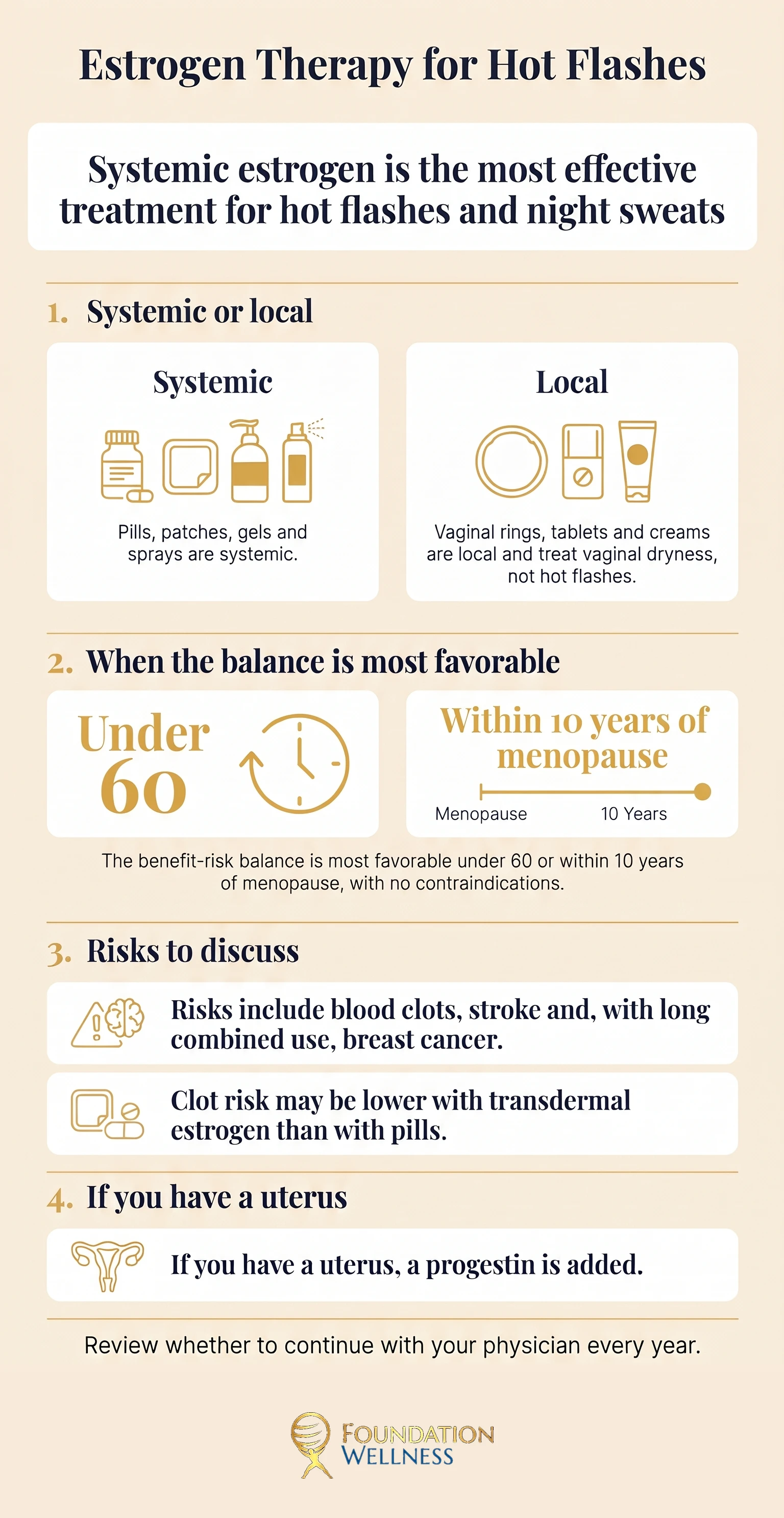
- Systemic estrogen is the most effective treatment for hot flashes and night sweats, according to ACOG and The Menopause Society.
- Pills, patches, gels and sprays are systemic. Vaginal rings, tablets and creams are local and treat vaginal dryness, not hot flashes.
- The benefit-risk balance is most favorable under 60 or within 10 years of menopause, with no contraindications.
- Risks include blood clots, stroke and, with long combined use, breast cancer. Clot risk may be lower with transdermal estrogen than with pills.
- If you have a uterus, a progestin is added. Review whether to continue with your physician every year.
Sources
- Menopause, The 2022 hormone therapy position statement of The North American Menopause Society
- ACOG, Hormone Therapy for Menopause
- The Menopause Society, Menopause Topics: Hormone Therapy
- MedlinePlus, Estrogen
- NHLBI, Women’s Health Initiative (WHI)
- ACOG, The Menopause Years
October 29, 2026 · 11 min read