
GLP-1 Cost in Utah: 2026 Prices and Insurance Rules
August 2, 2026
By Dr. Paul Frandsen · August 2, 2026 · 13 min read

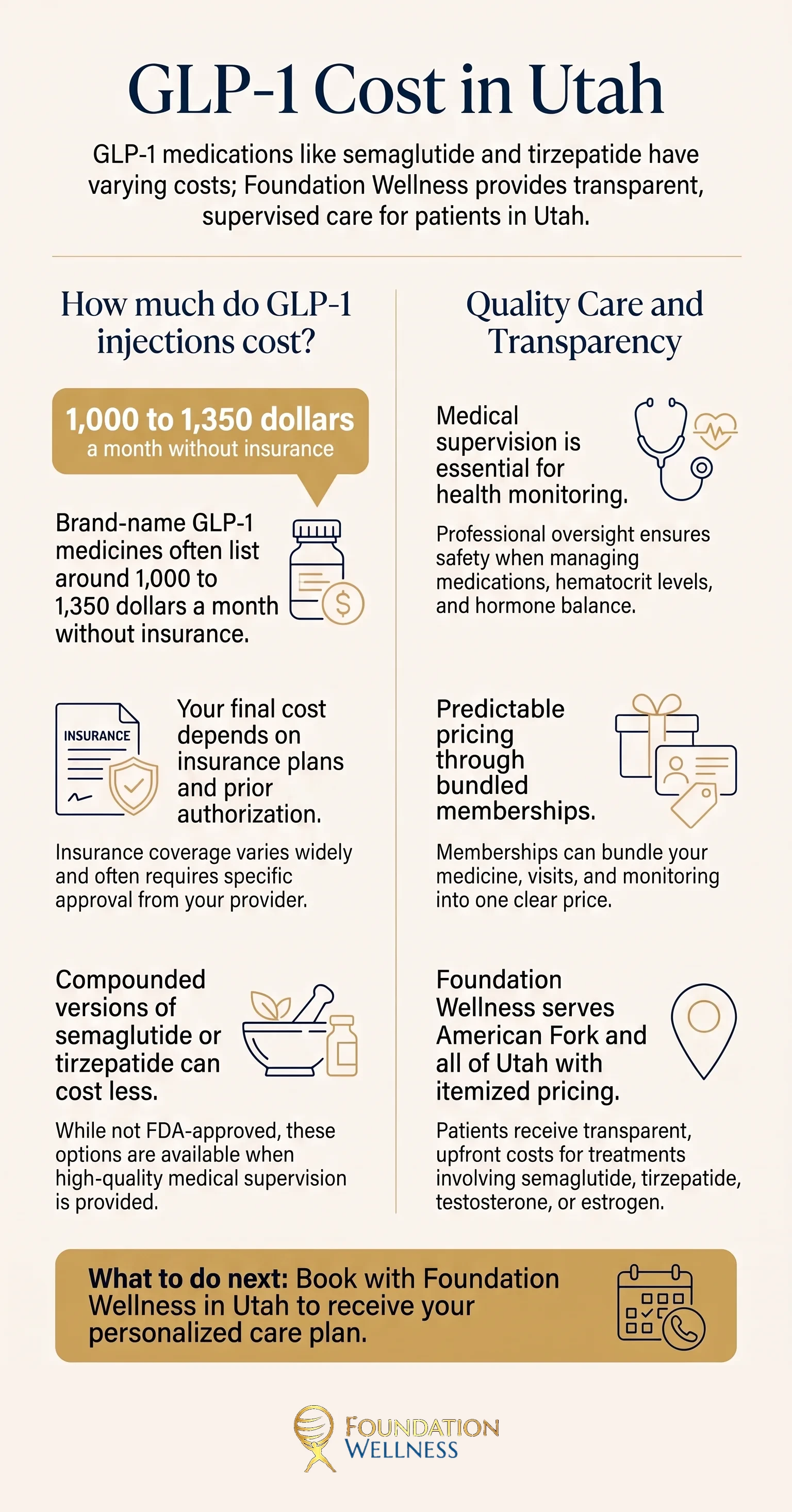
GLP-1 cost in Utah lands in three places in 2026. Self-pay runs about $349 a month for semaglutide and $299 to $449 for tirzepatide. Wegovy list price is roughly $1,349. With insurance, a covered copay often runs $25 to $150. Your plan and your diagnosis decide which number you get.
What Does a GLP-1 Cost in Utah in 2026?
Two molecules carry almost all of this market. Semaglutide is the GLP-1 in both Ozempic and Wegovy, and tirzepatide is the one in Mounjaro and Zepbound. Each molecule sells under two brand names, one approved for blood sugar control in type 2 diabetes and one approved for weight loss. That split drives most of what you pay, because insurance treats blood sugar and weight as two different problems even when the vial holds the same drug.
In our Utah practice, our patients often ask what they will actually pay long before they ask how the drug works. It’s a fair question, and the honest answer starts with knowing which of the three numbers below applies to you.
Here are the real numbers for August 2026.
Wegovy list price is about $1,349 a month. Ozempic cost at list is close to $998. List price is the sticker, not the total. Few people pay it in full. It still matters to you, though. If you have a high deductible or coinsurance, your share gets figured off that list price.
The sticker is moving. Novo Nordisk says the price for Wegovy, Ozempic and Rybelsus drops to $675 a month on January 1, 2027, for all doses. That’s a cut of about 50 percent for Wegovy and 35 percent for Ozempic. The company also says its direct cash prices don’t change.
Cash pay is where a lot of Utah patients land. Through the maker’s direct pharmacy, Wegovy pens run about $349 a month. The high-dose pen is about $399. The tablet starts near $149 for the two lowest doses, then moves to about $349.
Tirzepatide runs its own self-pay ladder, and it climbs with the dose rather than sitting flat. Eli Lilly lists the Zepbound KwikPen and vial at $299 a month for 2.5 mg, $399 for 5 mg, and $449 from 7.5 mg upward for patients whose plan does not cover it. The single-dose pen is the expensive way in at $499. Patients who do have commercial coverage can land as low as $25 a month on the savings card, capped at $100 of savings per fill.
Put plainly: at the starting dose tirzepatide undercuts semaglutide by about $50 a month, and by the doses most patients actually settle on the two are within roughly $100 of each other. Neither molecule is reliably the cheap one. The plan you carry decides far more than the drug you pick.
GLP-1 Cost by Drug and Path: A Side-by-Side Look

We compared what each path really costs a patient here. Prices move fast in this category. Treat the table as a planning range, then confirm your number before you fill anything.
| Option | Typical monthly cost (2026) | What drives the price |
|---|---|---|
| Wegovy injection, list price | About $1,349 | Sticker price; matters if you have a deductible or coinsurance |
| Ozempic injection, list price | About $998 | Approved for blood sugar in type 2 diabetes, not for weight loss |
| Maker’s cash price, Wegovy pens | About $349, or $399 for the high-dose pen | Self-pay, no insurance plan involved |
| Oral semaglutide tablet | About $149 to start, about $349 ongoing | Two lowest doses first, then standard cash pricing |
| Zepbound KwikPen or vial, self-pay | $299 at 2.5 mg, $399 at 5 mg, $449 from 7.5 mg up | Tirzepatide; the ladder climbs with your dose |
| Zepbound single-dose pen, self-pay | About $499 | The costliest way to start tirzepatide |
| Zepbound with commercial coverage | As little as $25 | Savings card, capped at $100 of savings per fill |
| Commercial insurance, drug covered | Plan copay, commonly $25 to $150 | Formulary tier, prior authorization, savings program |
| Commercial insurance, weight loss excluded | Full cash price | Employer benefit design, not a clinical call |
| Medicare Part D, GLP-1 Bridge | $50 | Demonstration program, July 2026 to December 2027 |
| Compounded semaglutide | About $199 to $349 | Legal now only for patient-specific clinical needs |
| Announced list price from January 1, 2027 | $675 | Maker’s reduction, all doses |
Two rows need a warning label. The insured copay range is a general pattern, not a promise, because your tier and deductible decide it. And the compounded semaglutide cost you see advertised as an intro rate usually covers the 0.25 mg starting dose only. That’s below what most people need long term.
How Do Utah Employer Plans Decide GLP-1 Coverage?
Sometimes. In Utah the answer swings hard from one employer to the next.
Plans we see often around Utah County include SelectHealth, PEHP, Regence, DMBA and University of Utah Health Plans. Each treats weight loss medication differently. Two people who both work in American Fork can get opposite answers. We saw that happen often enough to stop predicting it from the insurance card alone. Now our team pulls the pharmacy benefit in writing first, so a patient doesn’t start a program built on coverage that isn’t there. People arrive worried about the list price when their real number is often something else entirely, and the benefit check settles that in a day or two. Some plans cover a GLP-1 for weight loss outright. Others pay for the identical molecule only when the diagnosis is type 2 diabetes. A third group drops weight management from the formulary altogether. That’s a benefit design choice your employer made, and your healthcare provider can’t appeal it away.
Where insurance coverage exists, it comes with strings. Most plans want a documented BMI. They want a record of earlier weight loss attempts. They want a prior authorization before anything ships. Some add step therapy, so you try a cheaper weight loss medication first. Your healthcare provider sends the clinical notes, and the approved prescribing information backs up the request. In our experience, the plans that read as strict on paper often clear quickly when the chart notes arrive complete the first time. The delays we deal with tend to be paperwork gaps, not clinical disagreements.
Here’s how the coverage paths actually shake out.
| Coverage path | What it usually needs | Typical out of pocket |
|---|---|---|
| Commercial insurance, weight management benefit | Documented BMI, earlier weight loss attempts, prior authorization | Plan copay |
| Commercial insurance, diabetes benefit only | Type 2 diabetes diagnosis, blood sugar labs, prescribing information on file | Plan copay |
| Employer plan with weight loss excluded | Nothing unlocks it; it’s a benefit design choice | Full cash price |
| Medicare Part D, GLP-1 Bridge | Participating plan, clinical criteria, prescription for weight loss | $50 a month |
| No insurance coverage | Enrollment in the maker’s self-pay pharmacy | About $349 a month |
| Patient assistance program | Income documents, proof of little or no insurance | $0 to low cost |
| Compounded semaglutide | Documented clinical reason, licensed compounding pharmacy | About $199 to $349 |
Two support programs get mixed up all the time. Here’s the difference.
- A savings program from the maker lowers a copay you already have. The Ozempic savings card is the one people ask about. It’s for eligible patients with commercial insurance, and it doesn’t apply to Medicare or Medicaid.
- A patient assistance program is income-based help for people with little or no insurance. It’s a separate application, and it takes longer to process.
Got a denial? It’s frustrating, but ask for the reason in writing. In our experience, a first denial is usually a missing chart note, not a real exclusion. A clean resubmission often fixes it.
Does Medicare Cover GLP-1 Drugs in Utah?
Medicare Part D has long excluded “agents when used for anorexia, weight loss, or weight gain.” So a prescription medication given purely for weight management sat outside it. The same drug could still be covered for a covered use, like blood sugar control in type 2 diabetes.
That opened up a little this year. CMS launched a demonstration called the GLP-1 Bridge. It gives eligible Part D enrollees certain GLP-1 drugs for $50 a month, from July 1, 2026 through December 31, 2027. Wegovy is on the list, both the shot and the tablet. You need a participating plan, you need to meet the clinical criteria, and you need a prescription written for weight loss.
On Medicare? Call your plan and ask two things. Are you in the GLP-1 Bridge? And what paperwork do you want from my healthcare provider? Not every plan takes part. Utah Medicaid and marketplace plans run their own rules, so check those on their own.
Are Compounded GLP-1 Drugs Cheaper, and Still Legal?

Most of the advice online is out of date here, and the price gap has quietly closed.
Compounded semaglutide took off during the shortage. The FDA declared that shortage resolved on February 21, 2025. Then the grace periods ran out. Licensed 503A compounding pharmacies had until April 22, 2025 to stop making copies. Outsourcing facilities had until May 22, 2025. In March 2026 the FDA sent more than 50 warning letters to telehealth firms and compounders.
Compounded semaglutide isn’t banned. A licensed compounding pharmacy can still make a patient-specific compounded medication. There has to be a documented clinical reason the commercial product won’t work for you. A reaction to an inactive ingredient counts. So does a dosing need the approved product can’t meet. What they can’t produce is a copy of a drug you can already buy off the shelf.
The math has changed too. Compounded semaglutide cost through telehealth usually runs $199 to $349 a month at maintenance dosing. The maker’s cash price for the approved semaglutide medication is about $349. When we compared the two routes side by side for people paying cash, price stopped being the deciding factor. Most people are surprised by how small that gap has become. Compounded medications also skip the FDA review for quality, purity and effectiveness that the brand product goes through.
Honestly, compounded semaglutide isn’t the bargain it was in 2023 and 2024. For most of our patients, the approved product at cash price wins. If a compounded medication truly fits your case, a licensed provider should supervise it and watch your dose adjustments and your blood sugar.
Which GLP-1 Should You Price First in Utah?
Start with the one your plan already prefers, not the one you read about. Every formulary we deal with around Utah County ranks these drugs, and the ranking rarely matches what patients expect. A plan that buries Wegovy on a high tier will sometimes put Zepbound one tier down, or the reverse, and the difference between those two tiers is usually larger than the difference between the drugs.
There is a second ordering question underneath the first. Ozempic and Mounjaro are approved for type 2 diabetes; Wegovy and Zepbound are approved for weight management. If you have a diabetes diagnosis, the covered path is often the diabetes brand, and pricing the weight-loss brand first wastes a week.
Liraglutide and dulaglutide sit further down the list now, and we do not publish a monthly figure for either, because what a Utah pharmacy quotes for them moves too often for a number on a page to be worth anything. We price those live with your pharmacy benefit open rather than guessing.
The oral question comes up constantly, and it is worth one line here. There is no Ozempic pill; people searching that phrase want oral semaglutide, which exists as Rybelsus for blood sugar and as the 25 mg Wegovy tablet for weight management. Neither is automatically cheaper than the pen. Our national guide to semaglutide cost breaks the tablet pricing down dose by dose.
How Can You Lower a GLP-1 Bill in Utah Safely?
Saving money is smart. Cutting corners on oversight isn’t. Here’s the order our team walks patients through.
- Check the pharmacy benefit, not just the medical benefit. Different companies often run them. The answer that matters sits with the pharmacy benefit manager.
- Ask which semaglutide medication your plan prefers. Formularies pick winners. Sometimes a different GLP-1 sits on a lower tier for the same goal.
- Get the prior authorization right the first time. Send the BMI, the comorbidities, the earlier weight loss attempts, and a rationale tied to the prescribing information. Thin paperwork is the top reason for a denial. We learned to submit those pieces as one packet, because a file split across two submissions is the kind that stalls for weeks.
- Price the maker’s cash route before anything else if you have no insurance coverage. At about $349 a month, it beats a lot of what gets marketed as a discount.
- Apply to a patient assistance program if your income qualifies. Start early, because processing takes weeks.
- Budget the whole program, not the vial. Your real monthly cost includes labs, follow-up visits, and the dose adjustments that make the medication work.
- Be careful with very cheap online sellers. According to the National Institute of Diabetes and Digestive and Kidney Diseases, these medicines work best alongside medical guidance, nutrition and activity.
What This Looks Like at Foundation Wellness
Our patients get itemized pricing before they start, not after. We check your benefits. We run the prior authorization. Then we tell you plainly which path costs less for your situation, even when that path is the maker’s cash price instead of anything we dispense. One patient’s number can look nothing like the next person’s at the same employer, so we price it live with you rather than handing you a range and hoping it holds. We’re in American Fork, and we see people from Utah County, Salt Lake and along the Wasatch Front, in person and by telehealth.
You can see how the program runs on our GLP-1 injections in Utah page. Compare the two molecules in semaglutide vs tirzepatide. Read about the wider plan on our medical weight optimization page. Want your actual number? Call us and we’ll price it with your plan open in front of us.
This article is general information about semaglutide cost. It isn’t medical advice. Talk with a licensed provider about your own health, your blood sugar, and whether a weight loss drug belongs in your plan.
Key Takeaways
- GLP-1 cost in Utah in 2026: about $1,349 a month at Wegovy list price, about $998 for Ozempic, about $349 through the maker’s cash pharmacy, and $299 to $449 for self-pay Zepbound.
- Novo Nordisk has announced a price of $675 a month for Wegovy, Ozempic and Rybelsus starting January 1, 2027.
- Insurance coverage depends on your plan and your diagnosis. Many Utah employer plans exclude weight loss drugs while still covering the same medication for type 2 diabetes.
- Medicare Part D excludes weight loss drugs, but the CMS GLP-1 Bridge offers eligible enrollees certain GLP-1 medicines for $50 a month through December 31, 2027.
- Compounded semaglutide runs about $199 to $349 a month and is now limited to patient-specific clinical needs, so it’s rarely the bargain it once was.
- Neither molecule is reliably the cheaper one. Tirzepatide starts lower, semaglutide catches up at maintenance doses, and your formulary tier outweighs both.
- Foundation Wellness serves American Fork and all of Utah, with benefit checks and itemized pricing before you start.
Sources
- U.S. Food and Drug Administration, drug compounding and shortage guidance: fda.gov.
- Medicare, weight-loss drug coverage and the GLP-1 Bridge: medicare.gov.
- Centers for Medicare and Medicaid Services, GLP-1 Bridge demonstration: cms.gov.
- National Institute of Diabetes and Digestive and Kidney Diseases: niddk.nih.gov.
- Novo Nordisk, U.S. list price reduction for Wegovy, Ozempic and Rybelsus, announced 2026.
- Novo Nordisk, NovoCare pricing for Wegovy pens and tablets: novocare.com.
- Eli Lilly, Zepbound coverage and savings, self-pay KwikPen and vial pricing: zepbound.lilly.com.
Dr. Paul Frandsen
August 2, 2026 · 13 min read