
GLP-1 Injections in Utah: A Medical Weight Loss Guide
July 11, 2026
By Dr. Paul Frandsen · July 11, 2026 · 10 min read

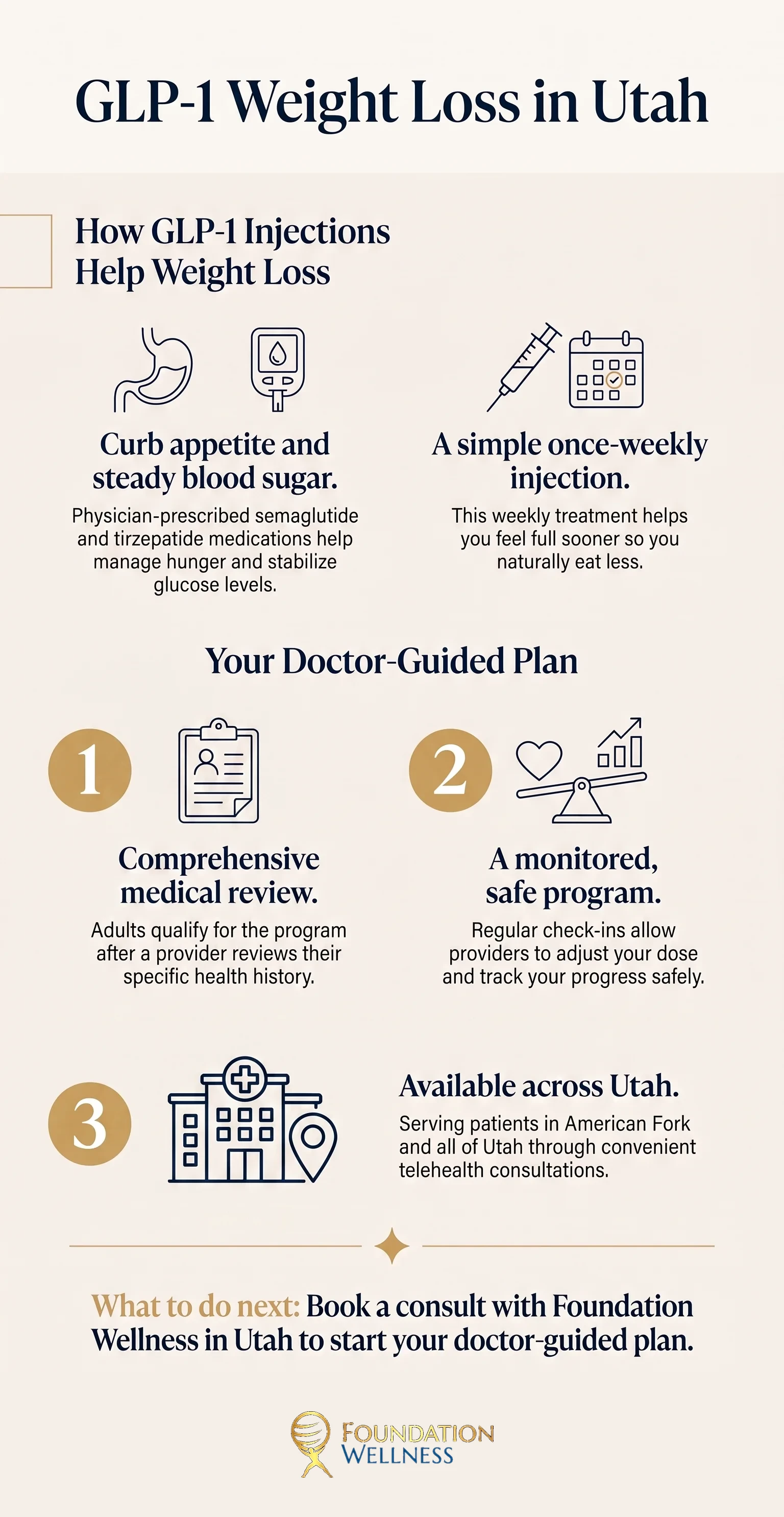
GLP-1 injections are a well-studied medical weight loss treatment used across Utah. At Foundation Wellness in American Fork, we prescribe FDA-approved GLP-1 medication, including semaglutide and tirzepatide, for chronic weight management. This treatment calms appetite and steadies blood sugar. We serve all of Utah in person and by telehealth.
If you’ve tried everything and the scale won’t budge, keep reading. This one is different.
What Is GLP-1?
GLP-1 stands for glucagon-like peptide-1. It’s a hormone your gut releases after you eat. Its job is simple. It tells your brain you’re full, slows how fast your stomach empties, and helps your body manage blood sugar levels.
A GLP-1 medication is a lab-made copy of that hormone. It boosts a signal your body already uses. That’s why these drugs are called GLP-1 receptor agonists. “Agonist” just means it switches on the same receptors your natural hormone does. It just does that more strongly and for longer.
You may have seen these drugs go by brand names. The two we use most are semaglutide and tirzepatide. Some people search for “GLP-3” or “GLP-1 injections Utah.” They wonder if there’s a newer class out there. There isn’t a separate GLP-3 weight loss medication. It’s the same family, just described differently online. Semaglutide and tirzepatide are the real medicines behind almost all of it.
Our patients often ask us to sort this out at the first visit, usually after a frustrating hour of reading conflicting posts. The short answer is that there’s nothing new hiding behind the other name.
How Do GLP-1 Injections Work for Weight Loss?
Old-school diet advice was “eat less, move more.” The problem is that hunger fights back. Your body ramps up appetite the moment you cut calories. Willpower loses that fight most of the time.
GLP-1 injections change the math. They work on the real biology of hunger and fat storage. You don’t have to white-knuckle through it.
Here’s what they do:
- They quiet your appetite. The constant food noise fades. You feel full sooner and stay full longer. So you eat less without feeling deprived.
- They slow digestion. Food leaves your stomach more slowly. That keeps you satisfied between meals.
- They steady your blood sugar. GLP-1 medication helps your body release insulin at the right time. That’s a big deal if you have insulin resistance. Better blood sugar regulation supports steady fat loss, and it cuts the spikes and crashes that drive cravings.
There’s a knock-on effect too. As weight comes off, insulin sensitivity usually improves, and that takes real pressure off your metabolism. Better metabolic health is often the quieter win here, even when the scale gets all the attention. Both semaglutide and tirzepatide went through large clinical trials before the FDA cleared them for chronic weight management.
In our experience, the appetite change is what people notice first, and it shows up well before the scale moves. That gap between “I feel different” and “the number changed” is worth knowing about ahead of time, because it’s where a lot of people quit.
Most people see real, measurable weight loss, and most of it is fat when the plan is done right. According to the National Institute of Diabetes and Digestive and Kidney Diseases, these medicines are prescription options for people who need medical help managing their weight.
Semaglutide vs Tirzepatide: What’s the Difference?
Both are given as a weekly injection. Both work on the GLP-1 pathway. The main difference is how many hunger and blood sugar signals each one targets. According to the Cleveland Clinic, tirzepatide acts on two gut hormone receptors, while semaglutide acts on one.
| Feature | Semaglutide | Tirzepatide |
|---|---|---|
| How it works | GLP-1 receptor agonist | Dual agonist (GLP-1 plus GIP) |
| Injection schedule | Once weekly | Once weekly |
| Targets | One appetite pathway | Two appetite and metabolic pathways |
| Dosing | Slow titration over weeks | Slow titration over weeks |
| Best for | Most first-time patients | Those wanting a stronger effect |
| Compounded option | Compounded semaglutide available | Compounded option available |
Tirzepatide hits an extra receptor called GIP. That’s why some patients respond more strongly to it. It doesn’t automatically make it right for you, though. Semaglutide works well for a lot of people. It may even be the smarter starting point. It depends on your history, your goals, and your budget. We match the treatment to you, not the other way around.
Who Qualifies for GLP-1 Weight Loss in Utah?
GLP-1 treatment isn’t a fit for every patient. Any provider handing it out after a two-minute quiz is cutting corners.
You’re likely a good candidate if your body mass index sits in the overweight or obese range. A lower BMI can also qualify if you have a weight-related condition. That includes prediabetes, type 2 diabetes, high blood pressure, or high cholesterol. We also look at your overall health and your full metabolic picture. Things like insulin resistance and poor sleep quietly sabotage weight loss.
Before we prescribe anything, we review your medical history and run the right labs. We check markers like fasting glucose, A1C, a lipid panel, and thyroid (TSH). Some conditions mean these medicines aren’t right for you. One example is a personal or family history of certain thyroid cancers. Screening like this is what makes GLP-1 treatment safe, and it’s the whole point of real medical weight loss care. An online mill skips it.
Our team goes through those results with you line by line, not as a formality. A borderline A1C or a thyroid number sitting outside the reference range changes the plan, and sometimes it changes the answer to whether you should start at all.
How Do You Take GLP-1 Injections?
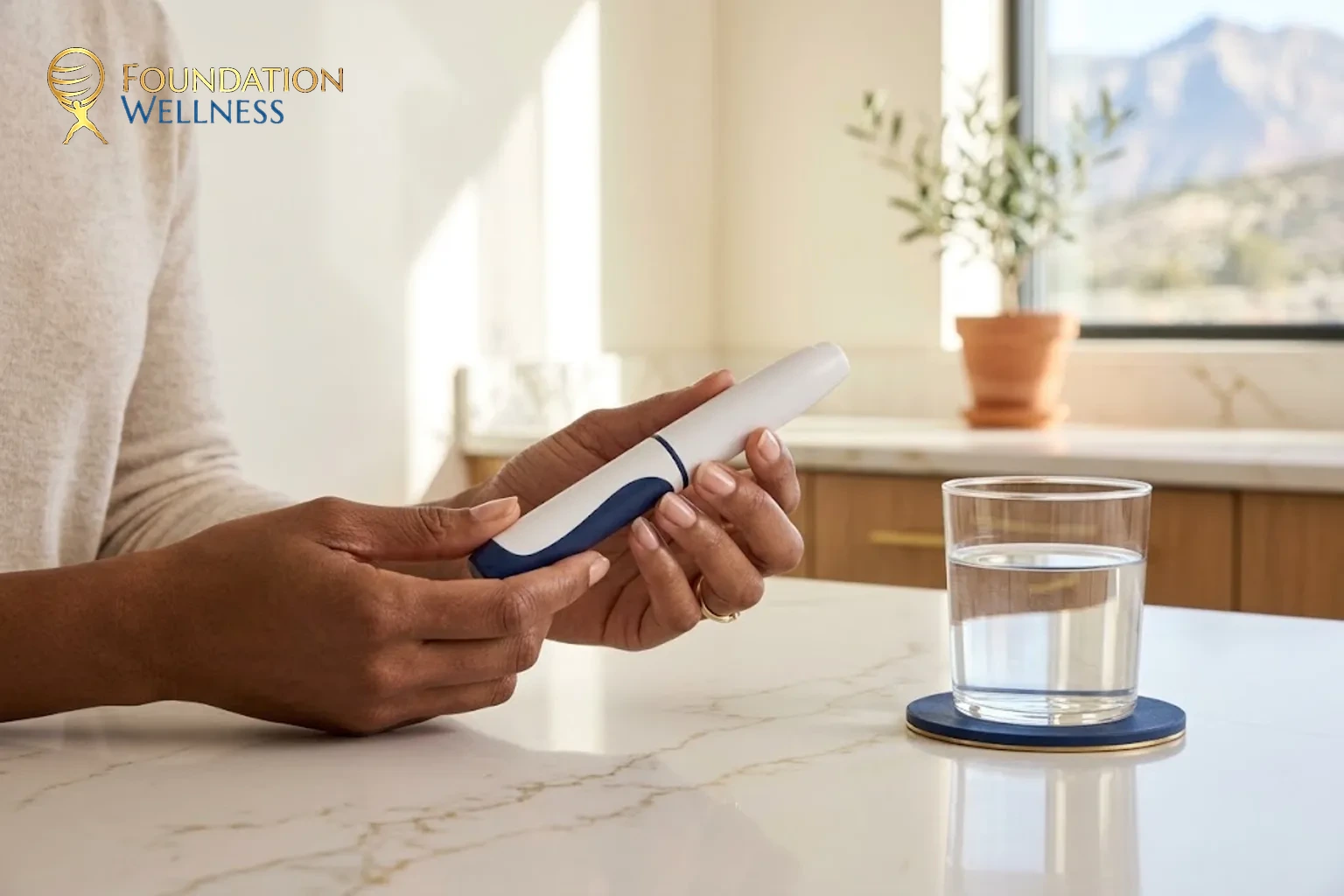
The injection is simple. It’s a tiny needle, done once a week at home. Most people use the belly, thigh, or upper arm. Plenty of patients come in nervous about giving themselves a shot and then tell us afterward it was easier than they expected. It barely feels like anything.
Dosing starts low on purpose. In our Utah practice we start most patients at the lowest labeled dose. That’s 0.25 mg weekly for semaglutide and 2.5 mg weekly for tirzepatide. From there we step up at roughly four-week intervals, and only if the current dose is sitting well. This slow ramp-up gives your body time to adjust. It also keeps side effects mild. What we learned early is that the titration schedule, not the medication itself, is usually what makes people feel awful. So we don’t rush it.
You’ll check in with us often. We track your weight, your body composition, your labs, and how you feel, because progress shows up in more places than the scale. At our American Fork clinic, we usually run labs at baseline, again around 6 to 8 weeks, then every 6 to 12 months. We monitor progress every few weeks while your dose is still climbing, then space visits out once it’s steady. If something needs tweaking, we tweak it. This steady adjustment is what separates lasting results from a quick drop that bounces back.
Two people on the same dose rarely need the same plan. One patient may sit at a mid-level dose for months because it’s doing the job, while another needs the full titration to get the same effect. That’s a clinical decision, not a schedule you follow off a chart.
How Soon Will You See Results?

Most people notice their appetite change within the first week or two. The food noise gets quieter fast. Our patients tend to describe that first shift the same way, as the relief of not negotiating with themselves every afternoon. Weight loss itself is more gradual, and that’s a good thing. Slow, steady loss protects your muscle. It’s also far easier to keep off. A pace of about 1 to 2 pounds a week is typical.
Over the first few months, your dose climbs to an effective level, and the results build. Patients who pair the medication with protein-focused eating and a simple exercise plan tend to lose more fat. They also hold onto more muscle. That combination improves your body composition, not just the number on the scale. Real results come from the whole plan, not the injection by itself.
Patience pays here. This is a tool for lasting weight management, not a two-week crash diet.
What Are the Side Effects?
The most common side effects are digestive. Think nausea, mild constipation or diarrhea, and feeling full quickly. These usually show up early, stay mild, and fade as your body adjusts. Raising the dose slowly helps a lot here.
We built our side effect coaching around the first six weeks, because that’s when the stomach complaints usually show up. Smaller meals, protein first, fluids between meals rather than with them, and holding a dose instead of pushing through it when your stomach is unhappy.
Serious side effects are rare but real, and that’s exactly why supervised care matters. As the Cleveland Clinic notes, GLP-1 receptor agonists should be prescribed and monitored by a qualified healthcare provider. We coach you on how to eat and hydrate to ease any discomfort. And we’re a phone call away if anything feels off. That kind of medical support is often the difference between quitting in week three and sticking with treatment long enough to see it work.
What Does Ongoing Support Look Like?
Medication is one part of medical weight loss. The rest is what happens in the weeks between doses.
Every patient gets a personalized plan built around their labs, their history, and their treatment goals. That means protein targets you can actually hit, an exercise plan that fits your real week, and sleep and stress habits that stop working against you. We adjust as your body changes.
Ongoing support is the part most online programs skip. You’ll have a direct line to our team for questions about dosing, a rough week, or a side effect that won’t settle. Practical guidance beats willpower every time. When patients tell us what’s actually happening at home, we can fix the plan instead of guessing.
We also care about what happens after you hit your goal weight. Some patients taper to a maintenance dose. Others step off the medication and keep the habits they built. Either way, weight management is a long game, and you shouldn’t have to play it alone.
How Much Do GLP-1 Injections Cost in Utah?
Cost depends on the treatment you choose, your dose, and the product. A brand-name or compounded option changes the price. Compounded semaglutide is often the cheaper path. It can bring the monthly cost down a lot compared to brand-name pens, which run high without insurance. In Utah, self-pay programs often land around $200 to $500 a month, depending on the plan.
Insurance coverage for weight loss medication is spotty. So many patients choose a self-pay program with a set monthly price. Our programs bundle the medication, your visits, and the support around them, so nothing shows up as a surprise line item later. During your consultation, we lay out your options clearly. You’ll know exactly what you pay and what care you get.
Getting Started in American Fork
Our clinic is in American Fork. We care for patients across Utah County, including Pleasant Grove, Lehi, Highland, Alpine, and Orem. We serve the rest of the state through telehealth too. Want to know what a local visit looks like? Our guide to GLP-1 weight loss in American Fork walks through it.
Getting started is easy. Book a free consultation. We’ll talk through your history, your goals, and whether this treatment fits. If it does, we build a plan around your biology and get you going. You can learn more about our full approach on our weight optimization page.
You don’t need more willpower. You need the right tool and a team that will support you while you use it.
Key Takeaways
- GLP-1 injections like semaglutide and tirzepatide treat the biology of weight. They calm appetite and steady blood sugar levels, so weight loss finally sticks.
- There’s no separate “GLP-3” weight loss drug. Searches for GLP-1 and GLP-3 all point to the same GLP-1 medication family.
- Tirzepatide targets an extra pathway (GIP). Semaglutide is a well-studied single-pathway option. The right choice depends on your body and goals.
- Dosing starts low and rises slowly. That keeps side effects mild and progress steady.
- The medication works best alongside protein, resistance training, and steady support from a supervised program.
- Foundation Wellness serves all of Utah from American Fork, in person and by telehealth, with supervised medical weight loss care.
Sources
- U.S. Food and Drug Administration (FDA): fda.gov/drugs
- National Institute of Diabetes and Digestive and Kidney Diseases (NIDDK): niddk.nih.gov
- Cleveland Clinic: my.clevelandclinic.org
Dr. Paul Frandsen
July 11, 2026 · 10 min read