
GLP-1 Muscle Loss: How Much Is Muscle and How to Keep It
September 19, 2026
By Dr. Paul Frandsen, MD · September 19, 2026 · 9 min read
Medically reviewed by Dr. Paul Frandsen, MD

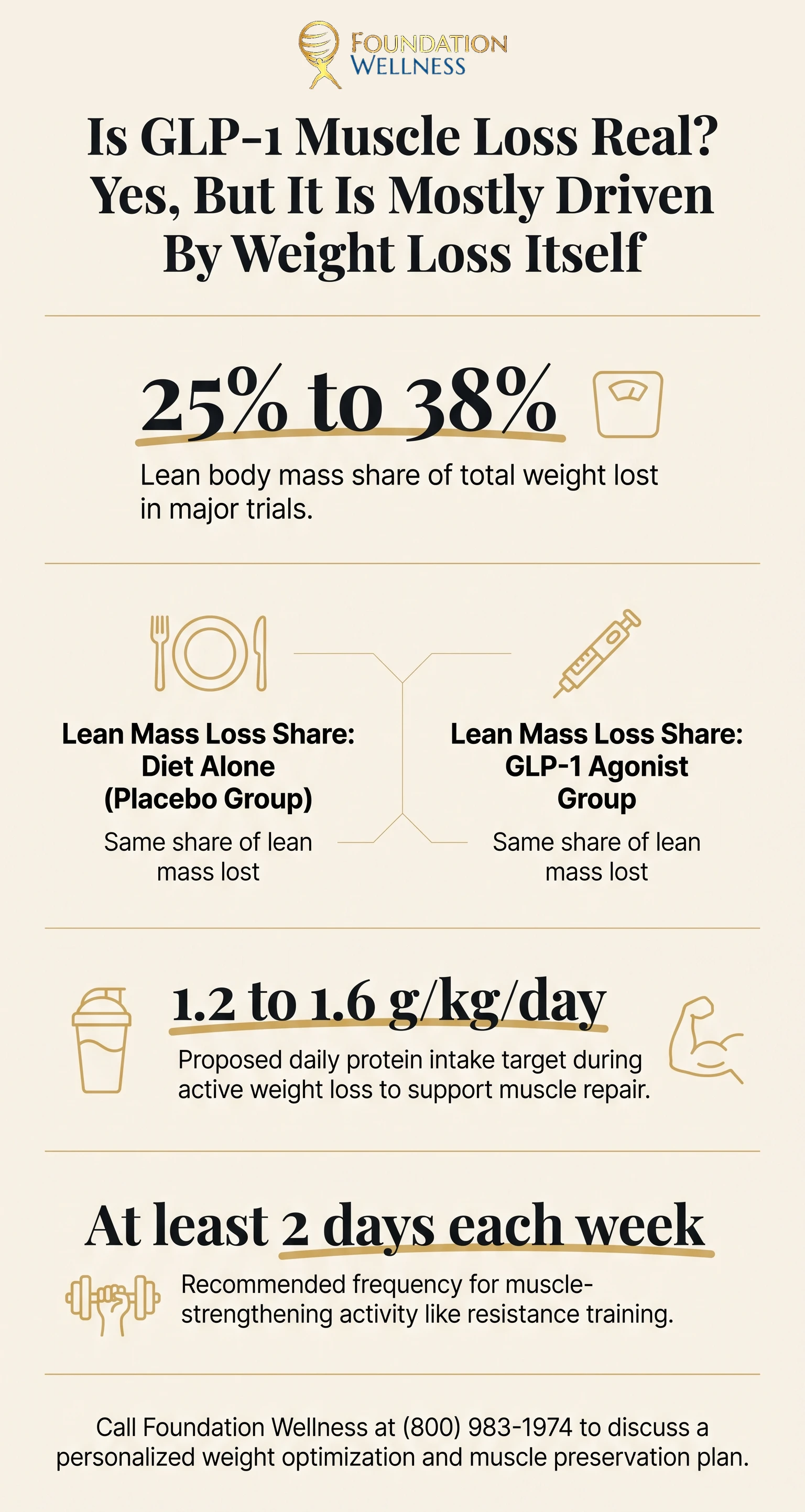
Yes, GLP-1 muscle loss is real, but it’s mostly a side effect of losing weight, not of the drug itself. Any large weight loss takes some lean tissue along with fat. In major trials, about a quarter to over a third of the weight lost was lean mass. Enough protein and regular strength training do the most to protect it.
What Is GLP-1 Muscle Loss?
GLP-1 stands for glucagon-like peptide-1. GLP-1 medications are a class of prescription drugs used for weight loss under a clinician’s care.
When people lose a lot of weight, not all of it is fat. Part of it is lean body mass, and muscle mass is one piece of that. “GLP-1 muscle loss” is the share of that lost weight that comes from muscle instead of fat.
You may have heard these medicines “eat muscle.” It’s a scary way to put it. The real picture is calmer, though, and a lot more useful.
Do GLP-1 Medications Cause Muscle Loss?
They cause weight loss, and weight loss can cause you to lose muscle. A 2025 joint nutrition advisory notes that GLP-1s reduce body weight by 5% to 18% in trials, with modestly lower effects in real-world use. It lists muscle and bone loss among the challenges to plan for. For how much weight people lose by drug, see our guide to how much weight you can lose on GLP-1 medications.
Now, the detail that changes things. In one trial, people on a placebo who lost weight through diet lost the same share of lean mass as people on the drug. So the lean loss looks like a feature of significant weight loss in general, not something unique to GLP-1 drugs. That surprised us a little, honestly. It also takes some of the fear out of the headlines.
Rapid weight loss of any kind can take muscle with it, with or without a GLP-1 receptor agonist. Planning for it belongs in any plan that uses GLP-1 agonists, including our medical weight optimization program.
How Much of the Weight Lost Is Muscle?

Most weight loss studies measure body composition, which splits body weight into fat mass and lean mass.
In the STEP 1 trial of semaglutide, people lost 13.6 kg on average. Of that, 8.3 kg (62%) was fat and 5.3 kg (38%) was lean body mass, which works out to about 20% of the total being muscle, because muscle mass is about half of lean body mass.
A company-funded body composition substudy of the SURMOUNT-1 trial of tirzepatide found that about 75% of the weight lost was fat mass and 25% was lean mass, for both the drug and placebo groups.
Across other studies, the spread is wide, which is frustrating if you want one clean number. A 2024 review found that lean mass reductions range between 40% and 60% of total weight lost in some studies, while others show approximately 15% or less.
| Data source | Average weight change | Lean share of weight lost | What it suggests for muscle |
|---|---|---|---|
| STEP 1 trial (2025 advisory) | 13.6 kg lost | 38% (5.3 kg) | About 20% of the loss was muscle |
| SURMOUNT-1 body composition substudy | Down 21.3% at week 72 | About 25%, same as placebo | Not reported |
| Range across studies (2024 review) | Not reported | About 15% or less, up to 40% to 60% | Lean mass is not the same as muscle |
| Advisory modeling, no strength training | Not reported | Not reported | 10% to 15% (women), 20% to 25% (men) |
So fat loss is still most of the story. Reassuring, mostly. But skeletal muscle mass does drop, and that’s not a free pass.
Is Lean Mass Loss the Same as Muscle Loss?
No. Lean mass loss is a broader measure. The 2024 review points out that lean body tissue includes not only muscle but also organs, bone, fluids and water in fat tissue. Lean muscle is only part of it.
The advisory estimates that muscle mass is about half of lean body mass, so the loss of muscle tissue is likely smaller than the lean number suggests.
The same review describes MRI studies suggesting that changes in skeletal muscle appear to be adaptive. What this means for muscle quality over the long term is still being studied, so keep lean muscle mass on your list of things to protect.
Does Muscle Loss Affect Strength?
Research is still catching up here. The 2025 advisory treats muscle and bone loss as a real concern. It recommends checking muscle strength, function and body composition at the start of treatment so changes can be tracked as weight loss goes on.
At the same time, the 2024 review suggests some muscle changes may be the body adapting, not muscle wasting or muscle atrophy in the usual sense. So muscle loss is neither proven harmless nor proven dangerous. That’s not the tidy answer anyone wants. It’s the honest one.
Watch muscle function in daily life. If you notice new muscle weakness, trouble with stairs or less strength than before, tell your clinician. Maybe a stretch of the Murdock Canal Trail that used to feel easy now leaves your legs heavy. That’s worth mentioning.
How Much Protein Do You Need on a GLP-1?
Protein gives your body the building blocks for muscle protein synthesis, the process that repairs and builds muscle. When your appetite drops on a GLP-1, protein intake can drop too. For a lot of people, this is where it gets tricky. You’re just not hungry, and a full plate can look like a chore.
The recommended daily allowance for protein is 0.8 grams per kilogram of body weight per day. During active weight loss, higher targets such as 1.2 to 1.6 g/kg/day have been proposed. The advisory also notes it isn’t yet clear which body weight to use for this math in people with obesity.
Treat those numbers as a starting point, not a prescription, and ask your clinician to set a personal target for adequate protein intake. A source of muscle protein at each meal helps you reach adequate protein when you’re not very hungry. Think of it as small and steady, not one big Sunday dinner.
What Exercise Helps Preserve Muscle?
Strength training is the habit with the strongest support for preserving muscle. The 2025 advisory says structured resistance training, or a mix of resistance and aerobic exercise, is well established to help preserve lean mass during weight loss. It adds that aerobic activity alone has a smaller effect during rapid weight reduction. That’s a bit of a letdown if long walks or rides up American Fork Canyon are your thing. Keep them. Just add some lifting.
In practice, resistance exercise can be bands, body weight or machines, with walking or other physical activity alongside. Muscle preservation comes from steady weeks, not one hard session, so ask your clinician before a big change. And when a Utah winter turns the trails icy or an inversion keeps you indoors, bands and body weight at home still count.
Who Is Most at Risk of Muscle Loss?
The 2025 advisory highlights higher concern for people with too little physical activity, too little protein intake, or older age. Men may lose a larger share of muscle than women, based on the advisory’s modeling in the table above. Older age being on the list can feel unfair. It’s also exactly why an early plan matters.
If any of these fit you, don’t wait. Plan to protect your muscle mass early in GLP-1 therapy. The advisory recommends a baseline exam that includes muscle strength, function and body composition. Then ask how it’ll be checked during your GLP-1 treatment and as your weight reduction continues.
Weight Management and GLP-1 Therapy at Foundation Wellness

Our Weight Optimization service combines GLP-1 therapies, hormone evaluation and metabolic support to create sustainable weight outcomes. We start with a thorough evaluation, including lab work. Our clinic is at 456 E State Street, Suite 1400, American Fork, UT 84003. We also offer telemedicine across Utah, alongside in-person visits, which helps if you’re out in Eagle Mountain or Saratoga Springs and can’t always make the drive, and we’re accepting new patients.
Here’s what that looks like in practice at our clinic:
- Evaluation first. Our lab work looks at metabolic, hormonal and inflammatory markers. We also take a detailed history of your weight over the years, what you’ve already tried, your medications, your sleep and your stress load.
- Hormones in the picture. We check thyroid function, cortisol and adrenal health, and insulin and glucose regulation, which can include fasting insulin, HbA1c and glucose tolerance testing. We look at sex hormones too, since declining estrogen, progesterone and testosterone affect metabolism and body composition.
- Medication with follow-up. When GLP-1 medications such as semaglutide or tirzepatide are part of your plan, we prescribe and monitor them with regular follow-up to adjust dosing, track progress and manage side effects. We don’t prescribe them in isolation.
- The long view. We’re not aiming for fast weight loss followed by regain. That means monitoring, adjusting and supporting you over time.
Weight care often connects to hormone therapy or mental wellness support. Because Foundation Wellness offers these under one roof, your care stays coordinated, and every treatment plan is overseen by a board-certified physician.
Bring your questions about protein, strength and muscle tracking, and read our guide to GLP-1 side effects before your visit.
Foundation Wellness accepts many insurance plans. Coverage depends on your plan, so check with our office first. Call (800) 983-1974 to talk about weight management options. Same-day appointments are often available.
Key Takeaways
- Some lean loss happens with any large weight loss, on a GLP-1 or not.
- In two major trials, lean mass was about 25% to 38% of the weight lost.
- Lean mass is not all muscle; muscle is about half of lean body mass.
- Higher protein targets of 1.2 to 1.6 g/kg/day have been proposed during weight loss.
- Strength training at least 2 days each week is the best-supported way to protect muscle.
Sources
- Obesity (ACLM, ASN, OMA and The Obesity Society, 2025), Nutritional priorities to support GLP-1 therapy for obesity: a joint Advisory.
- Diabetes, Obesity and Metabolism (2025), Body composition changes during weight reduction with tirzepatide in the SURMOUNT-1 study.
- Office of Disease Prevention and Health Promotion, Top 10 Things to Know About the Physical Activity Guidelines.
- Diabetes, Obesity and Metabolism (2024), Changes in lean body mass with glucagon-like peptide-1-based therapies and mitigation strategies.
September 19, 2026 · 9 min read