
GLP-1 Side Effects: How Each Drug in the Class Differs
July 29, 2026
By Dr. Paul Frandsen · July 29, 2026 · 18 min read

GLP-1 side effects are mostly digestive, and they aren’t identical across the class. Nausea reached 44% on semaglutide 2.4 mg in the FDA trials, 39.3% on liraglutide 3 mg, and 28% on tirzepatide 15 mg. Drug and dose both move that number. Here’s how the medications compare, and which symptoms earn a same-day call.
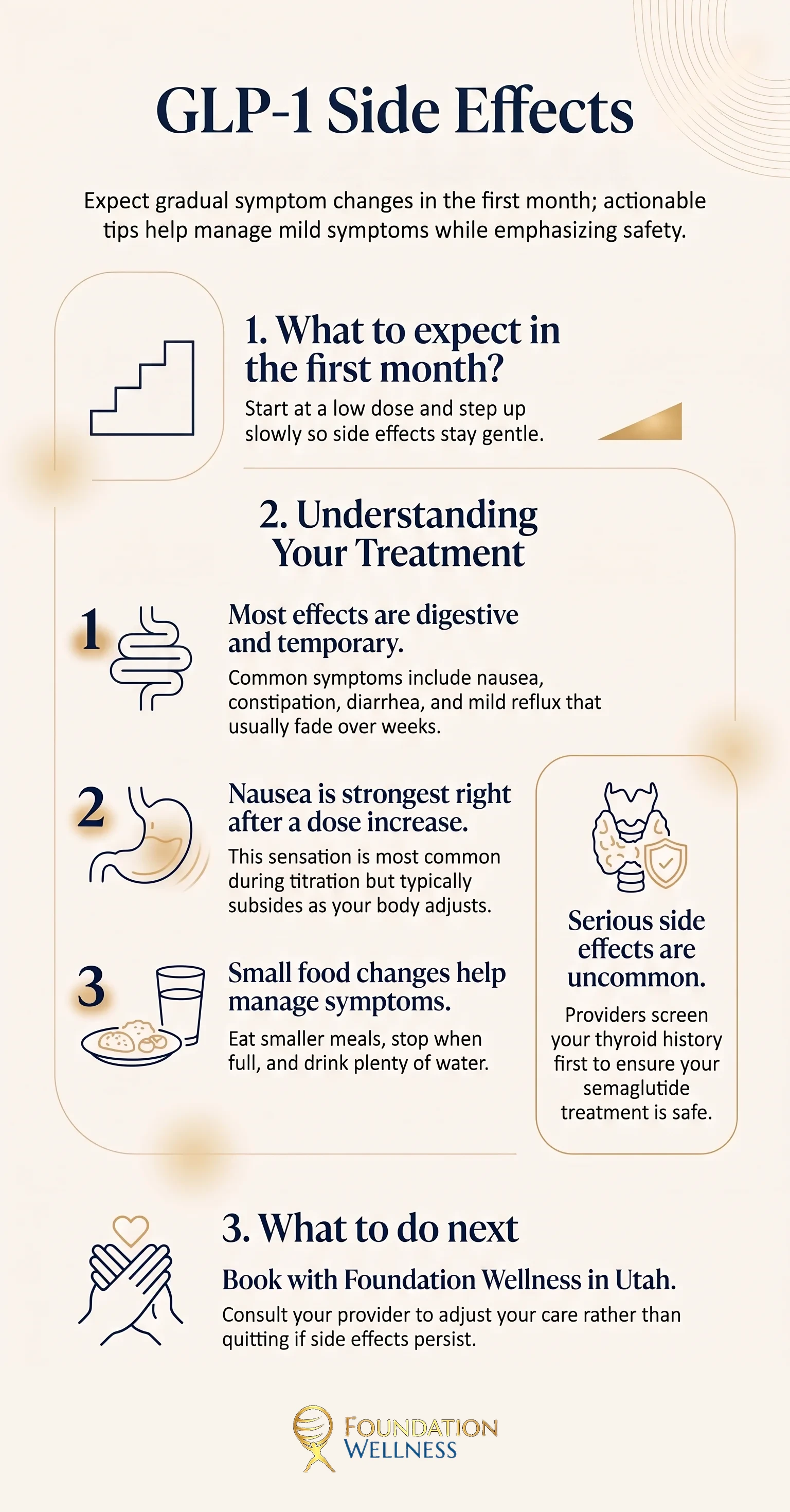
Which Drugs Count as GLP-1 Medications?
GLP-1 receptor agonists copy a gut hormone your body releases after eating. They slow how fast your stomach empties and quiet appetite signals in the brain. That shared mechanism explains why the whole class produces similar complaints.
Tirzepatide sits slightly outside the strict definition. It acts on a second receptor called GIP as well, which is why some labels call it a dual agonist. Clinics still group it with the class, and so do patients.
| Brand | Active drug | How it’s taken | FDA approved for |
|---|---|---|---|
| Wegovy | Semaglutide | Weekly injection or daily tablet | Chronic weight management |
| Ozempic | Semaglutide | Weekly injection | Type 2 diabetes |
| Rybelsus | Semaglutide | Daily tablet | Type 2 diabetes |
| Zepbound | Tirzepatide | Weekly injection | Chronic weight management |
| Mounjaro | Tirzepatide | Weekly injection | Type 2 diabetes |
| Saxenda | Liraglutide | Daily injection | Chronic weight management |
| Victoza | Liraglutide | Daily injection | Type 2 diabetes |
| Trulicity | Dulaglutide | Weekly injection | Type 2 diabetes |
| Byetta | Exenatide | Twice daily injection | Type 2 diabetes |
Notice how often the same molecule appears twice. Ozempic and Wegovy are both semaglutide at different doses for different jobs. Mounjaro and Zepbound share that relationship too.
What Are the Most Common GLP-1 Side Effects?
Every drug in the class produces the same short list. What changes is how many people get each symptom.
The table below pulls the maximum weight-management dose of each approved product straight from its FDA label.
| Reaction | Semaglutide 2.4 mg | Tirzepatide 15 mg | Liraglutide 3 mg |
|---|---|---|---|
| Nausea | 44% | 28% | 39.3% |
| Diarrhea | 30% | 23% | 20.9% |
| Vomiting | 24% | 13% | 15.7% |
| Constipation | 24% | 11% | 19.4% |
| Abdominal pain | 20% | 10% | 5.4% |
| Fatigue | 11% | 7% | 7.5% |
| Stopped treatment for side effects | 6.8% | 6.7% | 9.8% |
Placebo rates are the missing column, and they matter. Sixteen percent of adults on a dummy semaglutide injection still reported nausea. On the tirzepatide placebo arm the figure was 8%. Ordinary life produces a surprising amount of stomach trouble.
Read that last row before the rest. Roughly the same share of patients walked away from semaglutide and tirzepatide, even though the individual symptom rates look different. Liraglutide lost more people, and its daily injection schedule is part of why.
One warning applies to the whole table. These are separate trials with different patients, different lengths, and different rules for recording symptoms. Both manufacturers say so in their own labels. Treat the gaps as a rough guide, not a photo finish.
Which GLP-1 Has the Fewest Side Effects?
Dose answers this better than brand does. Line the class up by milligram strength and the pattern gets obvious.
| Medication and dose | Nausea | Vomiting |
|---|---|---|
| Dulaglutide 0.75 mg weekly | 12.4% | 6.0% |
| Semaglutide 0.5 mg weekly | 15.8% | 5.0% |
| Semaglutide 1 mg weekly | 20.3% | 9.2% |
| Dulaglutide 1.5 mg weekly | 21.1% | 12.7% |
| Tirzepatide 5 mg weekly | 25% | 8% |
| Liraglutide 3 mg daily | 39.3% | 15.7% |
| Semaglutide 2.4 mg weekly | 44% | 24% |
The gentlest options sit at the top, and they’re the diabetes doses. Dulaglutide at 0.75 mg is genuinely easy on most stomachs. It also isn’t approved for weight management, so it rarely enters this conversation.
Among the drugs approved for weight loss, tirzepatide reported the lowest digestive rates at full dose. Our patients who switched after a rough run on semaglutide mostly report an easier ramp, though a handful found no difference at all.

How Do the Escalation Schedules Compare Across Drugs?
Your gut adapts to one level, then meets a new one. Escalation schedules exist to keep each step small enough to tolerate, and they differ across the class.
| Medication | Starting dose | Step interval | Usual maintenance |
|---|---|---|---|
| Semaglutide injection | 0.25 mg weekly | 4 weeks | 1.7 mg or 2.4 mg weekly |
| Tirzepatide | 2.5 mg weekly | 4 weeks | 5 mg, 10 mg, or 15 mg weekly |
| Liraglutide | 0.6 mg daily | 1 week | 3 mg daily |
| Dulaglutide | 0.75 mg weekly | 4 weeks | 1.5 mg to 4.5 mg weekly |
| Semaglutide tablet | 1.5 mg daily | 30 days | 25 mg daily |
Liraglutide is the outlier, and patients rarely see it coming. Its ladder climbs every week rather than every month, so you reach full dose in about five weeks instead of four months. Faster to the target, rougher on the way.
Weekly injections produce a wave. Nausea peaks a day or two after the shot, eases, and then returns after the next step up. Daily dosing flattens that wave into something steadier and less predictable to plan around.
If a step knocks you flat, we hold you there. Every label in this class lets a provider delay escalation, and our team uses that option more often than we advance on schedule. Pushing through a miserable week is what makes patients quit treatment entirely.
Honestly, the most frustrating part of this job is watching someone abandon a plan that would have worked at a slower pace.
Do All GLP-1 Drugs Carry the Same Boxed Warning?
Semaglutide, tirzepatide, liraglutide, and dulaglutide each carry a boxed warning about thyroid C-cell tumors found in rodent studies. All four are contraindicated with a personal or family history of medullary thyroid carcinoma, or with MEN 2 syndrome.
We screen thyroid history before writing any prescription in this class. Our team asks twice, once on the intake form and once out loud, because people forget what a relative was treated for years ago.
Which GLP-1 Side Effects Are Serious?
Serious problems stay uncommon, and the warnings repeat across every label in the class.
- Acute pancreatitis. Severe belly pain that won’t ease, sometimes radiating to the back. Stop the drug and seek medical attention.
- Gallbladder disease. Upper right belly pain, fever, yellowing skin, or clay-colored stools. Rapid weight loss raises gallstone risk on its own.
- Kidney injury from dehydration. Several days of vomiting or diarrhea can strain the kidneys badly.
- Allergic reaction. Anaphylaxis and angioedema have been reported. Swelling of the face or throat is an emergency.
- Pulmonary aspiration under anesthesia. Food can still sit in a slowed stomach hours after you last ate.
That last one deserves emphasis. The American Society of Anesthesiologists issued consensus guidance in 2023 on managing patients taking a GLP-1 before elective procedures. Tell your surgeon, anesthesiologist, and dentist which medication you take, by name.
Dehydration is the risk patients wave off most. Dark urine, a dry mouth, and dizziness on standing are the early signals. Two days of vomiting gets you there faster than you’d guess, and pausing the medication while you rehydrate is a normal step rather than a failure.
Which GLP-1 Drugs Raise Hypoglycemia Risk?
On its own, rarely. These drugs prompt insulin release mainly when blood sugar already runs high, so they don’t push glucose down the way injected insulin can.
Combination changes that. Adding a GLP-1 to insulin or a sulfonylurea such as glipizide raises hypoglycemia risk across every drug in the class. FDA labels tell providers to lower those doses when needed and to teach the warning signs first.
Which drug you are on matters less here than what sits beside it. The FDA label for every product in this class carries the same instruction to reduce the companion drug rather than the GLP-1, because the GLP-1 is not the agent driving blood glucose down.
Check your blood sugar levels more often in the days right after each step up, and ask your prescriber to review the sulfonylurea or insulin dose at the same visit rather than waiting for a reading to go wrong. Without type 2 diabetes, low blood sugar stays uncommon on any drug in this class. Our guide to semaglutide side effects covers the warning signs and what to carry.
What About Your Eyes, Your Heart, and Your Face?
Three questions come up at nearly every consult, and each deserves a straight answer.
The eye question traces to one drug. In a two-year cardiovascular trial of semaglutide in adults with type 2 diabetes, diabetic retinopathy complications occurred in 3% of the treated group against 1.8% on placebo. The signal concentrated in patients who already had retinopathy. Fast improvement in glucose control is a recognized trigger, so book a dilated exam before starting if you have diabetes and any eye disease. Our semaglutide side effects guide breaks those numbers down by subgroup.
Heart rate rises a little on most of these drugs. The Ozempic label reports a mean increase of 2 to 3 beats per minute, and the Wegovy label puts the range at 1 to 4. That is why we check your pulse at every visit. The class has also shown benefit against cardiovascular disease outcomes, which is why cardiologists now prescribe them alongside standard care.
The face question has nothing to do with the drug. Fat leaves the face the same way it leaves everywhere else, and faces show it first. Losing weight at a steady pace, eating enough protein, and lifting something heavy twice a week all protect against the hollow look. Hair loss follows the same pattern and usually recovers once weight settles.

Do Side Effects Improve If You Switch GLP-1 Drugs?
Often, though not reliably. Tirzepatide’s trial numbers ran lower than semaglutide’s on every digestive symptom, and that gap shows up in clinic too. Some researchers credit the extra GIP activity with blunting nausea.
Switching comes with a catch. You restart escalation near the bottom of the new ladder, so a fresh ramp replaces the one you finished. Patients expecting relief within a week are usually disappointed by week two.
We saw enough of these switches to change how we frame them. A switch buys a different side effect profile, not an escape from side effects. Our semaglutide vs tirzepatide comparison covers cost and results alongside tolerability.
Dropping one rung on your current drug is the cheaper experiment, and it fixes more cases than switching does.
What Do the Long-Term Safety Questions Actually Say?
Four questions come up at almost every consult, and each has a real answer in the labels rather than a shrug. These apply across the class, so they belong here rather than on any single drug page.
Pancreatitis. This is the one the labels take most seriously. Acute pancreatitis appears in the Warnings and Precautions of every GLP-1 receptor agonist we prescribe, worded as an event observed in patients treated with a GLP-1 receptor agonist. The postmarketing section of the Ozempic label goes further and lists acute pancreatitis and necrotizing pancreatitis, sometimes resulting in death. Pancreatitis is uncommon, and it is also the reason severe belly pain gets a same-day call rather than a wait-and-see.
Pancreatic cancer. Patients ask about pancreatic cancer far more often than about pancreatitis, usually after reading the two as the same thing. They are not. No GLP-1 receptor agonist label carries a pancreatic cancer warning. What the labels carry is the acute pancreatitis warning above, plus a separate boxed warning about thyroid C-cell tumors seen in rodents. If a page tells you these drugs are known to cause pancreatic cancer, it is describing something the prescribing information does not say.
Acute kidney injury. This one is real, common enough to matter, and almost entirely preventable. The Ozempic label devotes a numbered warning to acute kidney injury due to volume depletion, and the mechanism is plain: several days of vomiting or diarrhea dries you out, and dehydrated kidneys do badly. Patients who pause the drug and rehydrate early rarely get near it. Patients who push through a rough week sometimes do.
Intestinal blockage. Postmarketing reports for the class include ileus, intestinal obstruction, and severe constipation including fecal impaction. These drugs slow the stomach on purpose, so constipation that stops moving altogether is a potential side effect worth naming out loud rather than treating as an inconvenience. Constipation that has not shifted in several days, especially with belly swelling or vomiting, needs a call.
Those are adverse events collected after approval, which means the labels themselves note that their frequency cannot be reliably estimated. Rare is not the same as impossible, and neither is it a reason to avoid a drug class that works.
Did the Mental Health Warning Get Removed?
Yes, and it is recent enough that most articles online still have it wrong.
Reports of suicidal thoughts in patients taking these medicines prompted an FDA review that ran for two years. In its January 2024 update, the agency said its preliminary evaluation had not found evidence that these medicines cause suicidal thoughts or actions. It had reviewed adverse event reports alongside the clinical trial record. It also said it could not rule out a small risk, and that it was still looking.
That review finished. On January 13, 2026 the FDA asked manufacturers to remove the suicidal ideation and behavior language from the labeling of Saxenda, Wegovy, and Zepbound, after a comprehensive review found no increased risk. The agency noted where the original wording came from. It was a general caution applied to older weight loss medications, not anything specific to this class. GLP-1 products approved for type 2 diabetes never carried it at all.
Worth being precise about what that does and does not mean. It removes a warning that the evidence did not support. It does not mean mental health stops mattering during treatment. Rapid change in how you eat, sleep, and see yourself is a real event in someone’s life, and our team asks about mood at follow-up visits regardless of what the label says.
How Do the Diabetes Trials Compare With the Weight Loss Trials?
Most of what patients read comes from the weight loss trials, where the doses run higher and the reported rates look worse. The type 2 diabetes trials used the same molecules at lower doses in a different population, and the numbers separate cleanly.
| Setting | Typical dose studied | Reported nausea |
|---|---|---|
| Semaglutide, type 2 diabetes | 1 mg weekly | 20.3% |
| Semaglutide, weight management | 2.4 mg weekly | 44% |
| Dulaglutide, type 2 diabetes | 0.75 mg weekly | 12.4% |
| Dulaglutide, type 2 diabetes | 1.5 mg weekly | 21.1% |
| Tirzepatide, weight management | 15 mg weekly | 28% |
| Liraglutide, weight management | 3 mg daily | 39.3% |
Two things follow from that table. A patient with type 2 diabetes reading a Wegovy statistic is reading about a dose they may never take. And a patient moving from a diabetes dose to a weight management dose of the same drug should expect the gastrointestinal symptoms to return, because for their body it is a new dose rather than a familiar drug.
Adverse effects also get counted differently across these programs. Trials record what patients report, and a study that asks about nausea weekly will find more of it than one that waits for a patient to volunteer it. That is part of why we treat cross-trial gaps as a rough guide.
What Helps, and Where to Read It
Managing the rough weeks is mostly drug-agnostic. Smaller meals, fluids with electrolytes, fiber and movement for constipation, and protein defended hard while appetite is low. Keep a steady injection day so the pattern stays readable. The single biggest lever is the ramp itself, and holding a dose is a normal adjustment rather than a setback.
One thing does differ by drug, and it catches people out. Liraglutide is dosed daily, so a rough patch on it cannot be planned around the way a weekly injection can. Patients moving from a weekly drug to a daily one often describe the change as milder but constant, and they are usually right.
Switching between drugs deserves the same expectation-setting. Tolerability is not a fixed property of a person, and a patient who could not stay on one GLP-1 receptor agonist is not automatically a patient who fails the class. Our team treats the first drug as a starting hypothesis rather than a verdict, which is the main reason we ask about symptoms in detail rather than asking whether things are going fine.
Because the week-by-week detail differs by product, we keep it on the drug pages rather than repeating it here. Read semaglutide side effects or tirzepatide side effects for the version that matches your prescription.
Who Else Needs to Know You Are on a GLP-1?
More people than patients expect, and the reason is the same slowed stomach that causes the nausea.
- Your anesthesiologist and your surgeon. Food can still be sitting in the stomach hours after you last ate, which is the aspiration risk the anesthesia guidance above addresses. Say the drug name and your last dose date, not just that you take something for weight loss.
- Whoever books your endoscopy or colonoscopy. Retained food can end a procedure before it starts, and the prep instructions sometimes change for patients on these drugs.
- Your dentist, for anything under sedation. Same mechanism, same conversation, and it gets skipped constantly.
- Every prescriber you see. A GLP-1 changes how quickly other oral medication is absorbed, so it belongs on the list you hand over, alongside supplements.
- Whoever manages your diabetes, if that is a different clinician from whoever wrote the GLP-1. Insulin and sulfonylurea doses often need revisiting.
None of this means a procedure gets cancelled. It means the team plans around a stomach that empties slowly instead of discovering it partway through. In our experience, patients who volunteer the drug name early almost never have a problem, and the ones who run into trouble are usually the ones who assumed a weight loss medication did not count as medication worth mentioning.
Who Should Avoid GLP-1 Medications?
Some people should skip this class, and a careful screening visit catches that in about twenty minutes.
- A personal or family history of medullary thyroid carcinoma, or MEN 2 syndrome.
- A prior serious allergic reaction to any GLP-1 receptor agonist.
- Severe gastroparesis, or another condition that already delays stomach emptying.
- Pregnancy, or plans to conceive in the coming months.
Pregnancy carries drug-specific rules. Semaglutide has a long half-life, so its label says to stop at least two months before a planned pregnancy. Liraglutide clears faster, and its instructions differ. Ask about the specific medication you take rather than assuming the class rule.
A history of pancreatitis, gallstones, or kidney disease doesn’t rule you out by itself. It changes how closely we watch you and how slowly we move.
When Does a Reaction Need Same-Day Care?
Call the clinic when symptoms cross from annoying into alarming. That list includes severe abdominal pain that won’t let up, vomiting you can’t stay ahead of, dark urine with dizziness, swelling of the face or throat, or low blood sugar you can’t correct with food.
Have four things ready when you call:
- Your drug, your current dose, and the date of your last injection.
- The symptoms, and the day each one started.
- Any other medication you took in the past week.
- Your most recent blood sugar reading, if you check it.
Speak up about the smaller stuff too. A grumbling gut, a week of low energy, or a GI side effect you have quietly worked around for a month are all adjustable, and none of them needs to be tolerated silently. Changing the plan beats quitting on your own.
According to the National Institute of Diabetes and Digestive and Kidney Diseases, weight management medication works best next to steady changes in how you eat and move. That’s the part no injection does for you.
How We Choose Between These Drugs at Foundation Wellness
Bring your full medication list to the first visit, supplements included. We screen thyroid and pancreatic history, review what you’ve already tried, and pick the drug that fits your stomach and your budget rather than the one with the loudest advertising.
Compounded products deserve one honest note. They add a dosing-error risk that prefilled pens don’t have, because you draw each dose yourself from a vial. We cover that tradeoff in detail on the semaglutide side effects page.
For results rather than reactions, read how much weight you can lose on GLP-1 medications. You can see how the monitored program runs on our GLP-1 weight loss in Utah page, check pricing on the GLP-1 cost in Utah page, and see where this fits inside medical weight optimization. Foundation Wellness treats patients across American Fork, Provo, and the rest of Utah County.
Everything above is general education rather than medical advice for your situation. Bring your questions to a clinician who knows your chart.
Key Takeaways
- GLP-1 side effects are digestive across the whole class, but the rates differ: 44% nausea on semaglutide 2.4 mg, 39.3% on liraglutide 3 mg, and 28% on tirzepatide 15 mg.
- Dose predicts severity better than brand does. Dulaglutide 0.75 mg reported 12.4% nausea at the gentle end of the ladder.
- Discontinuation rates tell the tolerability story best: 6.8% for semaglutide, 6.7% for tirzepatide, and 9.8% for liraglutide.
- Liraglutide climbs its ladder weekly rather than monthly, reaching full dose in about five weeks.
- Semaglutide, tirzepatide, liraglutide, and dulaglutide all carry the thyroid C-cell boxed warning.
- Pancreatitis, gallbladder disease, dehydration, and aspiration under anesthesia are class-wide warnings worth memorizing.
- Switching drugs restarts dose escalation, so it buys a different profile rather than an instant fix.
- The labels warn about acute pancreatitis, not pancreatic cancer. Postmarketing reports also cover ileus, intestinal obstruction, and acute kidney injury from dehydration.
- The FDA asked manufacturers to remove the suicidal ideation warning from Saxenda, Wegovy, and Zepbound on January 13, 2026, after a review found no increased risk.
- Tell your anesthesiologist, endoscopy team, and dentist the drug name and your last dose, because these drugs slow stomach emptying.
- Foundation Wellness serves American Fork and the rest of Utah, in person and by telehealth.
Sources
- U.S. Food and Drug Administration, Wegovy (semaglutide) prescribing information, sections 2, 5 and 6 - dailymed.nlm.nih.gov.
- U.S. Food and Drug Administration, Ozempic (semaglutide) prescribing information, warnings 5.2 and 5.6 and postmarketing section 6.2 - dailymed.nlm.nih.gov.
- U.S. Food and Drug Administration, Zepbound (tirzepatide) prescribing information, sections 2, 5 and 6 - dailymed.nlm.nih.gov.
- U.S. Food and Drug Administration, Saxenda (liraglutide) prescribing information, sections 2, 5 and 6 - dailymed.nlm.nih.gov.
- U.S. Food and Drug Administration, Trulicity (dulaglutide) prescribing information, sections 5 and 6 - dailymed.nlm.nih.gov.
- U.S. Food and Drug Administration, Byetta (exenatide) prescribing information - dailymed.nlm.nih.gov.
- American Society of Anesthesiologists, consensus-based guidance on preoperative management of patients on GLP-1 receptor agonists, 2023 - asahq.org.
- National Institute of Diabetes and Digestive and Kidney Diseases, prescription medications to treat overweight and obesity - niddk.nih.gov.
- U.S. Food and Drug Administration, update on the evaluation of reports of suicidal thoughts or actions, January 2024 - fda.gov.
- U.S. Food and Drug Administration, request to remove the suicidal behavior and ideation warning from GLP-1 receptor agonist labeling, January 13, 2026 - fda.gov.
Dr. Paul Frandsen
July 29, 2026 · 18 min read