
GLP-1 Weight Loss for Non-Diabetic Adults: Who Qualifies
November 7, 2026
By Dr. Paul Frandsen, MD · November 7, 2026 · 13 min read
Medically reviewed by Dr. Paul Frandsen, MD

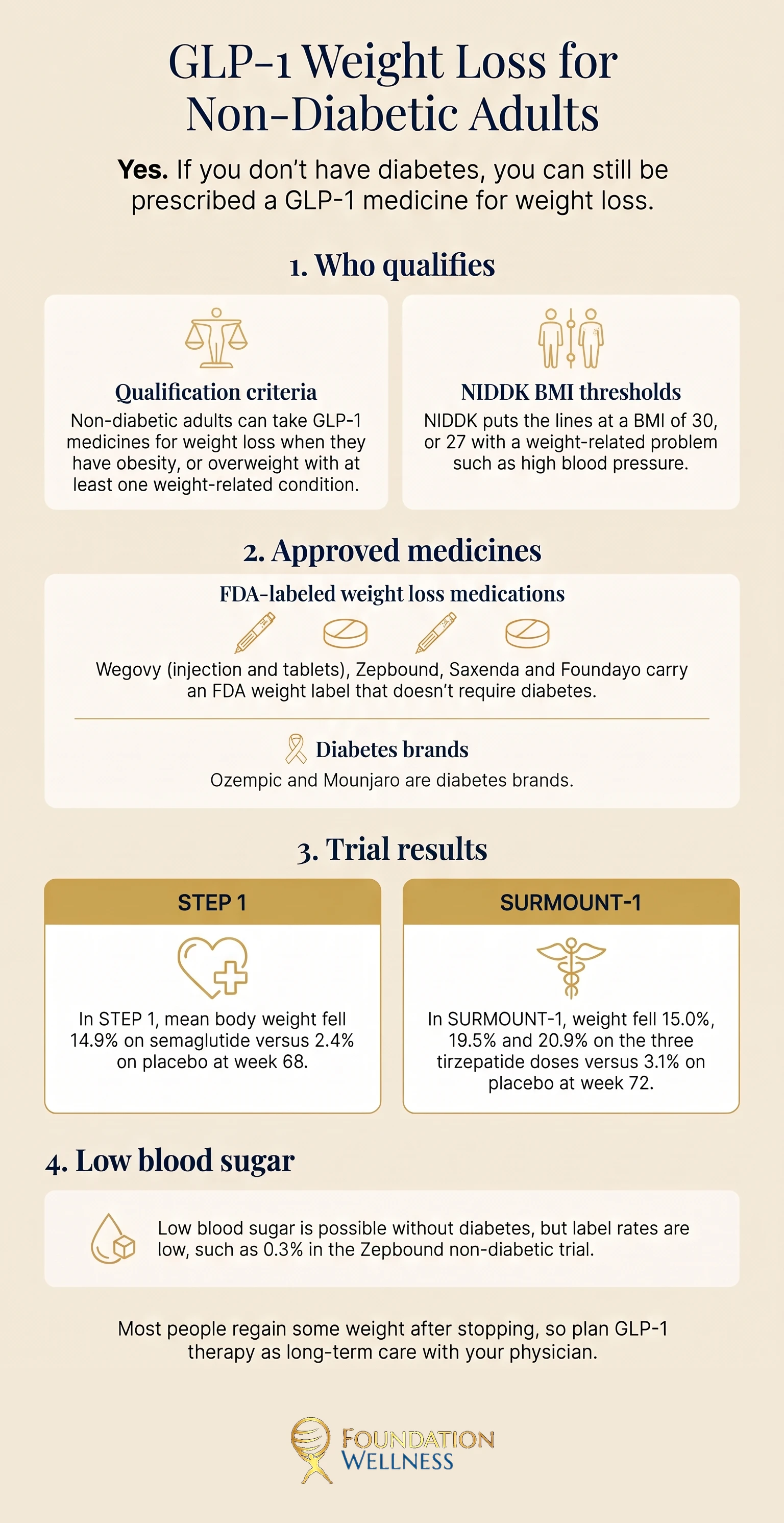
Yes. If you’re non-diabetic, you can still be prescribed a GLP-1 medicine for weight loss. The FDA approves these medicines for chronic weight management in adults with obesity, or overweight plus at least one weight-related condition, used with a reduced-calorie diet and more physical activity. Wegovy, Zepbound, Saxenda and the new Foundayo tablet all carry that label.
So where are the lines? NIDDK puts them at a BMI of 30 or higher, or 27 or higher with a weight-related problem such as high blood pressure.
A physician still has to check that a medication fits you, your history and your goals. That’s where we start at our American Fork clinic: our medical weight loss with GLP-1 medicines begins with that evaluation. Below, we cover which medicines are approved for non-diabetic adults, who qualifies, what the trials found, low blood sugar risk and what happens if you stop.
Can You Take GLP-1 Medications for Weight Loss If You Are Not Diabetic?
Yes. The weight indication on each label doesn’t require diabetes at all. Wegovy, Zepbound and Saxenda are each approved “to reduce excess body weight and maintain weight reduction long term.” That covers adults with obesity, or adults with overweight in the presence of at least one weight-related comorbid condition, together with a reduced-calorie diet and increased physical activity.
A 2026 review of the trials put it plainly. Two GLP-1 receptor agonists (semaglutide and liraglutide) and one dual agonist (tirzepatide) are FDA approved for weight loss in adults with obesity without type 2 diabetes (Lim 2026).
So GLP-1 medications aren’t only diabetes drugs. If you’ve mostly heard of them as Ozempic, that can come as a surprise. For non-diabetic adults, the approved use is chronic weight management. “Long term” is part of the label wording because obesity is treated as a chronic disease, not a short diet.
What Are GLP-1 Agonists and How Do They Work When Blood Sugar Is Normal?
GLP-1 receptor agonists mimic a hormone called GLP-1. NIDDK says semaglutide and tirzepatide target areas of the brain that regulate appetite and food intake. Tirzepatide also acts on a second hormone, GIP, so it’s called a dual agonist.
The labels describe the effects in plain terms. Each medicine decreases calorie intake, and the Wegovy and Zepbound labels say this is likely through appetite. Semaglutide and tirzepatide lower body weight with more fat loss than lean mass loss. So some muscle loss can come with the weight loss, which is one reason strength work matters (more on that below). All three labels say the medicine delays gastric emptying, so food leaves the stomach more slowly.
What about blood sugar levels? These medicines raise insulin secretion from the pancreas in a glucose-dependent way, which means the effect depends on how much sugar is in your blood. That’s part of why low blood sugar isn’t common in people without diabetes, which is a relief if you’ve worried about it. It can still happen, though (see below).
You also don’t need a diagnosis of diabetes or insulin resistance to use one for weight. The Zepbound label notes that tirzepatide increased insulin sensitivity in a study of people with type 2 diabetes, but that isn’t a requirement for the weight indication.
Which GLP-1 Medicines Are FDA Approved for Weight Loss Without Diabetes?
Four brands now carry a GLP-1 weight label for adults without diabetes, in five forms. Three are injections and two are daily tablets.
| Medicine | Active drug | Form | Weight label for adults without diabetes | Other approved use |
|---|---|---|---|---|
| Wegovy injection | Semaglutide (GLP-1 receptor agonist) | Weekly injection | Obesity, or overweight with a weight-related condition; also ages 12 and up with obesity | Lowers the risk of heart attack, stroke and heart death in adults with heart disease; MASH liver disease with fibrosis |
| Wegovy tablets | Semaglutide | Daily tablet | Obesity, or overweight with a weight-related condition | Lowers heart event risk in adults with heart disease |
| Zepbound | Tirzepatide (GIP and GLP-1 receptor agonist) | Weekly injection | Obesity, or overweight with a weight-related condition | Moderate to severe obstructive sleep apnea in adults with obesity |
| Saxenda | Liraglutide (GLP-1 receptor agonist) | Daily injection | Obesity, or overweight with a weight-related condition; also ages 12 and up over 60 kg with obesity | None |
| Foundayo | Orforglipron (GLP-1 receptor agonist) | Daily tablet | Obesity, or overweight with a weight-related condition | None |
Foundayo is the newest. The FDA approved Foundayo on April 1, 2026 for adults with obesity, or overweight with at least one weight-related comorbid condition. The FDA release notes that it doesn’t need to be taken on an empty stomach.
Choosing between these receptor agonists depends on your health, your other medicines and how you’d rather take it. Our guide to semaglutide vs tirzepatide compares the two most used ones.
Are Diabetes GLP-1 Drugs Like Ozempic Used Off Label?
Some GLP-1 drugs you’ve heard of are diabetes medicines. NIDDK explains that semaglutide is FDA approved under a different name and dosage to treat type 2 diabetes as Ozempic (injection) and Rybelsus (pill). Tirzepatide is approved for type 2 diabetes as Mounjaro. In those brands the goal is blood sugar control, not weight.
When a prescriber uses a medicine in a way the FDA hasn’t approved, such as a diabetes drug for weight, that’s called off-label use. NIDDK says you should feel comfortable asking whether a medication you’re offered is approved for treating overweight and obesity. For a non-diabetic adult, the medicines in the table above are the ones with that approval.
Compounded and other unapproved copies are a separate issue. The FDA says unapproved versions don’t go through its review for safety, effectiveness and quality before they’re sold. Our page on GLP-1 injections in Utah explains where compounding stands now.
Who Qualifies for GLP-1 Weight Loss Without Diabetes?

The current labels describe the group in words, “obesity” or “overweight with at least one weight-related comorbid condition”, and no longer print BMI numbers in that section. NIDDK and the trials give the numbers.
According to NIDDK, your provider may prescribe a weight management medication if you’re an adult with:
- a BMI of 30 or greater, or
- a BMI of 27 or greater and a weight-related health problem such as high blood pressure.
NIDDK defines a BMI from 25 to 30 as overweight and 30 or more as obesity. The big non-diabetic trials enrolled this same group. STEP 1 took 1,961 adults with a BMI of 30 or more (27 or more with a weight-related condition) who didn’t have diabetes. SURMOUNT-1 took 2,539 adults on the same BMI lines, excluding diabetes. SCALE took 3,731 adults without type 2 diabetes, with a BMI of 30 or more, or 27 or more with high blood pressure or abnormal blood fats.
But qualifying on body weight alone doesn’t mean a medication is right for you. NIDDK notes these medications aren’t for everyone with a high BMI. A personal or family history of a thyroid cancer called MTC or MEN 2 is one reason a physician won’t prescribe semaglutide or tirzepatide.
Do GLP-1 Medications Help Non-Diabetic Patients With Heart Disease or Sleep Apnea?
For some non-diabetic patients, yes. Two labels now include uses beyond weight.
Heart disease: the SELECT trial enrolled 17,604 adults aged 45 or older with existing heart disease, a BMI of 27 or more and no history of diabetes. Over a mean follow-up of 39.8 months, heart death, nonfatal heart attack or nonfatal stroke happened in 6.5% of people on semaglutide and 8.0% on placebo. The Wegovy label now includes lowering the risk of major heart events in adults with established cardiovascular disease and either obesity or overweight.
Sleep apnea: the Zepbound label includes treatment of moderate to severe obstructive sleep apnea in adults with obesity.
Weight loss itself helps too. NIDDK says losing weight can lower blood sugar, blood pressure and triglyceride levels, and can improve joint pain and sleep apnea.
Can GLP-1 Medications Cause Low Blood Sugar in People Without Diabetes?
Yes, it can happen, but the label numbers are low. Both the Wegovy and Zepbound labels say hypoglycemia has been reported in adults without type 2 diabetes. Here’s what the labels report:
- Zepbound: in Study 1 (adults without type 2 diabetes), a plasma glucose under 54 mg/dL was reported in 0.3% of people on Zepbound and none on placebo, per the Zepbound label.
- Wegovy: in a heart outcomes trial in adults without type 2 diabetes, 3 episodes of serious hypoglycemia were reported on Wegovy injection versus 1 on placebo. People with a history of bariatric surgery had more serious events (2.3% versus 0%).
- Saxenda: fasting glucose under 54 mg/dL at clinic visits occurred in 0.1% of people on Saxenda and 0.1% on placebo.
One catch. These trials didn’t systematically capture low blood sugar, so the numbers are a floor, not a full count. The risk is higher if you also take insulin or a sulfonylurea. The labels list signs such as dizziness, sweating, shakiness, confusion, a fast heartbeat, headache and hunger. If you notice them, tell your physician.
How Much Weight Do Non-Diabetic Adults Lose on GLP-1 Medicines?
In the large trials in adults without diabetes, every GLP-1 medicine beat placebo. Both groups in each trial also got a lifestyle intervention, meaning counseling on diet and activity.
| Trial | Medicine (trial arm) | Length | Average result | Placebo |
|---|---|---|---|---|
| STEP 1 | Semaglutide 2.4 mg | 68 weeks | -14.9% of body weight | -2.4% |
| SURMOUNT-1 | Tirzepatide 5, 10 or 15 mg | 72 weeks | -15.0%, -19.5% and -20.9% | -3.1% |
| SCALE | Liraglutide 3.0 mg | 56 weeks | -8.4 kg | -2.8 kg |
In STEP 1, mean body weight fell 14.9% on semaglutide versus 2.4% on placebo at week 68, and 86.4% of people on semaglutide lost at least 5%. In SURMOUNT-1, weight fell 15.0%, 19.5% and 20.9% on the three tirzepatide doses versus 3.1% on placebo at week 72. In SCALE, 63.2% of people on liraglutide lost at least 5% of their weight, compared with 27.1% on placebo.
Lim 2026 pooled 15 trials with 14,059 non-diabetic adults. The largest weight loss came with tirzepatide, followed by semaglutide 2.4 mg, then liraglutide 3 mg. NIDDK adds that most weight loss happens within the first 6 months.
These are averages, not a promise. Some people lose more, some less, and it’s hard to tell in advance which group you’ll be in. Not the neat answer anyone wants, we know. But it’s the honest one. For the details, see how much weight you can lose on GLP-1 medicines.
What Happens When You Stop Taking a GLP-1 for Weight Loss?
Most people regain some weight. In STEP 4, non-diabetic adults first took semaglutide for 20 weeks and lost an average of 10.6% of their baseline body weight. Then some kept taking it and some switched to placebo. From week 20 to week 68, the group that continued lost another 7.9%, while the group that switched to placebo regained 6.9%.
That’s frustrating to read after months of effort, and weight regain is the main reason this medication is usually kept up. Honestly, it’s also the most useful number here if you’re deciding whether to start.
NIDDK says you’ll probably regain some weight after you stop, and healthy eating and more physical activity may help you regain less. That fits the label wording, which approves these medicines to maintain weight reduction long term, so weight management with them is usually planned as long-term treatment.
How long treatment lasts depends on results and side effects. NIDDK says that if you’ve lost enough to improve your health and have no serious side effects, your provider may advise staying on it indefinitely. If you haven’t lost at least 5% of your starting weight after 12 weeks on the full dose, your provider will probably advise you to stop.
What Side Effects Should Non-Diabetic Patients Expect?

Most side effects of GLP-1 therapy affect the gut. In STEP 1, nausea and diarrhea were the most common, usually mild to moderate and easing with time. In SURMOUNT-1, most were mild to moderate and happened mainly while the dose was going up. That early stretch of treatment tends to be the hard part, and it can feel rough while it lasts. Some people do stop over it, though. In that trial, 4.3% to 7.1% of people on tirzepatide quit the medicine because of side effects, versus 2.6% on placebo. Lim 2026 found more adverse events than placebo with tirzepatide and semaglutide, but not with liraglutide.
The FDA lists nausea, constipation, diarrhea, vomiting, indigestion, stomach pain, headache, fatigue, burping, reflux, gas and hair loss among Foundayo’s side effects. Our guide to GLP-1 side effects covers what to expect with each medication and when to call.
Is It Possible to Lose Weight Without a GLP-1?
Yes. NIDDK says a healthy eating plan and regular physical activity may help you lose weight and keep it off, and medicines come in when these lifestyle changes aren’t enough. And medication supports healthy eating and activity. It doesn’t replace them.
The trials show both sides. Placebo groups that got lifestyle counseling lost 2.4% (STEP 1) to 3.1% (SURMOUNT-1) of their weight. The groups on medicine lost much more. Federal guidelines cited by NIDDK suggest at least 150 minutes of moderate activity a week and muscle strengthening on at least 2 days, whichever route you take. On a GLP-1, that strength work also helps you keep muscle mass while the scale goes down.
GLP-1 Weight Management at Foundation Wellness in American Fork
At Foundation Wellness, weight management starts with a full evaluation, either in person at our American Fork clinic or by telemedicine from elsewhere in Utah. We ask about your weight history, past treatments and current medications, and we check your lab work. When GLP-1 therapy fits the FDA label and your health, we prescribe and monitor treatment, with regular follow-up to track progress and manage side effects. Learn more about our weight optimization service.
Our clinic is at 456 E State Street, Suite 1400, American Fork, UT 84003, and we offer telemedicine visits across Utah. Foundation Wellness accepts many insurance plans. Coverage depends on your plan, so check with our office first. For what affects the total cost, see our guide to GLP-1 cost in Utah.
Not sure yet whether you qualify? That’s fine, it’s exactly what the first visit is for. Call (800) 983-1974 to book an evaluation in American Fork or by telemedicine.
Key Takeaways
- Non-diabetic adults can take GLP-1 medicines for weight loss when they have obesity, or overweight with at least one weight-related condition.
- Wegovy (injection and tablets), Zepbound, Saxenda and Foundayo carry an FDA weight label that doesn’t require diabetes; Ozempic and Mounjaro are diabetes brands.
- NIDDK puts the lines at a BMI of 30, or 27 with a weight-related problem such as high blood pressure.
- Low blood sugar is possible without diabetes, but label rates are low, such as 0.3% in the Zepbound non-diabetic trial.
- Most people regain some weight after stopping, so plan GLP-1 therapy as long-term care with your physician.
Sources
- DailyMed, WEGOVY (semaglutide) injection and tablets, prescribing information.
- DailyMed, ZEPBOUND (tirzepatide) injection, prescribing information.
- DailyMed, SAXENDA (liraglutide) injection, prescribing information.
- FDA, FDA Approves First New Molecular Entity Under National Priority Voucher Program.
- FDA, Foundayo (orforglipron) tablets, prescribing information.
- NIDDK, Prescription Medications to Treat Overweight & Obesity.
- FDA, FDA’s Concerns with Unapproved GLP-1 Drugs Used for Weight Loss.
- Lim M, et al. Weight Loss With GLP-1 Agonists in Nondiabetic Adults: Systematic Review and Network Meta-Analysis. Obesity, 2026.
- Wilding JPH, et al. Once-Weekly Semaglutide in Adults with Overweight or Obesity (STEP 1). N Engl J Med, 2021.
- Jastreboff AM, et al. Tirzepatide Once Weekly for the Treatment of Obesity (SURMOUNT-1). N Engl J Med, 2022.
- Pi-Sunyer X, et al. A Randomized, Controlled Trial of 3.0 mg of Liraglutide in Weight Management (SCALE). N Engl J Med, 2015.
- Rubino D, et al. Effect of Continued Weekly Subcutaneous Semaglutide vs Placebo on Weight Loss Maintenance (STEP 4). JAMA, 2021.
- Lincoff AM, et al. Semaglutide and Cardiovascular Outcomes in Obesity without Diabetes (SELECT). N Engl J Med, 2023.
November 7, 2026 · 13 min read