
Hormone Replacement Therapy in American Fork, Utah
July 18, 2026
By Dr. Paul Frandsen · July 18, 2026 · 7 min read

Hormone replacement therapy in American Fork brings your hormone levels back up when your body stops making enough. At Foundation Wellness, we use bioidentical hormones matched to your labs and your symptoms. Our physician-led clinic handles it all close to home. That means testing, a custom plan, and regular check-ins. No long drives across the valley.
Has your energy, sleep, mood, or body shape shifted for no clear reason? Hormones are worth ruling in or out. Here’s how it works in our American Fork practice, from your first lab draw to your ongoing follow-ups.
What Is Hormone Replacement Therapy?
Hormone replacement therapy brings low hormone levels back into a healthy range. When your own production drops, the gap shows up as real, daily symptoms. Think fatigue, brain fog, stubborn weight, low libido, poor sleep, and mood swings. That’s a hormone imbalance, and it’s something we can measure.
HRT replaces what’s missing. For many patients, that means bioidentical hormone replacement therapy. Those hormones match the ones you already make. The goal isn’t to overshoot. It’s to get you back to your own baseline. Want the deeper science on types, dosing, and delivery methods? Read our full guide to hormone replacement therapy in Utah. This page is about how it works in person.
What Does a First Hormone Consultation in American Fork Look Like?
Your first visit is a conversation, not a sales pitch. We sit down and go through how you feel. We ask when it started, your history, and what you want back. In our experience, that conversation surfaces details an intake form rarely catches, like sleep that broke two winters ago or a workout that stopped working.
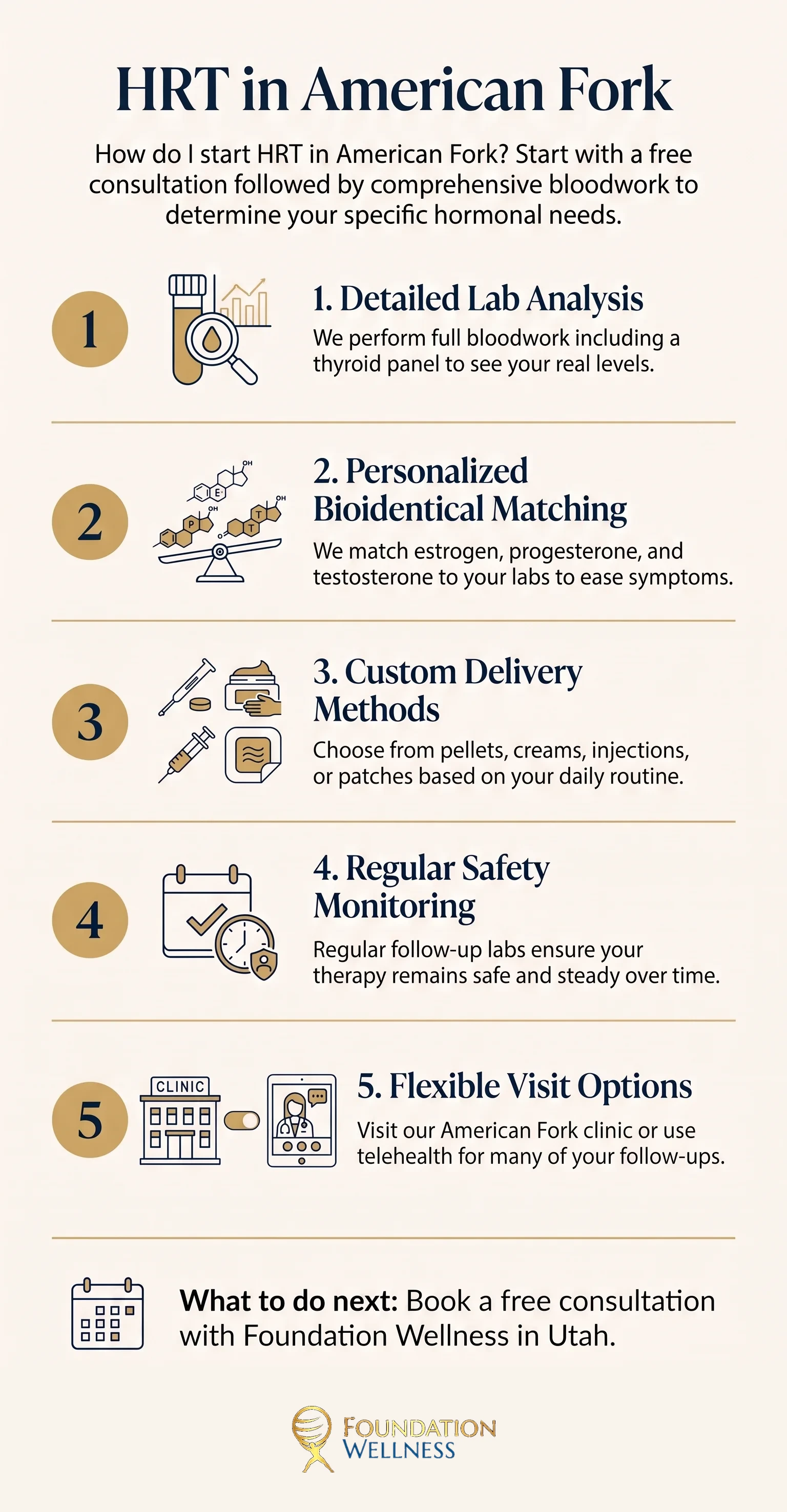
Then we test. That’s the part a lot of places skip. We won’t put anyone on hormones from a questionnaire. For menopause-related decline, we check estradiol, FSH, progesterone, and thyroid markers such as TSH. For low testosterone, we run total and free testosterone plus estradiol. Our team picks the panel that fits your picture rather than a fixed list. Your labs and your symptoms have to tell the same story first.
You’ll leave with a clear next step, not a same-day prescription. And your first consultation is free. There’s no pressure to commit.
Most of our patients have felt off for months, sometimes years, and honestly, most of them arrive frustrated. They’ve been told their labs are normal, or that this is just aging. Often it isn’t. Are you waking up tired? Gaining weight around the middle? Feeling flat? Those are worth a closer look. Bring any recent bloodwork, a symptom list, and your questions. The more we know, the better your plan.
What Labs Do You Need Before Starting HRT?

Good hormone therapy starts with good data. We run detailed bloodwork so we can see your real hormone levels instead of guessing. We start most patients with a full baseline panel instead of a single number, since one reading pulled on a rough morning can point the whole plan in the wrong direction.
For women, that usually means estradiol, progesterone, and testosterone. We add thyroid markers like TSH and DHEA to rule out other causes. For men, we look at total and free testosterone, estradiol, and safety markers such as red blood cell count. According to the Endocrine Society, this kind of baseline workup should come before any hormone treatment starts. We agree.
Getting labs done here in American Fork keeps it simple. You test locally. We review the numbers with you. Then we build your plan. No mailing kits back and forth. No waiting weeks for answers.
How Often Are Hormone Monitoring Visits?

Starting HRT isn’t a one-and-done thing. The follow-up is where results happen.
We check your labs at baseline first. Then we repeat them at about 6 to 8 weeks. Once your dose is dialed in, monitoring usually shifts to every 6 to 12 months. Each visit, we track your hormone levels, your symptoms, and your safety markers. We read every repeat panel against what we saw on your baseline, not against a generic range on the printout. That keeps your plan right for your body over time.
At our clinic, we typically bring new patients back within the first 2 months. Because we’re right here in Utah County, these visits are quick. It’s a lab draw and a check-in, not a half-day trip. One thing we learned from running follow-ups on site: people keep the appointments that fit inside a lunch break. In our experience, that local convenience is why people stick with treatment long enough to feel the full benefit. Our patients often tell us the short drive is what keeps them consistent. As one put it, “I finally feel like myself again after years of dragging.”
It also means we catch small issues early. Say your levels drift, or a side effect pops up. We can adjust before it turns into a problem. That steady, in-person follow-up is hard to get from a mail-order program. According to the Cleveland Clinic, ongoing monitoring is a core part of safe hormone therapy.
Your First Few Months on HRT: What to Expect
Here’s a rough map of how it unfolds at our clinic. Timing varies from person to person. This gives you the shape of it.
| Stage | What happens | Typical timing |
|---|---|---|
| First consultation | Symptom review, history, lab orders | Day 1 (free) |
| Lab review and plan | Go over your levels, start your custom plan | About 1 week later |
| First check-in | Repeat labs, dose adjustment, symptom check | 6 to 8 weeks in |
| Ongoing monitoring | Routine labs and fine-tuning | Every 6 to 12 months |
Delivery method matters too. Here’s how the common options compare.
| Method | How often | Good to know |
|---|---|---|
| Pellets | Every 3 to 4 months | Steady levels, small in-office insert |
| Patch | Twice a week | Easy, steady dosing through the skin |
| Cream or gel | Daily | Flexible, needs care around skin contact |
| Injection | Weekly or every 2 weeks | Precise dosing, you can do it at home |
Unlike daily creams, pellets last about 3 to 4 months per insert. Patches go on twice a week. Injections run weekly or every 2 weeks. We match the method to your labs and your routine, rather than forcing one plan on you.
Most people notice early changes in energy and sleep in about 2 to 6 weeks. Mood, focus, and body composition tend to improve over the next 3 months. Each person’s timeline is a bit different. One patient may sleep better by the second week while another needs a dose adjustment at the 8 week check before much shifts, and both are normal. We set honest expectations at your first visit rather than promising a date on the calendar.
HRT in American Fork and Nearby Utah County Towns
Our clinic sits at 456 E State Street, Suite 1400, in American Fork. We serve the surrounding towns every day, and most of our patients drive in from somewhere along this stretch of the Wasatch Front. If you’re in Lehi, Highland, Alpine, Pleasant Grove, Orem, or Provo, quality care is a short drive away.
Hormones are only one part of what we do. Many patients pair HRT with medical weight loss once their levels settle, since the two work together. We also offer peptide therapy and IV therapy. Those support recovery, energy, and metabolic health alongside your hormone plan. It’s a connected approach, not a menu of add-ons.
Women going through perimenopause and menopause can learn more about our women’s health and hormone program. Men exploring testosterone can start with our men’s health and TRT services.
Ready to find out if your symptoms are hormonal? Book your free consultation. We’ll get you tested, then build a plan that fits your life in Utah County. Call us at (800) 983-1974 to get started.
Key Takeaways
- Foundation Wellness offers physician-led HRT in American Fork, with labs, planning, and monitoring all done locally.
- We treat both men with low testosterone and women in perimenopause or menopause, using bioidentical hormones matched to your labs.
- Every plan starts with detailed bloodwork, because responsible hormone treatment tests before it treats.
- We recheck labs at about 6 to 8 weeks, then every 6 to 12 months once your dose is dialed in.
- In Utah, self-pay HRT often runs roughly $100 to $400 a month, and your first consultation is free.
Sources
- Endocrine Society - clinical guidance on hormone testing and treatment
- Cleveland Clinic - patient information on hormone replacement therapy and menopause
Dr. Paul Frandsen
July 18, 2026 · 7 min read