
Hormone Replacement Therapy in Pleasant Grove, Utah
July 20, 2026
By Dr. Paul Frandsen · July 20, 2026 · 11 min read

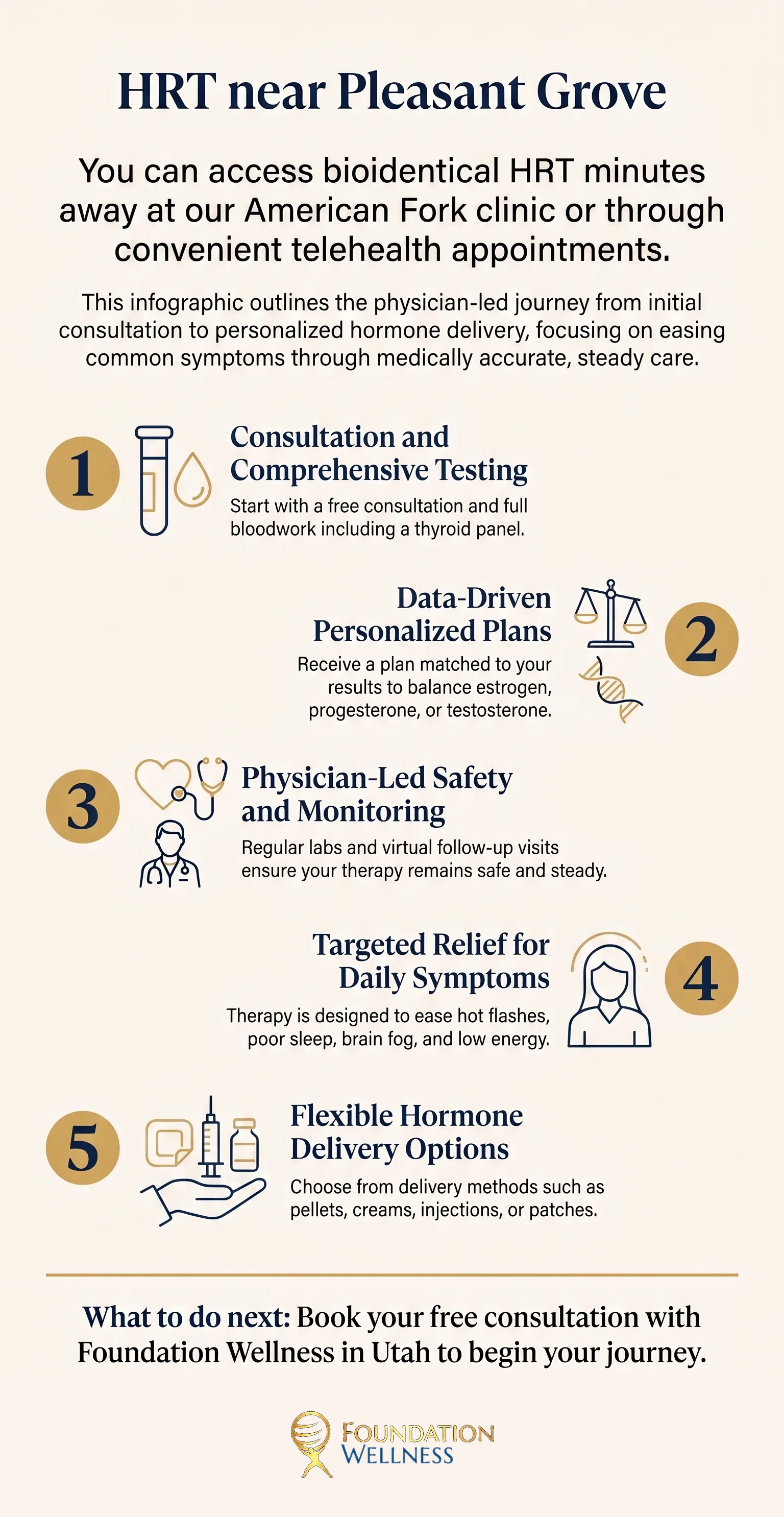
Live in Pleasant Grove, Utah and thinking about hormone replacement therapy? You can start close to home. Foundation Wellness runs a physician-led clinic in American Fork, UT, just minutes away. We test first, then build a care plan around your results. Telehealth follow-ups keep it easy to stay with.
What Is Hormone Replacement Therapy?
Hormone replacement therapy, or HRT, puts back hormones your body has stopped making in the right amounts. As you age, your levels shift. For women, estrogen and progesterone fall around perimenopause and menopause. For men, testosterone drifts down year after year. According to the Endocrine Society, these changes are a normal part of aging, not a personal failing.
That drop shows up in ways that are easy to brush off. Low energy. Poor sleep. Weight that won’t budge. Brain fog. A flat mood and low drive. Hormones touch almost everything, so when they slip, you feel it. Hormone health isn’t a side issue. It sits underneath energy, focus, and drive, which is why it’s more common than folks admit. We saw the same thing over and over, which is that people wait months before raising it and write the change off as ordinary aging.
HRT brings you back into a healthy range. At our American Fork clinic, we often use bioidentical hormones, which means hormones that match the ones your body already makes. The goal isn’t to make you superhuman. It’s to help you feel like yourself again.
We test before we treat. That means real lab numbers, rather than a guess from your symptoms. For the full clinical breakdown across the state, see our guide to hormone replacement therapy across Utah. This page is about getting started when you live in Pleasant Grove.
What Is Bioidentical Hormone Replacement Therapy?
Bioidentical hormone replacement therapy, usually shortened to BHRT, uses compounds built with the same molecular structure your body already produces. Your cells read them the way they read your own.
Synthetic versions are close, but not identical. Plenty of people do fine on them. Others don’t. The FDA has noted that compounded products are not reviewed the same way approved drugs are, so we stay careful about sourcing and dosing.
We don’t treat BHRT as a magic word. It’s one option among several, and it earns its place through testing and follow-up rather than marketing.
What Symptoms Point To A Hormonal Problem?
Hormone health rarely falls apart overnight. Hormonal imbalances build slowly, and they show up as small changes you learn to work around, until you notice how much ground you’ve given up.
For women, it often starts in the late thirties or forties. Nights get broken. Patience runs short. Anxiety arrives without a reason attached, and a flat mood can look a good deal like depression. Vaginal dryness and low libido turn intimacy into something you schedule or skip, which strains a marriage more than most couples admit.
For men, the same story arrives in different packaging. Muscle mass slides even though the training hasn’t changed. Recovery drags. Drive goes quiet at work and at home, and it usually gets blamed on stress or age.
Both groups describe a similar fog: less mental clarity, less patience, less interest in what used to be fun. Our team hears the same wording again and again, which is that they feel dulled rather than sick. These shifts don’t stay in one lane. They leak into daily life, into work, and into how you show up at home.
| What you notice | Common in women | Common in men |
|---|---|---|
| Low energy through the afternoon | Yes | Yes |
| Mental fog, poor focus | Yes | Yes |
| Anxiety or a flat, low mood | Yes | Yes |
| Low libido, less intimacy | Yes | Yes |
| Hot flashes, night sweats | Yes | Rare |
| Falling strength, softer build | Sometimes | Yes |
| Thinning bone density over years | Yes | Yes |
None of this proves a hormonal cause on its own. Thyroid trouble, low iron, and plain overwork can look identical from the outside. Our testing has turned up all three in Pleasant Grove residents who arrived certain of the cause. That’s why treatment starts after the labs, not before.
Where Can I Get Hormone Replacement Therapy Near Pleasant Grove?
Right next door. Foundation Wellness sits in American Fork, a short drive from anywhere in Pleasant Grove. For most people that’s less than 10 minutes, door to door. You don’t have to cross the valley or block out half a day. You can reach us on a lunch break.
We see women and men across Utah County, such as Pleasant Grove, Lehi, Highland, Alpine, Orem, and Provo. Being close matters more than folks expect. Our patients in Pleasant Grove tell us the drive is what decides whether they keep up with follow-ups. Hormone care isn’t one visit and done. You’ll come in for labs, come back for results, and check in over time as we fine-tune your plan. When the clinic is minutes away, none of that feels like a chore. That’s a big reason to weigh local access before you pick a provider.
What Should I Expect When Starting Hormone Therapy Locally?

Starting is simpler than most people think. Here’s how it usually goes.
First, we talk. Your first visit is a real conversation about what’s off. Maybe it’s the fatigue, the mood swings, the sleep that fell apart, or weight that keeps creeping up. We want the full story, rather than a rushed intake form.
We also walk through your health history. Past surgeries, family patterns, medications, and whatever you’ve already tried on your own. That health history shapes what’s safe for you and what we leave alone. Bring any lab information you already have, even if it’s a few years old, since it gives us a starting point to compare against.
Then we test. Our team draws bloodwork to see where things actually stand. We check named markers such as estradiol, testosterone, FSH, and TSH. We learned early on to test broadly the first time, because a single number rarely explains the whole picture. Real numbers lead to a real plan.
Once your labs are back, we build a care plan around your results, your symptoms, and your goals. Our team takes a functional medicine approach. We look at the whole picture, including your metabolism, stress, sleep, and thyroid, rather than one number on a page. A hormone imbalance rarely travels alone, so we treat the system.
Then we monitor. In our experience, a steady rhythm works best. We check labs at baseline, again at about 6 to 8 weeks, then every 6 to 12 months once you’re stable. According to the Cleveland Clinic, hormone therapy can ease symptoms like hot flashes, mood changes, and disrupted sleep. Most people notice early shifts in energy, sleep, and mood within 2 to 6 weeks. Fuller effects often show by about 3 months, though the timeline differs from patient to patient.
Monitoring is where local access pays off. You can swing in for a quick lab draw, then get back to your day. It’s honestly one less thing to stress about, and the relief of a plan that gets checked is real.
How the delivery methods compare
There’s no single right way to take hormones. Treatment options differ, and so do people, so we compared the common choices with real routines in mind:
| Method | How often | Trade-offs |
|---|---|---|
| Pellets | Placed under the skin every 3 to 4 months | Steady levels, small in-office procedure |
| Patch | Changed 1 to 2 times a week | Easy, though it can irritate the skin |
| Cream or gel | Applied daily | Simple, needs care to avoid transfer |
| Injection | Usually about every 7 days | Low cost, though you handle a needle |
Pellets suit folks who want to set it and forget it. A patch or cream suits those who’d rather adjust week to week. Unlike a daily cream, pellets keep dosing steady for months at a time. Injections work well for men on testosterone who don’t mind a quick shot, and they usually cost less compared to pellets. Your comfort with the routine counts here. One patient will happily do a weekly shot at the kitchen counter, while the next wants nothing to do with a needle. If needles are a hard no, we’ll say so and pick something else.
Cost is a fair question. In Utah, self-pay hormone therapy often runs roughly $100 to $400 a month, depending on the method and dose. Pellets tend to cost more up front but last longer. Injections, for example, are usually the least expensive. We give you real numbers before you commit, so there’s no surprise bill. That clarity is part of the plan.
Can I Do Hormone Therapy From Pleasant Grove Through Telehealth?

Yes, and it’s popular for good reason. A lot of follow-up can happen over video, which helps when your life is already full. You still get labs done at a local draw site. Then we go over everything together on a call. In-person visits are there when you need them, so you won’t come in for every small thing.
Here’s how the two options compare for Pleasant Grove patients:
| Part of your care | In clinic (American Fork) | Telehealth from home |
|---|---|---|
| First consultation | Face to face | Video visit |
| Bloodwork to check hormone levels | Drawn on site | Local lab draw, reviewed with you |
| Physical exam, when needed | Yes | Arranged locally |
| Building your treatment plan | Yes | Yes |
| Follow-up check-ins | Yes | Yes |
| Adjusting doses over time | Yes | Yes |
| Prescription refills | Yes | Yes |
Most Pleasant Grove women and men mix the two. That is the pattern we saw take hold once video visits became routine at our American Fork clinic. They come in for the first visit and labs, then handle a good share of follow-ups from their couch. You get the ease of telehealth, with a real clinic minutes away for anything hands-on. The comfort of doing a check-in from your kitchen table is worth more than it sounds.
What Are The Long Term Benefits Of Hormone Therapy?
Relief from symptoms is the reason most people call us. It isn’t the whole reason they stay.
Estrogen helps women protect bone density, and that protection fades after menopause. Bone loss stays quiet until a fracture makes it loud. For men, testosterone in a healthy range supports muscle mass and red blood cell production.
Sexual health belongs in this conversation too. Doctors skip it, people skip it, and it goes unaddressed while it quietly wears on a relationship. Restoring sexual health often does more for a couple than another round of advice about date nights.
Then there’s vitality, which is a soft word for something concrete. Getting through the afternoon without needing a nap. Wanting to train again. Having enough left at 7 p.m. to be present with your kids. That’s the daily life people are actually asking for.
We frame the plan around long term health, not a quick fix. That means rechecking labs, adjusting doses, and revisiting whether treatment still earns its place in your health picture. According to The Menopause Society, timing matters, and starting nearer to menopause generally carries a better risk profile than starting many years later. That’s what protecting long term health actually takes.
Hormone Replacement Therapy Pleasant Grove Residents Can Reach Today
You don’t need every answer before you reach out. That’s what the first visit is for.
If you’ve felt off and suspect your hormones, the first step is simple. Get tested, and talk to a physician-led team that reads the whole picture. Our team will tell you when hormone therapy is not the answer, which happens often enough to be worth mentioning. Foundation Wellness is right here in American Fork, an easy drive from Pleasant Grove. We offer a free consultation, so you can decide whether treatment fits your health goals before you commit. That local access is what makes care here genuinely convenient.
We care for both men and women. If you’re a woman working through perimenopause or menopause, our women’s health and hormone optimization service is built for this. Steady estrogen and progesterone can lift your mood, support bone and heart health, and bring back sleep and libido. According to Mayo Clinic, hormone therapy is one of the most studied treatments for menopause symptoms, though it isn’t right for every patient. Our services cover both sides of the house, from perimenopause to testosterone support for men.
Men in Pleasant Grove come to us too, often for the same reasons in a different package. The energy is gone. The drive is flat. Workouts don’t do what they used to, and the weight around the middle won’t quit. That’s frequently a hormone story. One patient told us he “felt like himself again” once his testosterone was back in range. It responds to the same careful, tested approach.
Book now for a free consultation, and we’ll take it from there.
Key Takeaways
- Hormone replacement therapy Pleasant Grove residents can begin close to home: our clinic sits in American Fork, minutes away and easy to keep up with.
- We test your hormone levels first, then build a plan around your real results.
- Named markers we check include estradiol, testosterone, FSH, and TSH.
- Hormonal imbalances often show up as fatigue, mental fog, and a drop in drive long before anyone names the cause.
- We usually recheck labs at baseline, at 6 to 8 weeks, then every 6 to 12 months.
- Delivery options range from pellets every 3 to 4 months to weekly injections, often $100 to $400 a month self-pay in Utah.
- Telehealth follow-ups let you handle much of your care from home, with in-person visits available when you need them.
- A free consultation is the simplest way to start.
Sources
Dr. Paul Frandsen
July 20, 2026 · 11 min read