
Hormone Replacement Therapy in Utah: BHRT Costs and Safety
July 16, 2026
By Dr. Paul Frandsen · July 16, 2026 · 10 min read

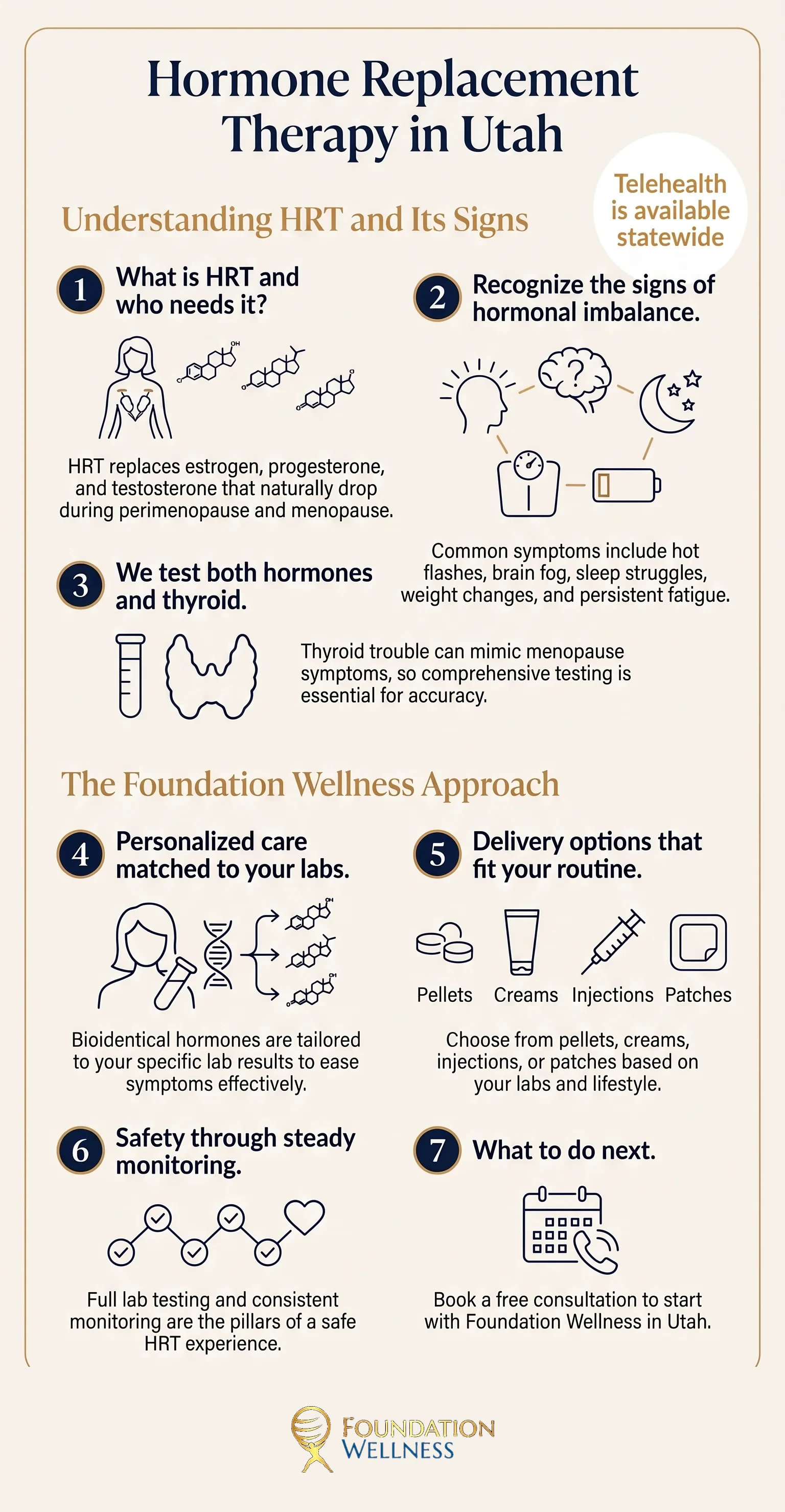
Hormone replacement therapy in Utah replaces the estrogen, progesterone, and testosterone your body stops making in perimenopause and menopause. At Foundation Wellness in American Fork, we match bioidentical hormones to your own lab results. That eases hot flashes, brain fog, and low energy. Telehealth covers the rest of the state.
Have you felt “off” for a couple of years? Have you kept hearing that your labs are normal? You’re not imagining it. Honestly, it’s one of the most frustrating things our patients describe. Let’s walk through what HRT is, who it helps, and how to start.
What Is Hormone Replacement Therapy (and BHRT)?
HRT replaces the hormones your body no longer makes in normal amounts. For women, that’s mostly estrogen and progesterone. Sometimes it’s a small dose of testosterone too. The goal is plain. We get your hormone levels back to a healthy range so you feel like you again.
You’ll hear several names for the same treatment. Menopausal hormone therapy is the term most medical guidelines use. Hormone treatment and hormone therapy mean the same thing in plain speech. HRT is just the short version.
Bioidentical hormone therapy is one type of HRT. The hormones match the ones your ovaries used to make. Your body reads them the same way. Older synthetic hormones are built from different molecules. They still work. They just don’t copy your own chemistry. That’s why we lean on the bioidentical route at Foundation Wellness.
Men know this care as testosterone replacement therapy, or TRT. Some people call the male version male menopause. The doses differ. The idea holds. We measure what’s low, replace it with care, and watch the labs. Low testosterone tends to show up as fatigue, low drive, and lost muscle. If your partner is looking at men’s TRT, think of women’s HRT as the companion piece.
What Are the Signs of Hormonal Imbalance in Women?

A hormone imbalance rarely shows up as one big symptom. Imbalanced hormones creep in. Most women notice several small changes that add up. Low estrogen, progesterone, or thyroid can look like:
- Hot flashes and night sweats.
- Sleep that used to be easy and now isn’t.
- Brain fog and trouble finding words.
- Weight that settles around the middle.
- Low libido and vaginal dryness.
- Mood swings, anxiety, or a low mood that doesn’t fit.
- Fatigue that rest doesn’t fix.
Here’s the tricky part. A standard yearly panel often misses this. It flags disease, not the slow slide of levels that read normal but still drag you down. Menopause symptoms and thyroid trouble overlap, so we test both. A thyroid functional imbalance can look just like early perimenopause. If the thyroid turns out to be the real problem, thyroid hormone replacement may be the better fix. In our experience, that overlap surprises more new patients than anything else. At our American Fork clinic, we run a full thyroid panel on nearly every new patient. Our patients in Utah County often ask whether one symptom is enough to justify testing. Usually it isn’t the loudest symptom that tells us the most. It’s the pattern, and how long it has been running.
Who Is a Good Candidate for Bioidentical Hormone Replacement Therapy?
You may be a good fit if you’re in perimenopause or menopause with symptoms that affect daily life. You may also qualify if you’re younger and labs confirm a real hormone deficiency. Menopause is diagnosed after 12 months with no period. According to the Cleveland Clinic, the average age in the US is about 51. Perimenopause can start years earlier, sometimes in your late 30s.
HRT isn’t right for every woman. Some histories need careful review first. That includes certain hormone-sensitive cancers and active blood clots. That’s what a proper evaluation is for. A responsible clinic tests and talks through your history before it prescribes.
Our team takes a functional medicine approach. Over the years we learned to ask about sleep and stress before we read a single number, because the same estradiol level can mean two different things in two different women. We read your hormone levels next to your sleep, stress, thyroid, and metabolism. Then we build a customized treatment plan around the whole picture. Good hormone specialists explain the trade-offs of each treatment before you commit to one.
Pellets, Creams, or Injections: Which Delivery Method Is Best?

There’s no single best way to take hormones. The right choice depends on your labs, your routine, and how your body responds. Here’s an honest comparison of the common options.
| Delivery method | How it works | Pros | Trade-offs | Typical cost in Utah |
|---|---|---|---|---|
| Pellets | Tiny pellets placed under the skin, replaced every 3 to 4 months | Steady levels, nothing to remember daily | Minor in-office procedure, dose is hard to adjust mid-cycle | $300 to $500 per insertion |
| Creams and gels | Applied to the skin daily | Easy to adjust, low upfront cost | Must apply consistently, can transfer to others | $75 to $150 per month |
| Injections | Self-administered shots, usually weekly | Precise dosing, cost-effective | Requires needles, levels can rise and fall between doses | $50 to $120 per month |
| Patches and pills | Worn or taken on a set schedule | Familiar, often FDA-approved options | Pills process through the liver, patches can irritate skin | $30 to $100 per month |
Costs above are general ranges to help you plan, not quotes. In Utah, self-pay HRT often runs roughly $100 to $400 a month. The exact figure depends on the method and your labs. Pellets cost more up front. You only redose every 3 to 4 months, though. Unlike creams, they hold levels steady with nothing to remember daily. Creams cost less to start, but you apply them every day. Injections sit in the middle on price. They also give precise dosing compared to patches. Some hormone medication comes as an FDA-approved pill or patch, which can matter for insurance. We walk you through the real numbers at your first visit.
In our American Fork practice, most women start on creams or injections rather than pellets. We compared notes across our own follow-up visits, and one pattern holds. Patients who begin with a daily cream usually reach a steady dose faster, because we can adjust it the same week the labs come back. Pellets trade that flexibility for consistency. Once they are placed, the dose holds for 3 to 4 months. For example, a woman who commutes from Lehi, Orem, or Pleasant Grove and dislikes a daily routine often does better with pellets, while someone still hunting for her right dose does better on a cream.
Is Hormone Replacement Therapy Safe?
For most healthy women who start within about 10 years of menopause, HRT is generally safe when it’s monitored. It’s one of the most reliable tools we have for hot flashes. It also helps protect bone density. According to the Mayo Clinic, the benefits tend to outweigh the risks for most healthy women under 60. Safety comes down to the right patient, the right dose, and steady checks.
One thing is worth knowing. The FDA has approved many HRT products. Compounded bioidentical hormones made at a pharmacy are not FDA-approved. They aren’t held to the same testing standards. That doesn’t make them unusable. Many women do well on them. It does mean you want a physician who prescribes and monitors them. A mail-order shortcut isn’t the same thing. Our protocols follow the clinical standards set by the Endocrine Society.
Growth hormone comes up a lot in hormone clinic ads. It sits outside standard HRT. The FDA has approved human growth hormone for diagnosed deficiency, not for anti-aging. So we keep it out of your hormone plan unless there’s a real medical reason.
What Do Labs and Monitoring Look Like?
Good HRT isn’t set-and-forget care. We start with full bloodwork. Here are the key hormones and markers we check:
- Estradiol and FSH, which map where you sit in the transition.
- Progesterone, which balances estrogen and helps with sleep.
- Testosterone and DHEA, for energy, muscle, and libido.
- TSH and a full thyroid panel, since thyroid trouble copies the same symptoms.
- Metabolic markers, including fasting glucose and lipids.
Then we build your plan around those numbers and your symptoms, not your age alone.
Here’s a typical monitoring rhythm. We draw labs at baseline. We check again around 6 to 8 weeks after you start. After that, we recheck every 6 to 12 months once you’re steady. According to the Endocrine Society, regular follow-up and dose review are part of responsible hormone care. At each visit we read estradiol, testosterone, and TSH, adjust the dose, and ask how you feel.
Our team at Foundation Wellness reviews your panel before you walk in, so the visit is spent on the plan rather than on reading numbers aloud. We use the same markers whether you draw with us in American Fork or at a Utah lab closer to home. We monitor hormone levels next to your symptoms, not instead of them. A result that looks fine on paper still counts as a problem if you feel terrible.
Hormone balance isn’t one number on a page. Your sleep, mood, and energy count too. Hormonal balance usually takes a few rounds of tuning. If the labs look fine and you still feel off, something needs adjusting. In our experience, the 6-week check is the turning point for most women.
How Soon Will You Feel a Difference?
Most women notice better sleep and steadier mood within the first 2 to 3 weeks. Hot flashes and night sweats often ease over the first 4 to 8 weeks. Changes in body composition, libido, and brain fog take longer. Think 2 to 3 months there. Your body needs time to settle. We use that early window to fine-tune your dose. One patient told us she finally slept through the night by week three.
In our experience across Utah County, sleep is the first thing our patients report back on, ahead of hot flashes. The question we hear most at that first follow-up is a short one: “How long before I feel like myself again?” The honest answer is that it comes back in pieces, not all at once.
Starting Hormone Replacement Therapy in American Fork
Foundation Wellness is based in American Fork and serves women across Utah County. That includes Pleasant Grove, Lehi, Highland, Alpine, and Orem. If you live farther out, the drive isn’t a barrier. Online hormone therapy handles most of what comes after your first blood draw. Online hormone replacement therapy still needs real labs, though, so plan on a local draw to start. Our patients along the Wasatch Front, and further out across Utah, often ask whether telehealth means lighter care. Some worry it does. It doesn’t. It does mean we hold you to the lab schedule, since we are reading numbers instead of watching you across the room.
Have you searched “hormone replacement therapy Utah” and found a dozen look-alike clinics? Ask each one two questions. Which labs do you run before prescribing? Who reads them with me? Hormone replacement therapy doctors should walk you through your own numbers, not hand you a protocol.
Starting is simple. Book a free consultation and get full testing. Then sit down with a physician who reads your results in context. You can learn more on our women’s health and hormone optimization page. If you’re local, our hormone replacement therapy in American Fork page covers what to expect at the clinic.
You deserve to feel like yourself again. That’s what we’re here for.
Key Takeaways
- HRT restores estrogen, progesterone, and sometimes testosterone that drop in perimenopause and menopause.
- Bioidentical hormone therapy uses hormones that match what your body makes, and it’s one form of HRT.
- Signs of imbalance include hot flashes, poor sleep, brain fog, weight gain, low libido, and fatigue.
- Thyroid problems copy menopause symptoms, so test both before you blame hormones alone.
- Pellets, creams, injections, and patches each have trade-offs. The right fit depends on your labs and lifestyle.
- Full lab testing and steady monitoring are what keep hormone treatment safe.
- Foundation Wellness serves American Fork and all of Utah, with telehealth statewide.
Sources
- Cleveland Clinic - Menopause: https://my.clevelandclinic.org/health/diseases/21841-menopause
- Mayo Clinic - Hormone therapy: Is it right for you?: https://www.mayoclinic.org/tests-procedures/hormone-therapy/about/pac-20384841
- U.S. Food and Drug Administration - Menopause: Medicines to Help You: https://www.fda.gov/consumers/free-publications-women/menopause-medicines-help-you
- Endocrine Society: https://www.endocrine.org
Dr. Paul Frandsen
July 16, 2026 · 10 min read