
How Long Does TRT Take to Work? A Realistic Timeline
July 26, 2026
By Dr. Paul Frandsen · July 26, 2026 · 10 min read

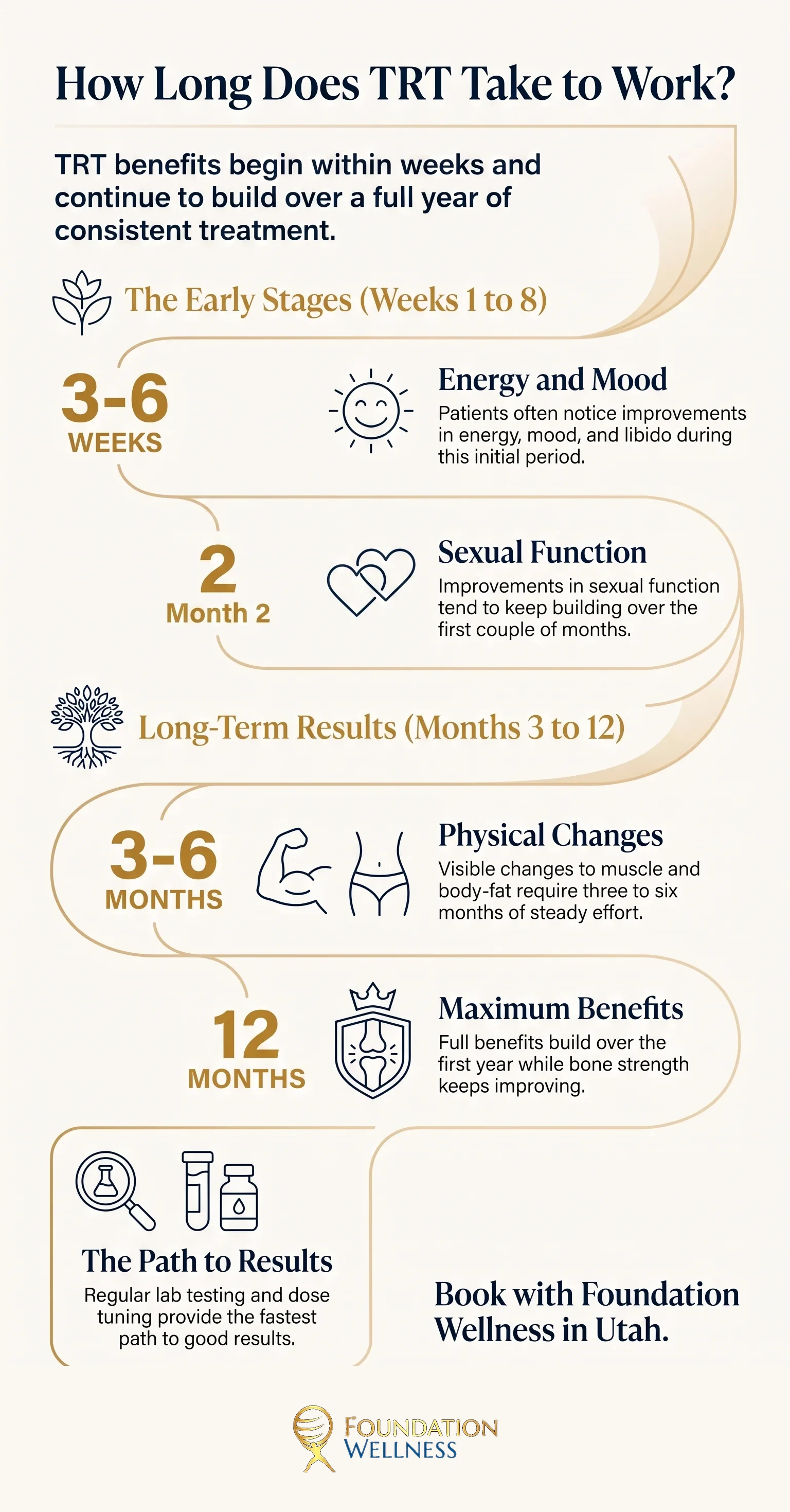
How long does TRT take to work? Sooner than most men expect, but not all at once. Sex drive, mood, and energy often lift in the first 3 to 6 weeks. Fat and muscle changes take 12 to 16 weeks. Here’s a realistic testosterone therapy timeline, stage by stage, built on published research and what we watch in clinic.
Does TRT Start Working Right Away?
Your testosterone levels rise within days of your first injection. How you feel takes longer to catch up. Treatment moves your numbers well before it moves your life. That gap is the single biggest reason men abandon testosterone replacement therapy before it has had a fair run. Our patients tend to ask the question in the same shape, wanting to know when they will feel like themselves again rather than when a lab value will move.
Think of it in layers. Blood levels move first, then symptoms lift, in an order researchers have actually mapped. According to a 2011 review in the European Journal of Endocrinology, the effects of testosterone replacement therapy follow a fairly predictable schedule. Sexual interest responds in about 3 weeks. Bone density keeps improving for at least 3 years.
So the honest answer has two halves. Part of testosterone therapy is fast. Part of it is a long game. Knowing which is which is what keeps men from quitting at week 4. Testosterone replacement therapy is one branch of hormone replacement therapy, and every branch runs on its own clock.
What Changes in the First 3 to 6 Weeks?

Early wins land here. Most men notice their energy level lift, their mood steady out, and the mental fog thin. Sleep often improves as well, which then makes everything else feel better. In our Utah practice, our patients typically bring up sleep and energy first, well before anything about the mirror.
Sex drive tends to move first among the sexual symptoms. That same review found sexual interest climbs after roughly 3 weeks and plateaus near 6 weeks, with little extra gain after that. Quality of life improves within 3 to 4 weeks. Depressive mood becomes measurably better at 3 to 6 weeks, and the full benefit builds out to 18 to 30 weeks.
What has not changed yet is your body. Physical changes lag well behind how you feel, and that mismatch is normal. Week 4 usually lands as a quiet relief rather than a transformation.
Feeling nothing by week 6 is information, not failure. Usually it means your dose, your delivery route, or your injection spacing needs a second look.
What Happens Between Weeks 6 and 12?
Now the early gains settle and the next layer opens. Erections and ejaculation often keep improving past this window, sometimes needing the full 6 months to reach their best. Increased libido tends to hold steady once it arrives.
This is also when your first real follow-up happens. Our team rechecks bloodwork around 6 to 8 weeks in, reading your testosterone level, estrogen, hematocrit, and related hormone levels. Testosterone levels should be sitting in a healthy range by now, even when your symptoms are still catching up. Then we fine-tune. Most of our patients need one or two dose adjustments before a plan is truly dialed in.
Fat and muscle are quietly shifting during these weeks too. The mirror simply hasn’t caught up yet.
When Do Muscle and Fat Changes Show Up?
Later than the internet promises. That 2011 review puts measurable changes in fat mass, lean muscle mass, and muscle strength at 12 to 16 weeks. Those gains stabilize between 6 and 12 months, then continue slowly for years afterward.
Increased muscle mass is real, then, but it’s a months-long story rather than a six-week one. Testosterone raises your ceiling. Training and protein still do the work of getting you there. Men who lift consistently see muscle growth on this schedule. Men who don’t mostly see the energy, mood, and body-fat side of the ledger.
In our experience, the men happiest at month 6 treated testosterone therapy as one piece of their overall health plan, not the entire plan. Sleep, protein, and resistance training move muscle mass alongside the hormone, not after it.
TRT Timeline at a Glance
Here’s the map. Your own pace shifts with your starting testosterone levels, your age, your training, and your sleep.
| Timeframe | What typically improves | What to expect |
|---|---|---|
| Days 1 to 14 | Blood testosterone levels | Labs move first, feelings usually don’t |
| Weeks 3 to 6 | Libido, mood, energy, focus | Sexual interest plateaus near week 6 |
| Weeks 3 to 12 | Quality of life, improved mood | Mood benefit peaks at 18 to 30 weeks |
| Weeks 12 to 16 | Fat mass, muscle, strength | First changes you can see and feel |
| Months 3 to 12 | Red blood cells, blood sugar control, lipids | Erythropoiesis peaks at 9 to 12 months |
| Months 6 to 12 | Body composition, stamina | Most benefits stabilize here |
| Year 1 and beyond | Bone density | Keeps improving for 3 years or more |
Timings above come from the European Journal of Endocrinology review of testosterone replacement therapy studies, not from marketing claims.
Does Your Delivery Method Change the Timeline?
Somewhat, though less than men expect. The delivery method changes how steady you feel between doses. It does not change the biological order in which benefits arrive.
- Weekly or twice-weekly TRT injection. Steady levels, simple to adjust, the most common choice in our clinic.
- Testosterone injections every two weeks. Bigger peaks and deeper dips, so some men slump before the next dose.
- Daily gels and creams. Very even hormone levels, though absorption varies and skin transfer to family is a genuine concern.
- Pellets. Convenient, but a dose that lands wrong means waiting months instead of days to correct it.
Gels and pellets hold testosterone levels steadier between doses. Weekly shots give up a little of that smoothness in exchange for easy, precise adjustment.
A man on an every-other-week testosterone injection may feel sharp on day 4 and flat on day 12. That isn’t testosterone replacement therapy failing him. That’s the schedule, and the schedule is fixable.
Why Does Monitoring Speed Things Up?

Because guessing is slow. The quickest route to good results is measuring, adjusting, then measuring again. According to the Endocrine Society clinical practice guideline, clinicians should track symptoms, side effects, adherence, serum testosterone, and hematocrit. The same guideline says prostate cancer risk should be evaluated during the first year of testosterone therapy.
In practice that means:
- Baseline labs before your first dose. We confirm a genuinely low testosterone level rather than assume one from symptoms alone. Testosterone levels swing through the day, so draw timing matters.
- A recheck at 6 to 8 weeks. This is where most dose corrections happen.
- PSA and prostate health screening in year one. The guideline puts this at 3 to 12 months after starting.
- Blood pressure at every visit. In February 2025 the FDA required a new blood pressure warning across all testosterone products.
Skipping labs doesn’t make low testosterone treatment faster. It makes it slower, because nobody knows what to change or when. Good treatment runs as a loop. Measure, adjust, then measure again.
Early on we learned to hand men their checkpoint dates at the first visit instead of waiting for them to ask. Knowing that week 12 is the physical checkpoint keeps week 5 from feeling like a failure.
Why Isn’t My TRT Working Yet?
Four explanations cover most cases. Feeling stuck is frustrating, so let’s be specific rather than vague.
- You’re early. Three weeks in and waiting on visible strength means waiting for something scheduled at week 12.
- The dose or frequency is off. Common, and the easiest thing to fix once labs come back.
- Testosterone deficiency wasn’t the whole story. Poor sleep, thyroid disease, depression, and heavy drinking produce nearly identical symptoms.
- Expectations outran biology. No hormone therapy repairs a diet, a schedule, and a training gap on its own.
Please don’t raise your own dose while you wait. Higher isn’t faster. It mostly raises your red blood cell count. That’s a poor trade for an improvement that was never dose-limited to begin with.
Every TRT patient runs a slightly different clock. One patient may notice the mood lift by week 3 while another on a similar dose waits until week 7, worried through the gap that nothing is happening. Men who search Low T at 3 a.m. and start therapy the same week often expect a switch to flip. Low T corrects on a curve instead, and the curve is worth respecting.
What Should You Watch While You Wait?
A few things, and none of them should scare you away from treatment. Testosterone replacement therapy can thicken your blood and raise PSA slightly during the first year.
On prostate cancer, the evidence is reassuring but not a free pass. Testosterone therapy is not thought to cause prostate cancer. It also isn’t given to men who already have it. That’s precisely why we screen before starting and keep monitoring afterward.
Hematocrit is the number we watch hardest, because testosterone replacement therapy can push red blood cell levels up over months. Mood swings, worsening sleep apnea, acne, and fluid retention are worth telling us about at your visits too. Most are dose-related and settle once your treatment plan is tuned. If you want the full picture, our guide to TRT side effects walks through what’s common and what’s rare.
How Do We Track Progress at Foundation Wellness?
We treat the timeline as a working document, not a promise. At each visit we compare your symptoms against your labs, because one without the other is guesswork. Our patients hear the same checkpoints at every visit, so nothing about the pace comes as a surprise. In clinic we saw the same order the published timeline describes, with mood and libido moving first and body composition arriving months later.
Men ask how long testosterone therapy takes to work more often than any other question in our American Fork clinic. The useful answer is a schedule with checkpoints. Week 6 for mood and libido. Week 12 for the first physical changes. Month 6 for body composition, and year one for bone. Each effect keeps its own appointment.
You can learn how the therapy works on our TRT in Utah guide. Our men’s health and TRT services page walks through the full program. We serve American Fork, Pleasant Grove, Provo, and the rest of Utah, in person and by telehealth.
Key Takeaways
- Sexual interest and mood usually improve at 3 to 6 weeks, and quality of life at 3 to 4 weeks.
- Erections and ejaculation can take up to 6 months, so early sexual gains aren’t the whole picture.
- Fat mass, lean muscle mass, and muscle strength change at 12 to 16 weeks and stabilize by month 12.
- Bone density improves from about 6 months and keeps building for 3 years or more.
- Your delivery route changes how steady you feel between doses, not the order of the benefits.
- Testosterone replacement therapy works best alongside sleep, protein, and resistance training.
- Regular labs, plus prostate health and cardiovascular checks, are the fastest path to real TRT results.
- Testosterone therapy is a treatment you monitor, not a switch you flip and forget.
- Baseline labs, a 6 to 8 week recheck, and first-year screening keep treatment on schedule.
- Foundation Wellness serves American Fork and all of Utah, in person and by telehealth.
Sources
- Saad F, Aversa A, Isidori AM, et al. Onset of effects of testosterone treatment and time span until maximum effects are achieved. European Journal of Endocrinology, 2011 - academic.oup.com/ejendo
- Bhasin S, Brito JP, Cunningham GR, et al. Testosterone Therapy in Men With Hypogonadism: An Endocrine Society Clinical Practice Guideline. Journal of Clinical Endocrinology and Metabolism, 2018 - endocrine.org
- U.S. Food and Drug Administration, class-wide labeling changes for testosterone products, February 2025 - fda.gov
- Cleveland Clinic, Low Testosterone (Male Hypogonadism) - my.clevelandclinic.org
Dr. Paul Frandsen
July 26, 2026 · 10 min read