
How Much Weight Can You Lose on GLP-1 Medications, by Drug
July 31, 2026
By Dr. Paul Frandsen · July 31, 2026 · 12 min read

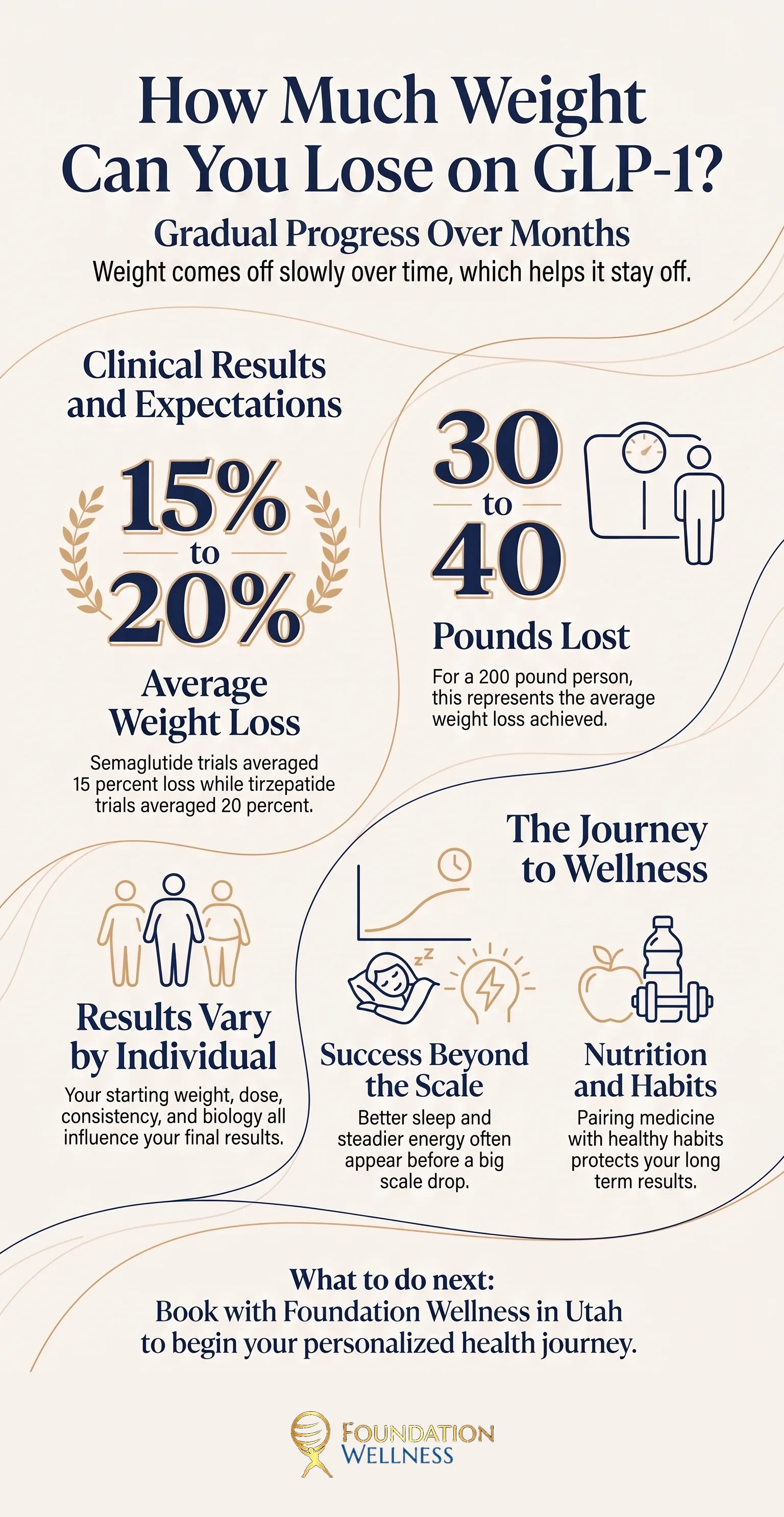
How much weight you lose on a GLP-1 depends heavily on which drug you take. FDA trials put semaglutide 2.4 mg at 14.9 percent of body weight, tirzepatide 15 mg at 20.9 percent, and liraglutide 3 mg at 7.4 percent. Those are averages across long trials. Your dose, your starting weight, and your habits move the number in both directions.
Which GLP-1 Medications Are Approved for Weight Loss?
Only three, which surprises patients who have heard a dozen brand names. The rest of the class is approved for type 2 diabetes, and several of those contain the same molecule at a lower dose. So how much weight can you lose on GLP-1 medications depends first on which of the three you are actually prescribed.
| Brand | Active drug | Approved for | Average body weight change |
|---|---|---|---|
| Zepbound | Tirzepatide 15 mg weekly | Long-term weight loss | Down 20.9 percent at 72 weeks |
| Wegovy | Semaglutide 2.4 mg weekly | Long-term weight loss | Down 14.9 percent at 68 weeks |
| Saxenda | Liraglutide 3 mg daily | Long-term weight loss | Down 7.4 percent at 56 weeks |
| Ozempic | Semaglutide, up to 2 mg weekly | Type 2 diabetes | No weight-loss label |
| Mounjaro | Tirzepatide, up to 15 mg weekly | Type 2 diabetes | No weight-loss label |
| Trulicity | Dulaglutide, up to 4.5 mg weekly | Type 2 diabetes | No weight-loss label |
Placebo arms are the missing context. Semaglutide’s comparison group lost 2.4 percent, tirzepatide’s lost 3.1 percent, and liraglutide’s lost 3 percent. Every one of those groups received the same diet and activity coaching as the treated group.
So the drug effect is the gap, not the whole number. Each label reports that gap directly: 12.4 points for semaglutide 2.4 mg, 17.8 for tirzepatide 15 mg, and 4.5 for liraglutide 3 mg.
Which GLP-1 Works Best for Weight Loss?
One trial answered this directly, which is rare. SURMOUNT-5 randomized 751 adults with obesity and no diabetes to the maximum tolerated dose of either drug for 72 weeks.
| Trial | Drugs compared | Result at 72 weeks |
|---|---|---|
| SURMOUNT-5 (head to head) | Tirzepatide 10 or 15 mg | Down 20.2 percent |
| SURMOUNT-5 (head to head) | Semaglutide 1.7 or 2.4 mg | Down 13.7 percent |
The published results in the New England Journal of Medicine put waist circumference at 18.4 cm down on tirzepatide against 13.0 cm on semaglutide. Tirzepatide won on both measures.
Two caveats keep this honest. The trial was open label, so everyone knew which drug they were taking. And it was funded by the manufacturer of the winning drug, which is normal for phase 3 work but worth saying out loud.
Cost, insurance coverage, supply, and how your stomach handles each one still decide the real choice. We walk through that on our semaglutide vs tirzepatide page.

What Do the Trial Numbers Look Like in Pounds?
Percentages hide how different two results feel. Here is each drug’s trial average translated into pounds by starting body weight.
| Starting weight | Liraglutide, 7.4 percent | Semaglutide, 14.9 percent | Tirzepatide, 20.9 percent |
|---|---|---|---|
| 180 lb | 13 lb | 27 lb | 38 lb |
| 200 lb | 15 lb | 30 lb | 42 lb |
| 250 lb | 19 lb | 37 lb | 52 lb |
| 300 lb | 22 lb | 45 lb | 63 lb |
Notice where the health benefit starts. According to the National Institute of Diabetes and Digestive and Kidney Diseases, losing 5 to 10 percent of your initial body weight already improves blood pressure, blood sugar, and cholesterol.
That threshold sits below every column in the table. Significant weight loss in the clinical sense begins lower than most patients expect, and liraglutide clears it comfortably.
Does Type 2 Diabetes Change the Result?
Yes, and by a consistent margin across the class. Adults with type 2 diabetes lost 9.6 percent on semaglutide 2.4 mg against 14.9 percent without diabetes. On liraglutide the split was 5.4 percent against 7.4 percent.
The reasons aren’t fully settled. Insulin and older diabetes medication push weight up on their own. High blood sugar spills calories into urine, so correcting glucose can quietly reclaim calories the body was throwing away. Years of diabetes may also change how fat tissue responds.
Patients with diabetes still get real value here. A1c usually falls alongside the scale, and plenty of our patients end up cutting other diabetes medication as blood sugar steadies.
How Fast Does the Weight Come Off?
Slowly, and the ladder is why. Every drug in this class starts below its therapeutic dose and climbs, which blunts the gastrointestinal side effects that make people quit in month one.
| Medication | Starting dose | Step interval | Time to maintenance |
|---|---|---|---|
| Semaglutide injection | 0.25 mg weekly | 4 weeks | About 17 weeks |
| Tirzepatide | 2.5 mg weekly | 4 weeks | 5 to 21 weeks by target dose |
| Liraglutide | 0.6 mg daily | 1 week | About 5 weeks |
| Semaglutide tablet | 1.5 mg daily | 30 days | About 13 weeks |
Liraglutide reaches full dose fastest and delivers the least. Tirzepatide takes the longest climb to 15 mg and delivers the most. There’s no shortcut hiding in that table.
Honestly, weeks one through four are where we lose people. Appetite drops, food noise quiets, the scale sits still, and patients decide the injection isn’t working. It’s working. The scale is just the last thing to catch up.
Our patients feel the appetite change before the scale reflects it, and that gap makes people nervous. We name it at the ramp visit now, because a quiet appetite in week two is the medication doing its job.
Which Patients Respond Best to Which Drug?
Averages flatten an enormous range. In the semaglutide trial, 47.9 percent of patients cleared a 15 percent loss while others finished in single digits. A few things explain the spread.
- Your starting weight. A heavier starting point usually means more pounds at the same percentage.
- The dose you actually hold. Reaching and staying at a maintenance dose is where the bulk of loss happens.
- Structured coaching. Semaglutide patients given intensive lifestyle therapy averaged 16.0 percent rather than 14.9 percent.
- Protein and resistance training. Muscle protects your metabolic health while weight comes off.
- Sleep and stress. Short sleep pushes appetite hormones the wrong way.
- Other prescriptions. Some medication for mood, blood sugar, or blood pressure nudges weight upward.
- Type 2 diabetes. It lowers the average, as the numbers above show.
One patient of ours held at 1.7 mg of semaglutide for eight months and finished near the trial average. Another needed a full switch to tirzepatide before much moved at all. Neither did anything wrong.
Does the Weight Come Off as Fat or as Muscle?
Both, and the split is the part patients never get told. Rapid weight loss on any GLP-1 medication takes muscle mass along with fat, the same way it does after bariatric surgery or during a hard diet. The drug does not choose for you. What you eat and how you train while the scale moves is what decides the ratio.
That is why our team treats protein and resistance training as part of the prescription rather than a nice extra. Muscle loss is the quiet cost of fast weight loss, and it is the one thing you cannot get back on the way down. Two sessions of something heavy each week, plus enough protein to actually rebuild, protects the tissue that keeps your metabolism and your insulin resistance heading the right way.
Total body weight is also a blunt instrument for judging progress. A patient who drops eight pounds of fat and gains two of muscle sees six pounds on the scale and assumes the drug stalled. We measure body weight against waist, strength, and blood sugar levels instead, because those tell you whether the weight loss outcomes are the kind worth keeping.
Sustainable weight loss follows the same logic. The lifestyle changes that protect muscle during treatment are the same healthy habits that hold your result afterward, which is why we start them at the first dose rather than at the end.
How Much Weight Comes Back After Each Drug?
Regain is the honest risk, and both drugs measured it directly. The pattern repeats across the class.
| Withdrawal trial | Group that continued | Group switched to placebo |
|---|---|---|
| STEP 4 (semaglutide), week 20 to 68 | Lost 7.9 percent more | Gained 6.9 percent back |
| SURMOUNT-4 (tirzepatide), week 36 to 88 | Lost 5.5 percent more | Gained 14.0 percent back |
In SURMOUNT-4, published in JAMA in 2024, 670 adults had already lost 20.9 percent during a 36 week lead-in. Of those who stayed on tirzepatide, 89.5 percent held at least 80 percent of that loss. Among the placebo group, 16.6 percent did.
Longer follow-up looks similar. A year after stopping semaglutide, STEP 1 participants had regained roughly two thirds of what they lost, and their blood pressure and cholesterol drifted back toward baseline.
Thankfully, that’s biology rather than failure. Appetite returns when the drug leaves. Obesity behaves like a chronic condition, which is why every label in this class reads chronic weight management instead of a twelve week course.

Do Compounded or Oral Versions Change the Math?
They change what you can predict. Trial averages were measured on the branded injections at verified concentrations, and a compounded vial isn’t the same product.
Compounded semaglutide skips FDA review for safety, quality, and effectiveness. According to the FDA safety page on semaglutide medications, many of the adverse event reports it has received involve dosing errors from patients or clinicians measuring out of multi-dose vials. The agency has also flagged salt forms such as semaglutide sodium, which it says are different active ingredients.
None of that makes a compounded medication wrong for every patient. It does mean you’re borrowing an expectation from a trial that tested something else.
Oral versions are a separate question. The semaglutide tablet sold as Rybelsus is approved for type 2 diabetes rather than weight management, while a higher dose tablet reaching 25 mg daily carries the Wegovy name. Approvals and stock keep shifting, so ask what’s actually available the week you start.
How Do You Protect the Result Long Term?
This is the part that decides where you land three years from now, and most of it isn’t the drug.
- Protein at every meal. It protects muscle while calorie intake drops.
- Strength training twice a week. Muscle is what holds your metabolic rate steady through a long weight loss journey.
- Physical activity you’ll repeat. Walking counts. The plan that works is the one still happening in March.
- Regular labs. We track A1c, lipids, thyroid, and kidney markers rather than guessing.
- A maintenance plan built early. Some patients stay on a lower dose long term. Others taper with a written food and activity plan.
We learned to put the maintenance conversation in the first visit rather than in month nine. A taper you planned for is a different experience from one you improvise after the scale stops moving.
According to the NIDDK, weight management medication works alongside changes in eating and physical activity, not instead of them. No medication does the job alone.
What This Looks Like at Foundation Wellness
We start with labs, not a prescription pad. Your first visit at our American Fork clinic covers blood sugar, thyroid, hormones, and an honest account of what you’ve already tried.
If a GLP-1 fits, we choose the drug together and map the dose ladder against your budget and your stomach. Side effects drive that choice more often than people expect, so read our GLP-1 side effects breakdown before your consult.
The question we hear most at that first visit is some version of “how much of this will I actually keep?” We answer with the ranges above and with your own labs, not with a promise.
Our patients check in monthly, because the difference between an 8 percent and a 15 percent result usually comes down to who caught the plateau early. The NIDDK puts it plainly on its treatment page for overweight and obesity: stick with your eating plan and stay physically active while taking a weight-loss medicine. That pairing is how we run the program.
For the semaglutide numbers dose by dose, read how much weight you can lose on semaglutide. You can see how the program runs on our GLP-1 weight loss in Utah page, real pricing sits on the GLP-1 cost in Utah page, and the wider plan lives on our medical weight optimization page. We serve American Fork, Provo, Lehi, and the rest of Utah, in clinic and by telehealth.
This article is general education rather than medical advice. These are prescription medications with real risks, so plan your weight loss journey with a clinician who has seen your labs.
Key Takeaways
- FDA trial averages differ sharply by drug: 20.9 percent on tirzepatide 15 mg, 14.9 percent on semaglutide 2.4 mg, and 7.4 percent on liraglutide 3 mg.
- Placebo arms lost 2.4 to 3.1 percent with the same coaching, so the drug effect is the gap rather than the headline.
- SURMOUNT-5, the only head to head trial, put tirzepatide at 20.2 percent against semaglutide at 13.7 percent over 72 weeks.
- Only Wegovy, Zepbound, and Saxenda are FDA approved for chronic weight management.
- Type 2 diabetes lowers the average on every drug in the class, from 14.9 to 9.6 percent on semaglutide.
- Stopping brings regain: 14.0 percent back over 52 weeks off tirzepatide, and about two thirds of the loss a year after stopping semaglutide.
- Structured lifestyle coaching added roughly a percentage point in the semaglutide trials.
- Foundation Wellness serves American Fork and all of Utah, in clinic and by telehealth.
Sources
- U.S. Food and Drug Administration, Wegovy (semaglutide) prescribing information, sections 2 and 14 - dailymed.nlm.nih.gov.
- U.S. Food and Drug Administration, Zepbound (tirzepatide) prescribing information, sections 2 and 14 - dailymed.nlm.nih.gov.
- U.S. Food and Drug Administration, Saxenda (liraglutide) prescribing information, sections 2 and 14 - dailymed.nlm.nih.gov.
- Aronne and colleagues, “Tirzepatide as Compared with Semaglutide for the Treatment of Obesity,” New England Journal of Medicine, 2025 (SURMOUNT-5) - pubmed.ncbi.nlm.nih.gov.
- Aronne and colleagues, “Continued Treatment With Tirzepatide for Maintenance of Weight Reduction in Adults With Obesity,” JAMA, 2024 (SURMOUNT-4) - pubmed.ncbi.nlm.nih.gov.
- Wilding and colleagues, STEP 1 trial extension, Diabetes, Obesity and Metabolism, 2022 - pmc.ncbi.nlm.nih.gov.
- U.S. Food and Drug Administration, medications containing semaglutide marketed for type 2 diabetes or weight loss - fda.gov.
- National Institute of Diabetes and Digestive and Kidney Diseases, prescription medications to treat overweight and obesity, and treatment for overweight and obesity - niddk.nih.gov.
Dr. Paul Frandsen
July 31, 2026 · 12 min read