
HRT and Breast Cancer Risk: What the Real Numbers Show
September 22, 2026
By Dr. Paul Frandsen, MD · September 22, 2026 · 8 min read
Medically reviewed by Dr. Paul Frandsen, MD

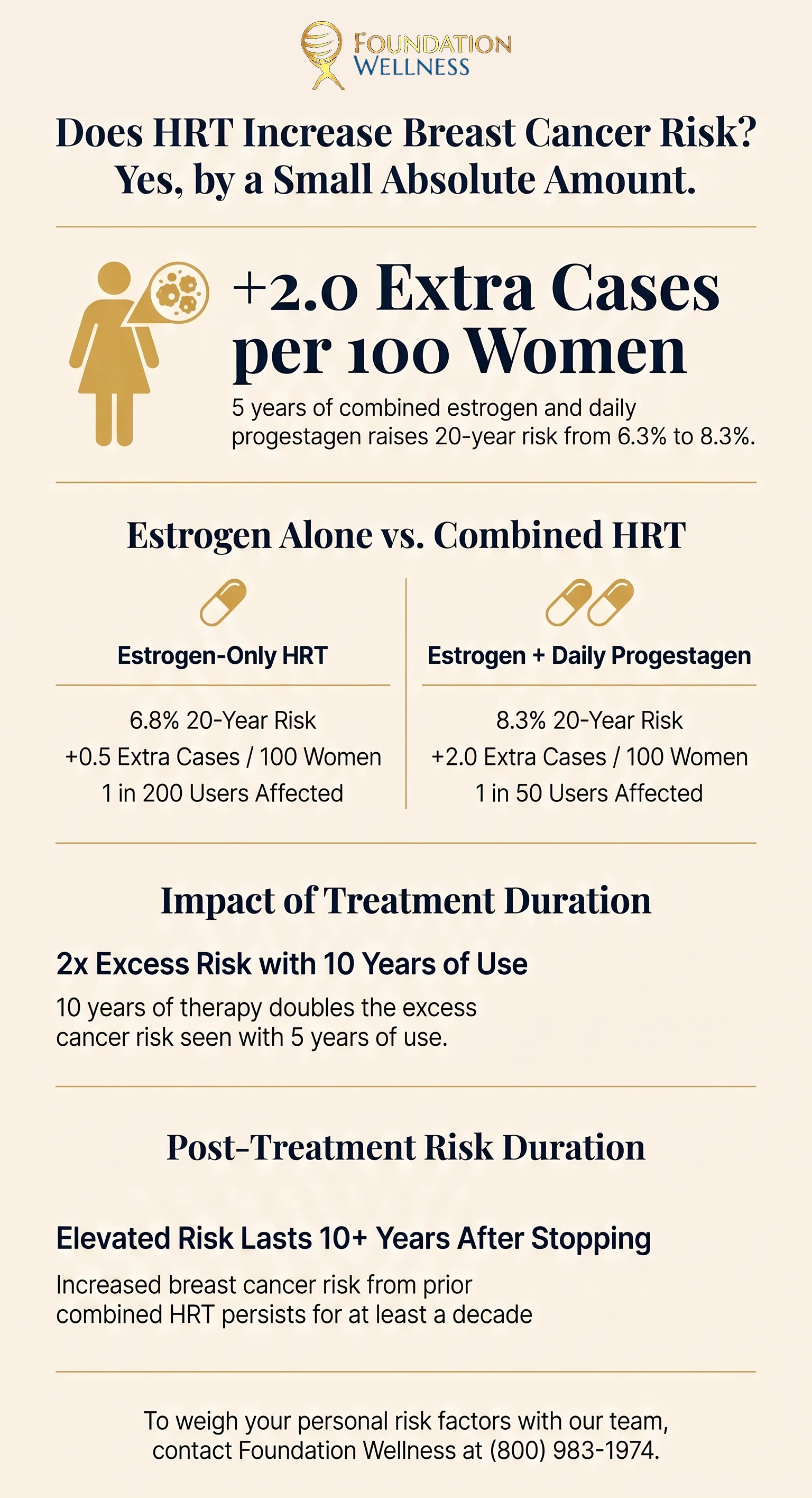
Combined estrogen plus progestogen HRT raises breast cancer risk by a small amount that grows with years of use. In one large analysis, 5 years of use from age 50 would raise the 20-year risk from 6.3% to 8.3%. Estrogen alone raised it less, and in the WHI trial it lowered it.
What Does HRT Breast Cancer Risk Really Mean?
HRT breast cancer risk is the change in your chance of developing breast cancer while you take hormone replacement therapy, or after you stop. Headlines about it can be scary, and they rarely give you the whole picture. Studies report risk in two ways, and the difference matters.
Relative risk compares two groups. A hazard ratio of 1.28 means the rate of new cases was roughly 28% higher in the treated group than in the placebo group. Absolute risk tells you how many extra women are affected, such as 2 extra cases per 100 users. A big-sounding relative number can be a small absolute one, and headlines tend to lead with the relative one. So on this page, every relative figure sits next to an absolute one.
If you want help weighing your own risk, our women’s health and hormone care team can look at your history and labs with you.
Does HRT Increase Breast Cancer Risk?
The short answer: for combined therapy, yes, by a small absolute amount. The Women’s Health Initiative (WHI) tested estrogen plus progestin against placebo in postmenopausal women. Its 2002 report found 8 more invasive breast cancers per 10,000 person-years, with a hazard ratio of 1.26 (1.00-1.59), over an average 5.2-year follow-up.
The long-term report followed 27,347 women, with a mean age of 63.4, for more than 20 years. Among women with a uterus taking estrogen plus progestin, there were 584 breast cancer cases (annualized rate, 0.45%) vs 447 cases on placebo (annualized rate, 0.36%; HR, 1.28). The trial report itself describes this as “statistically significantly higher breast cancer incidence.”
So taking HRT that combines estrogen with a progestin carries an increased risk of invasive breast cancer. That increased breast cancer risk is real. But it’s small in absolute terms. Estrogen alone tells a different story, covered below.
What Is the Absolute Risk of Breast Cancer From HRT?

The clearest absolute numbers come from a 2019 Lancet meta-analysis of observational studies. It modeled 5 years of menopausal hormone therapy starting at age 50, then looked at the 20-year breast cancer risk from ages 50 to 69.
| HRT type, 5 years from age 50 | 20-year breast cancer risk, ages 50-69 | Extra cases | About 1 extra case in |
|---|---|---|---|
| No HRT | 6.3% | None | Not reported |
| Estrogen only | 6.8% | 0.5 per 100 women | 200 users |
| Estrogen plus intermittent progestagen | 7.7% | 1.4 per 100 women | 70 users |
| Estrogen plus daily progestagen | 8.3% | 2.0 per 100 women | 50 users |
Duration changes the picture. For 10 years of use, the same analysis found the 20-year increases would be about twice as great as for 5 years.
Is that low risk? It depends on how you weigh it. For most users the extra cancer risk is a few cases per 100, not zero. That’s a relief for some women and still too much for others, and both reactions are fair. In practice, that call also rests on your other risk factors (like family history and age) and on why you want treatment in the first place.
Is Estrogen-Only HRT Safer for the Breast Than Combined HRT?
For the breast, the evidence leans that way. In the WHI long-term report, women with a prior hysterectomy who took estrogen alone had 238 cases (annualized rate, 0.30%) vs 296 on placebo (annualized rate, 0.37%; HR, 0.78). The National Cancer Institute lists “lower risk of breast cancer with systemic estrogen” alone as a benefit.
There’s a catch. Estrogen alone is for women without a uterus. If you still have one, ACOG says you’ll need a progestin. It helps reduce the risk of uterine cancer that can occur when estrogen is used alone. Skipping the progestogen trades one cancer risk for another, endometrial cancer. And the breast isn’t the only organ to think about. The National Cancer Institute also lists an increased risk of death from lung cancer with estrogen plus progestin.
Breast tissue also responds. The National Cancer Institute notes increased breast density with estrogen plus progestin, which makes mammograms harder to read. So keep up your screening.
Is micronized progesterone therapy kinder to the breast than synthetic progestin therapy? These sources don’t show that. Our guide to bioidentical and synthetic HRT covers that debate.
Does Breast Cancer Risk Go Down After You Stop Taking HRT?
Not right away. The National Cancer Institute lists an increased risk of breast cancer with prior use of estrogen plus progestin “for at least a decade after use is discontinued”. The risk from HRT treatment doesn’t vanish the day you stop.
Length of treatment is one of the risk factors you can plan around. The Lancet work, from the Collaborative Group on Hormonal Factors in Breast Cancer, found that 10 years of use carries about twice the excess of 5 years. Cancer research on exactly how fast risk falls after stopping is still going. So we won’t promise a timeline.
Does Vaginal Estrogen Raise Breast Cancer Risk?
Vaginal estrogen works differently from pills or patches. ACOG explains that women who only have vaginal dryness may use local estrogen, which releases small doses of estrogen directly into the vaginal tissue.
For these genitourinary menopausal symptoms, the Menopause Society’s 2022 position statement recommends low-dose vaginal estrogen therapy or other therapies. The sources we used give no breast cancer figure for vaginal estrogen, so we won’t invent one. If you need symptom relief and worry about your breasts, ask your clinician about local options.
Can You Take HRT After a Breast Cancer Diagnosis?
This is a decision for your breast cancer treatment team, not a general article. ACOG says women with a history of hormone-sensitive breast cancer should try nonhormonal therapies first to treat menopause symptoms.
After a breast cancer diagnosis, fear of breast cancer recurrence is part of every hormone conversation. That caution can feel frustrating when hot flashes keep you up at night. Still, your oncology team knows your tumor type and treatment history. Bring them into any decision about hormones, and ask which nonhormonal treatment options could help with hot flashes and sleep.
What Did the FDA Change About Hormone Therapy Warnings in 2025?
On November 10, 2025, the FDA announced it is working with companies “to remove references to risks of cardiovascular disease, breast cancer, and probable dementia” from hormone replacement therapy labeling. It isn’t seeking to remove the boxed warning for endometrial cancer for systemic estrogen-alone products. Its labeled advice is to start systemic HRT within 10 years of menopause onset or before 60 years of age.
The part people miss: a label change doesn’t change the study numbers above. Those stay as the trials and analyses reported them.
Now, timing matters to the Menopause Society too. Its 2022 statement says that for women younger than 60, or within 10 years of menopause onset, with no contraindications, “the benefit-risk ratio is favorable” for bothersome hot flashes and prevention of bone loss. It adds that risks differ by type, dose, duration, route, timing and whether a progestogen is used.
One more point. The label change covers approved products. It doesn’t show that bioidentical hormones carry a lower breast cancer risk.
How We Weigh HRT Breast Cancer Risk at Foundation Wellness

Our Women’s Health & Hormone Optimization service uses comprehensive lab work, bioidentical hormone therapy, and ongoing monitoring. We start with detailed bloodwork, a thorough medical history and an honest conversation about your symptoms and your reasons for treatment. Then we talk through the numbers on this page openly. If hormone therapy isn’t a good fit, we say so. If it is, our team keeps checking in with follow-up labs after you start.
We see patients at 456 E State Street, Suite 1400, American Fork, UT 84003, and by telemedicine across Utah. We’re accepting new patients. Foundation Wellness accepts many insurance plans. Coverage depends on your plan, so check with our office first.
For more background, read about hormone replacement therapy in Utah or the difference between perimenopause and menopause. To book, call (800) 983-1974.
Key Takeaways
- Combined estrogen plus progestogen HRT raises breast cancer risk by a small absolute amount.
- Five years from age 50 would raise the 20-year risk from 6.3% to 8.3% with daily progestagen, and to 6.8% with estrogen only.
- Longer use means a larger excess, and the increased risk from combined use lasts at least a decade after stopping.
- Estrogen alone lowered breast cancer incidence in the WHI trial but is only for women without a uterus.
- The 2025 FDA label change doesn’t change the study numbers. Decide with a clinician.
Sources
- The Lancet (PMC), Type and timing of menopausal hormone therapy and breast cancer risk (2019).
- JAMA (PMC), Association of Menopausal Hormone Therapy With Breast Cancer Incidence and Mortality During Long-term Follow-up of the WHI Randomized Clinical Trials (2020).
- National Cancer Institute, Menopausal Hormone Therapy and Cancer.
- U.S. Food and Drug Administration, HHS Advances Women’s Health, Removes Misleading FDA Warnings on Hormone Replacement Therapy (2025).
- American College of Obstetricians and Gynecologists, Hormone Therapy for Menopause.
- JAMA (PubMed), Risks and benefits of estrogen plus progestin in healthy postmenopausal women: principal results from the WHI randomized controlled trial (2002).
- Menopause (PubMed), The 2022 hormone therapy position statement of The North American Menopause Society.
September 22, 2026 · 8 min read