
How Much Does HRT Cost in Utah? Pellets vs Cream vs More
August 7, 2026
By Dr. Paul Frandsen · August 7, 2026 · 11 min read

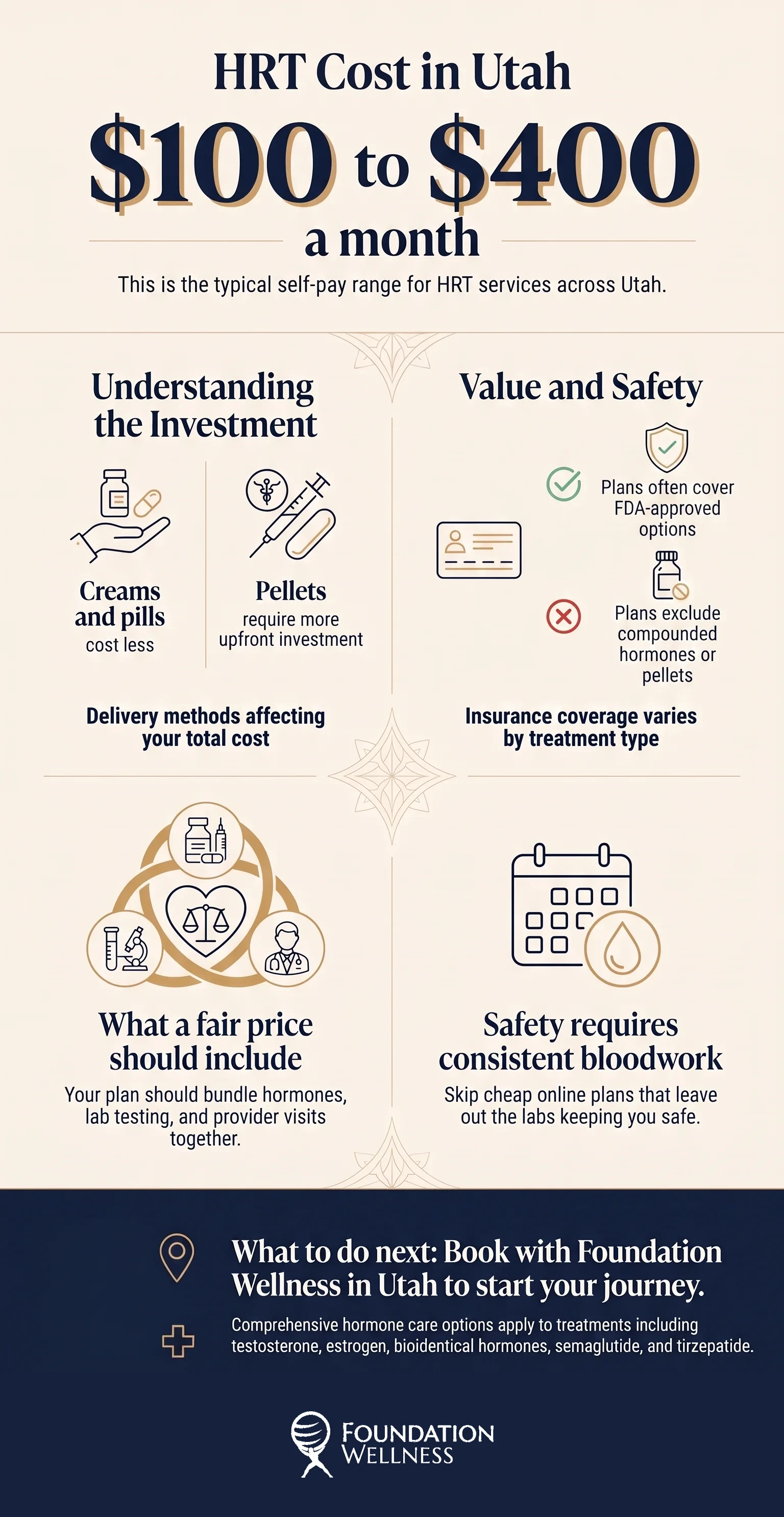
HRT in Utah usually costs roughly $100 to $400 a month for self-pay, depending on the method. Generic pills and patches sit at the low end, injections in the middle, and pellets cost more up front. Insurance covers some FDA-approved options and rarely covers compounded ones. Here’s a clear breakdown of HRT cost, what your medication and labs run, and what should be included.
What Does HRT Cost in Utah?
Let’s start with the range. Self-pay hormone replacement therapy in Utah often runs about $100 to $400 a month. The exact number depends on the method you choose, the medication you need, and how often your labs get drawn. Your insurance plan can shift that range a long way in either direction. Our patients in American Fork usually ask about price before they ask anything clinical, and that is a fair place to start.
Method is the biggest driver of price. Generic pills and patches tend to cost the least, sometimes under $30 a month. Injections sit in the middle. Pellets run $300 to $500 at each visit, though you redose only 3 or 4 times a year. So the cheapest sticker price is not always the cheapest across 12 months.
Two people can walk out of the same clinic with very different HRT costs. One patient needs estrogen only. Another needs estrogen plus progesterone, which adds a second prescription. Your medical history, your lab results, and your goals all shape the final number.
There is no single average cost that fits everybody, which is why one quoted hormone replacement therapy cost can mislead you. Treat the range as a starting point, then price your own treatment.
For example, estradiol tablets plus 2 lab panels a year is a very different bill from compounded pellet insertions 4 times a year. Same clinic, same care, different treatment plan. We compared those 2 paths on paper with enough Utah patients to know the yearly totals rarely match the monthly impression.
That is why we quote an itemized price at your initial consultation, before you commit to anything. Our patients get that quote in writing.
HRT Cost by Method

Here’s an honest comparison of hormone replacement therapy prices by method. These are general self-pay ranges seen around Utah, not quotes, and your own price may land outside them.
| Method | Typical self-pay cost | How often | Insurance coverage | Notes |
|---|---|---|---|---|
| Oral pills (generic estradiol) | $15 to $60 a month | Daily | Often covered | Lowest price at a retail pharmacy |
| Estradiol patch | $25 to $100 a month | Twice weekly | Often covered | Steady levels, skips the stomach |
| Creams and gels | $75 to $150 a month | Daily | Sometimes covered | Compounded versions rarely covered |
| Injections | $50 to $120 a month | Usually weekly | Sometimes covered | Precise dosing, needs needles |
| Pellets | $300 to $500 per insertion | Every 3 to 4 months | Rarely covered | Higher up front, fewer doses |
| Progesterone, when added | $15 to $50 a month | Daily or cyclic | Often covered | Needed if you still have a uterus |
| Lab panel | $75 to $250 per draw | 2 to 4 times a year | Often partly covered | Not optional, not an extra |
Read that table by the year, rather than by the visit. A pellet looks expensive next to a pill, yet you pay 4 times instead of 12. Creams cost less to start, then you buy them again each month. Spread everything across 12 months and the totals land closer together than they first appear.
What Drives Your HRT Costs Up or Down?
Five things move your hormone replacement therapy bill more than anything else.
- Brand versus generic. Generic estradiol from a local pharmacy is the cheapest way to take systemic HRT. A brand-name version of the same hormone can cost several times more.
- FDA-approved versus compounded. A compounding pharmacy mixes custom products to order, such as creams and troches. There’s no generic to fall back on, so you pay the full medication cost yourself.
- How many hormones you need. Estrogen alone costs less than estrogen paired with progesterone. Adding progesterone is a safety step rather than an upsell, if you still have a uterus.
- How much monitoring you need. Early on, bloodwork runs more often while we dial in your dose. Once your dose settles, testing spreads out and your monthly cost drops.
- Whether insurance is involved at all. Self-pay pricing and insurance pricing follow different rules, so the same medication can carry two very different numbers.
Age and symptoms matter too, mostly through those levers. A patient starting therapy in the middle of rough perimenopause symptoms usually needs closer follow-up for the first 6 months. That means more office visits and more labs, so the cost runs higher early and then settles. In our experience, that first stretch is where a budget gets strained, so we walk our patients through the likely 6-month picture before they fill a single prescription.
Does Insurance Cover HRT?
Sometimes, and the details matter more than the headline. Many FDA-approved hormone replacement therapy products are covered under the prescription drug side of an insurance plan. Compounded bioidentical hormones and pellet insertions often are not. Lab work is usually covered in part when there’s a documented medical reason.
According to the US Food and Drug Administration, approved hormone therapy products go through FDA review for safety, quality, and labeling, whereas compounded bioidentical products carry no FDA approval. That one fact explains most insurance coverage decisions you’ll meet. Your insurance company pays for what sits on its formulary, and compounded items usually don’t.
Here’s how insurance coverage tends to break down item by item.
| What you’re paying for | Typical insurance coverage | What to ask your insurance company |
|---|---|---|
| Generic tablets or capsules | Usually covered, lowest copay tier | What’s my copay on the formulary? |
| Brand-name patch | Often covered after prior authorization | Do you require prior authorization? |
| Compounded creams | Rarely covered | Will you reimburse a compounding pharmacy receipt? |
| Pellet insertion | Rarely covered | Is the procedure code payable at all? |
| Lab panel | Often covered with a diagnosis code | Which lab is in network for me? |
| Office visits | Usually covered as a specialist visit | What’s my copay and deductible? |
None of that is a promise from any insurer. It’s a map of where to aim your questions.
Medicare works differently. Prescription coverage runs through Part D, and according to Medicare.gov each Part D plan sets its own drug list and its own costs. Two neighbors on Medicare can pay very different amounts for the same hormone replacement therapy.
Call the number on your insurance card before your first visit. Ask about 3 things specifically: your prescription benefit, your lab benefit, and your specialist copay. The answers are rarely the same.
Bring what you hear to your visit. Our team goes through those answers with you in our American Fork office and matches them against the plan we are considering, so you are not guessing at the pharmacy counter.
Can You Use an HSA or FSA to Pay for HRT?

Usually yes, and this is the easiest money most patients leave on the table. Prescription HRT medication is generally a qualified medical expense, so a health savings account or a flexible spending account can pay for it. Your lab work and your hormone therapy copays typically qualify as well.
Paying from a health savings account means spending pre-tax dollars instead of post-tax ones. Your sticker price doesn’t change, but what the therapy actually costs you does. A flexible spending account works the same way, with one catch. That money is use it or lose it inside the plan year, so size your contribution around 12 months of treatment.
These accounts work alongside insurance, not in place of it. You can run a prescription through your plan and then pay the leftover copay from the account.
Our patients often forget the account covers lab work and visit copays too, not only the prescription itself. Those are the pieces people tend to budget for last.
Two housekeeping notes. Keep every receipt, including the pharmacy printout. And check with your plan administrator before you assume a compounded product qualifies, because rules differ between administrators.
What Do the Medications Themselves Cost?
Medication cost is the one piece you can genuinely shop, so it’s worth understanding.
Estradiol tablets are inexpensive at almost any retail pharmacy in Utah, often $15 to $60 a month. Generic oral progesterone sits in the same neighborhood. If your prescription is for a common generic, the cash price is sometimes lower than your insurance copay. Ask the pharmacy for both numbers. It takes 30 seconds and it occasionally saves real money.
The patch usually costs a bit more than tablets, and brand-only versions cost more again. Plenty of patients still prefer it, specifically because it delivers a steady dose twice a week.
Compounded hormone replacement therapy sits in a different world. Your compounding pharmacy makes it to order, so there’s no generic and no formulary price to compare against. That’s where HRT costs climb fastest, and it’s the main reason 2 clinics can quote numbers that look nothing alike.
Pellets have their own math. You pay for the pellet and the insertion procedure together, which is why the figure looks large beside a monthly prescription. Divide $300 to $500 across 3 or 4 months before you judge it.
Route matters as much as price. According to the National Institute on Aging, systemic hormone therapy comes in several forms, such as pills, patches, gels, and sprays, and the form you choose changes both your cost and how the medication reaches you.
What Should Be Included in the Price?
A fair HRT treatment plan bundles the things you actually need. Watch for these three.
- Your medication. The hormone itself, in whichever form you and your provider choose.
- Lab testing. Regular bloodwork to check your hormone levels and keep the dose safe.
- Provider visits. Real time with a healthcare provider to read your labs and adjust.
Lab testing is the piece budget clinics love to trim. Don’t let them. According to the North American Menopause Society (NAMS), hormone replacement therapy should be individualized, with the dose, the route, and the reason for continuing reviewed over time. Testing is not an add-on. It’s part of safe treatment.
In our experience, labs are the surprising line on a bill, not the hormone. Our team reads every panel before we touch your dose.
Follow-up matters for the same reason. If your dose is wrong, you need a healthcare provider who can change it this week, instead of a portal message answered next month. Ask how quickly you can reach someone when something feels off.
How Do You Avoid Hidden HRT Fees?
Patients ask some version of “what will I actually pay every month?” before anything else, and it deserves an answer you can read line by line. Whether you drive over from Lehi or Pleasant Grove or meet us by telehealth, that answer should be the same short list of items. Ask 6 questions before you pay for anything.
- Are labs included in the price, or billed as an additional cost?
- Do follow-up visits cost extra?
- What happens to my price if my dose or treatment option changes?
- Is this medication available as a generic at my local pharmacy?
- Do you bill my insurance, or is this self-pay only?
- Will you put an itemized quote in writing?
Clear answers are a good sign. Vague answers, or a single bundled number nobody will break down, are a reason to keep shopping.
Be careful with very cheap online hormone replacement therapy too. If a plan skips regular bloodwork, that isn’t a bargain, it’s a corner cut. Hormones need monitoring so the dose stays right and problems get caught early. A low monthly price means little when no one is checking your hormone levels or your symptoms.
Want the clinical picture rather than the price list? See how the therapy works in our hormone replacement therapy in Utah guide. Compare formulations in our bioidentical vs synthetic HRT explainer. The full program lives on our women’s health and hormone services page. Our clinic sits in American Fork, and we see people from Lehi, Pleasant Grove, Orem, and Provo, plus the rest of Utah by telehealth. Every patient gets pricing in writing before anything is scheduled.
Key Takeaways
- Self-pay hormone replacement therapy in Utah often runs roughly $100 to $400 a month, driven mostly by method.
- Generic tablets are the lowest-cost route, while compounded creams and pellets cost the most.
- Insurance coverage usually follows FDA approval, so compounded products and in-office insertions are rarely repaid.
- An HSA or FSA lets you pay for treatment with pre-tax dollars.
- A fair price bundles your medication, lab testing, and provider visits into one treatment plan.
- Skip any cheap online hormone therapy plan that leaves out the bloodwork keeping you safe.
- Foundation Wellness serves American Fork and all of Utah, with itemized pricing up front.
Sources
- US Food and Drug Administration (FDA). Compounded bioidentical hormone products, fda.gov.
- North American Menopause Society (NAMS). Hormone therapy position statement, menopause.org.
- Medicare.gov. How Medicare drug coverage works under Part D, medicare.gov.
- National Institute on Aging (NIH). Hormones and menopause, nia.nih.gov.
Dr. Paul Frandsen
August 7, 2026 · 11 min read