
Infrared Sauna Utah Guide: What the Heat Really Does
September 25, 2026
By Dr. Paul Frandsen, MD · September 25, 2026 · 6 min read
Medically reviewed by Dr. Paul Frandsen, MD

An infrared sauna uses infrared heaters to warm your body directly, so the air stays cooler than in a traditional sauna. Research on the heat is promising but small. This infrared sauna Utah guide sticks to the basics: how it works, what the studies show and who should ask a doctor first. If you’d like to try one, Foundation Wellness offers infrared sauna sessions to its patients.
What Is an Infrared Sauna, and How Does Infrared Heat Work?
A traditional sauna heats the air, and the hot air heats you. Infrared saunas flip that around. Their heaters give off radiant heat, a kind of infrared light you feel as warmth but can’t see, and it warms your skin and tissue directly.
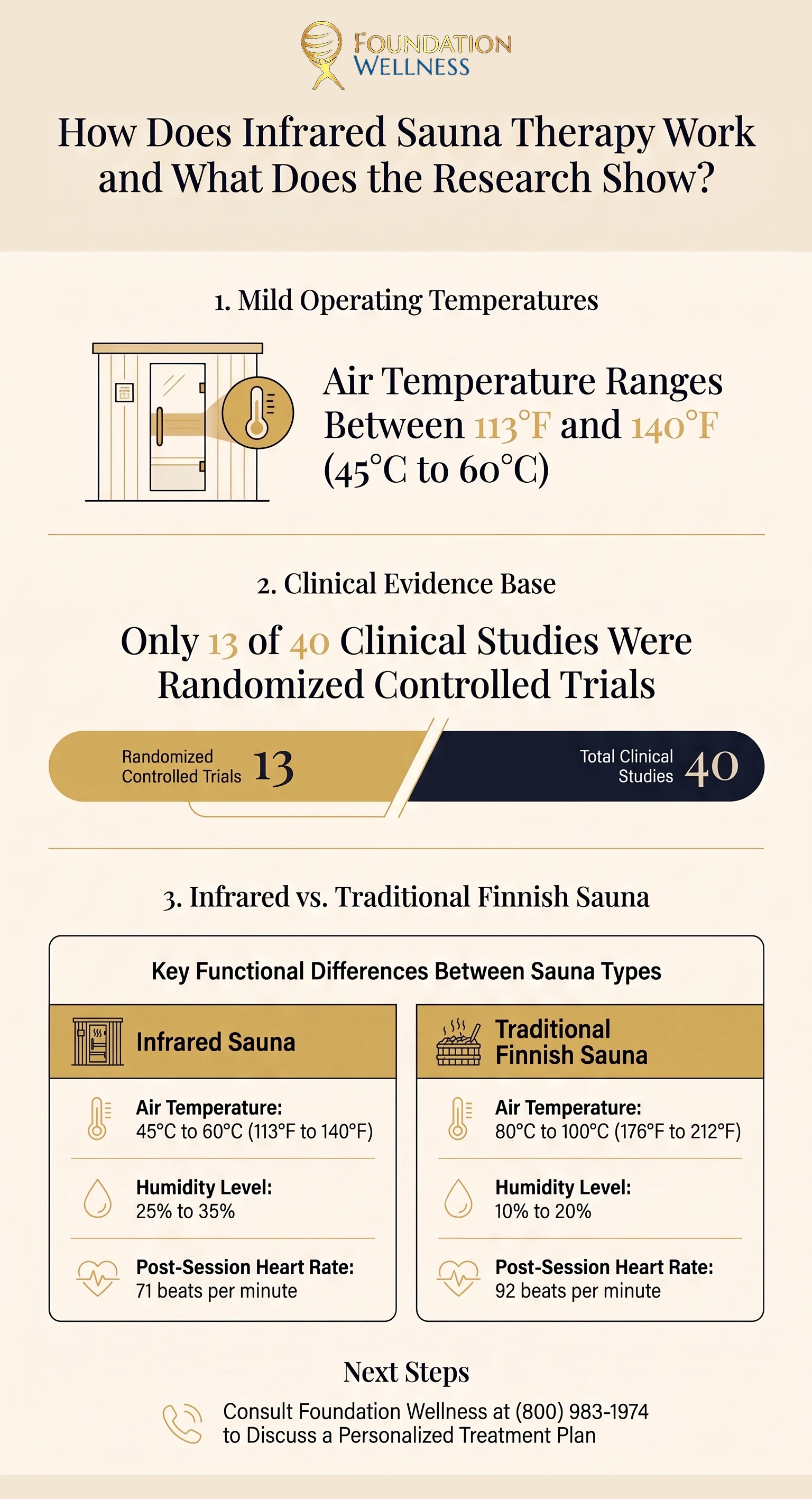
So the air can stay milder. A 2018 systematic review notes that infrared saunas generally run at 45 to 60 C.
In Fahrenheit, that’s about 113 to 140 F.
You may see it called infrared therapy, heat therapy or infrared sauna therapy. Same basic idea. Not all infrared saunas are alike, though. Infrared models differ in their heaters and settings, so ask what a given sauna uses.
How Is an Infrared Sauna Different From a Traditional Finnish Sauna?
Both saunas make you sweat. But a Finnish sauna uses very hot, dry air, so deep sweating usually starts sooner.
| Feature | Infrared sauna | Traditional Finnish sauna |
|---|---|---|
| How it heats | Infrared heaters warm the body directly | Hot, dry air |
| Air temperature | About 45 to 60 C (113 to 140 F) | About 80 to 100 C (176 to 212 F) |
| Humidity | 25 to 35% in one study sauna | 10 to 20% |
| Typical session in studies | 30 minutes in one study | 5 to 20 minutes |
| Heart rate after a session (one study) | 71 beats per minute | 92 beats per minute |
| Strength of evidence | Small, short studies | Most consistent evidence |
Here’s the part people miss: most long-term sauna bathing research is on Finnish saunas, not infrared ones.
Red light is a different tool. Red light therapy, sometimes grouped with color light therapy, uses light that cells absorb, not heat. See our separate guide to red light therapy in Utah.
What Does the Research Say About Infrared Sauna Benefits?

Honestly, the research is still early. One review found 40 clinical studies with a total of 3855 participants, but only 13 were randomized controlled trials, and most had fewer than 40 people. The authors say regular dry sauna use has potential health benefits. They also say more high quality data is needed.
The heart. In a meta-analysis of heart failure patients, the plan was an infrared sauna at 60 C for 15 minutes, five times a week for 2 to 4 weeks. It was linked with short-term gains in heart function. It had no significant effect on systolic or diastolic blood pressure, though. And these patients were under medical care, so this says little about healthy hearts.
Blood pressure. A 2024 review says consistent sauna bathing in hot Finnish saunas has the strongest evidence, including a lower risk of hypertension. That’s Finnish sauna data, not infrared. Wellness benefits such as improved circulation from infrared sauna use alone are less well studied.
Recovery. In a study of 10 active men, a 30-minute infrared session made no difference after strength training. After endurance training, jump height was better. The authors called it “a very light loading for the body.”
Detoxification. None of these sources show that sweating removes toxins. Think of the warmth as part of your overall wellness, not a cleanse.
Who Might Benefit, and Who Should Check Before Sauna Bathing?
Many adults enjoy the warmth as quiet relaxation, even deep relaxation. If stress is one of your wellness goals, our mental wellness team can help with the bigger picture.
Heat has real limits, though. MedlinePlus says older adults, young children, and people who are sick or overweight are most at risk of heat illness, and certain medicines or alcohol raise the risk. In heat stroke, body temperature can rise above 106 F (41 C) in minutes.
Ask your doctor before adding a sauna to your wellness routine if you:
- Are pregnant.
- Have a heart condition or low blood pressure.
- Take regular medicines.
- Are a man trying to conceive (one study of 10 men found a sperm change that reversed after stopping).
Worried one of these fits you? Ask first. Don’t guess.
What Happens During an Infrared Sauna Session?
Drink water first. During an infrared sauna session, you sit and relax as the heat builds, and you usually sweat more gently than in a traditional sauna. That’s because infrared saunas keep the air cooler, so the warmth tends to be easier to sit with.
Leave right away if you feel dizzy or faint. Don’t push through it. This is meant to be relaxation, not a test of how long you can last. After the session, cool off slowly and drink more water. Some people follow the heat with a cold plunge (going back and forth is sometimes called contrast therapy). Foundation Wellness doesn’t list that as a service, though.
How long should your sauna sessions be? That usually depends on your treatment plan, so our team will talk it through with you.
Where Can You Try an Infrared Sauna in Utah?

Our infrared sauna is at 456 E State Street, Suite 1400, American Fork, UT 84003. Sessions are open to all Foundation Wellness patients, as standalone visits or as part of a treatment plan.
If you live in Salt Lake City or Utah County, our American Fork clinic is the nearest one. We also offer telemedicine visits across Utah, and we’re accepting new patients.
Foundation Wellness accepts many insurance plans. Coverage depends on your plan, so check with our office first. To learn more, visit our infrared sauna and red light page, book a visit, or call (800) 983-1974.
Key Takeaways
- An infrared sauna warms your body directly, with air at about 45 to 60 C (113 to 140 F).
- The evidence is small: only 13 of 40 studies in one review were randomized trials.
- Blood pressure benefits are best studied in Finnish saunas, not infrared saunas.
- Ask your doctor first if you are pregnant, have a heart condition, take medicines or are trying to conceive.
- Foundation Wellness patients can book sessions at our American Fork clinic.
Sources
- Evidence-Based Complementary and Alternative Medicine (PMC), Clinical Effects of Regular Dry Sauna Bathing: A Systematic Review.
- SpringerPlus (PMC), Effects of far-infrared sauna bathing on recovery from strength and endurance training sessions in men.
- Clinical Cardiology (PMC), Effects of sauna bath on heart failure: A systematic review and meta-analysis.
- Temperature (PMC), The multifaceted benefits of passive heat therapies for extending the healthspan: A comprehensive review with a focus on Finnish sauna.
- MedlinePlus (National Library of Medicine), Heat Illness.
September 25, 2026 · 6 min read