
Low Estrogen Symptoms: Signs, Causes by Age and Testing
November 3, 2026
By Dr. Paul Frandsen, MD · November 3, 2026 · 13 min read
Medically reviewed by Dr. Paul Frandsen, MD
Common low estrogen symptoms are irregular or missed periods, hot flashes and night sweats, vaginal dryness and pain during sex, urinary changes, trouble sleeping, mood changes, trouble concentrating and a lower sex drive. Low estrogen most often comes with perimenopause and menopause, but it can happen much earlier, from primary ovarian insufficiency, low body weight, hard training, breastfeeding or cancer treatment. Symptoms alone don’t confirm it, so a doctor checks your history and, when needed, your hormone levels.
What Is Low Estrogen?
Estrogen is a hormone made by the ovaries. It helps control the menstrual cycle, according to ACOG. It also helps keep the vagina lubricated, elastic and thick, and it helps keep bones strong. That’s a lot of jobs for one hormone. So when there’s less of it, you can feel it in more places than you’d expect. Low estrogen, sometimes called estrogen deficiency, means estrogen production has dropped below what your body is used to.
Some decline is a normal part of aging. MedlinePlus notes that women have lower levels of estradiol and other estrogen hormones after menopause, and that estrogen levels fall significantly with age. Low estradiol after menopause is expected. Low estrogen levels years before menopause are a different story. That’s the part that catches people off guard, and it’s a big part of this guide.
Low estrogen isn’t the only kind of hormone imbalance women run into. If you’re wondering about the opposite problem, see our guide to estrogen dominance symptoms. Progesterone can fall too.
What Are the Symptoms of Low Estrogen?
Low estrogen symptoms tend to fall into eight groups. Not every woman has all of them. The National Institute on Aging (NIA) says some women have no or mild menopausal symptoms, while others have many that can be severe. This table shows each group, what women notice and what the sources say about why.
| Symptom group | What women notice | What the sources say about the cause |
|---|---|---|
| Period changes | Periods become irregular, shorter or longer, lighter or heavier, or are skipped | Often the first sign; in POI the first sign is usually irregular or missed periods |
| Hot flashes and night sweats | Sudden heat in the upper body and face, flushing, sweating; night sweats during sleep | Not fully clear; NIA says they are likely related to changing hormone levels |
| Vaginal and urinary changes | Dryness, burning or itching, pain during sex, repeat UTIs, needing to urinate often or suddenly | Low estrogen thins and dries the vaginal walls and can irritate the urethra |
| Sleep | Trouble falling asleep, waking too early, waking from night sweats | Night sweats and bladder symptoms can break up sleep |
| Mood | Feeling moodier, irritable, anxious or depressed | Scientists don’t know exactly why; stress, tiredness and depression may play a part |
| Thinking and memory | Forgetting words, trouble focusing or concentrating | Common in perimenopause and often improves after menopause |
| Skin, joints and body | Thinner, drier skin; stiff, achy joints and muscles; weight gain comes more easily | The body uses energy differently and fat distribution changes; researchers are still studying the link |
| Sex drive | Lower interest in sex, discomfort during sex | Listed among the later symptoms of POI; dryness makes sex uncomfortable |
Sources for the table: NIA, ACOG, the Office on Women’s Health, MedlinePlus and the Endocrine Society.
One honest caveat. NIA points out that some of these changes may be part of aging rather than being directly related to menopause. That’s why a symptom list can point you in a direction, but it can’t tell you your estrogen is low.
If several of these sound familiar, our Women’s Health and Hormones team in American Fork can go over them with you.
What Does a Drop in Estrogen Feel Like Day to Day?
Declining estrogen rarely shows up as one big event. It’s more often a run of small changes that add up. Which is frustrating, because each one on its own is easy to brush off as stress or a bad week.
A hot flash, as NIA describes it, is a sudden feeling of heat, most often in the upper body and face. Your face and neck may flush and heavy sweating can follow. Most last between 30 seconds and 10 minutes. They can come several times an hour, a few times a day or just once or twice a week.
Sleep is often the next thing to slip. You may struggle to fall asleep or wake long before your usual time, and night sweats or the need to urinate can wake you. Over time, MedlinePlus says, a lack of sleep can lead to fatigue and memory problems.
Mood swings are common too. NIA says you might feel moodier or more irritable, and the Office on Women’s Health adds anxiety and depression to the list of mood changes. If you’re thinking about harming yourself, call or text 988 to reach the 988 Suicide & Crisis Lifeline.
Many women describe brain fog: forgetting words or finding it hard to focus. Our guide to menopause brain fog goes deeper. Lower sex drive is common too, and dryness can make sex uncomfortable.
How Does Low Estrogen Affect the Vagina and Bladder?
Honestly, this is the group of symptoms many women don’t connect to hormone levels at first. An ob-gyn writing for ACOG explains that low levels of estrogen can cause thinning, drying and inflammation of the vaginal walls, which is called vaginal atrophy. Vaginal dryness can cause irritation, burning and pain with sex. The vulva can get dry and irritated too, and some women notice it just putting on underwear.
The urinary tract feels it as well. The Office on Women’s Health groups these changes under one name, genitourinary syndrome of menopause, or GSM. Its symptoms include repeat urinary tract infections, pain during sex, burning or itching of the vagina and vulva, a sudden or frequent need to urinate and vaginal dryness. NIA adds that many women develop bladder control problems, such as leaking urine when they sneeze, laugh or exercise.
Low estrogen levels aren’t the only cause of dryness. ACOG notes that cold and allergy medicines, some antidepressants and Sjogren syndrome can dry vaginal tissue too. If irritation or pain during sex doesn’t improve, see your doctor. It can feel awkward to bring up. Bring it up anyway.
What Causes Low Estrogen?
The most common cause is the natural estrogen decline of the menopausal transition. NIA says most women begin that transition between ages 45 and 55, and the average age of menopause is 52 in the United States. ACOG puts the average at 51. Close enough. Either way, it’s a gradual thing, not a switch.
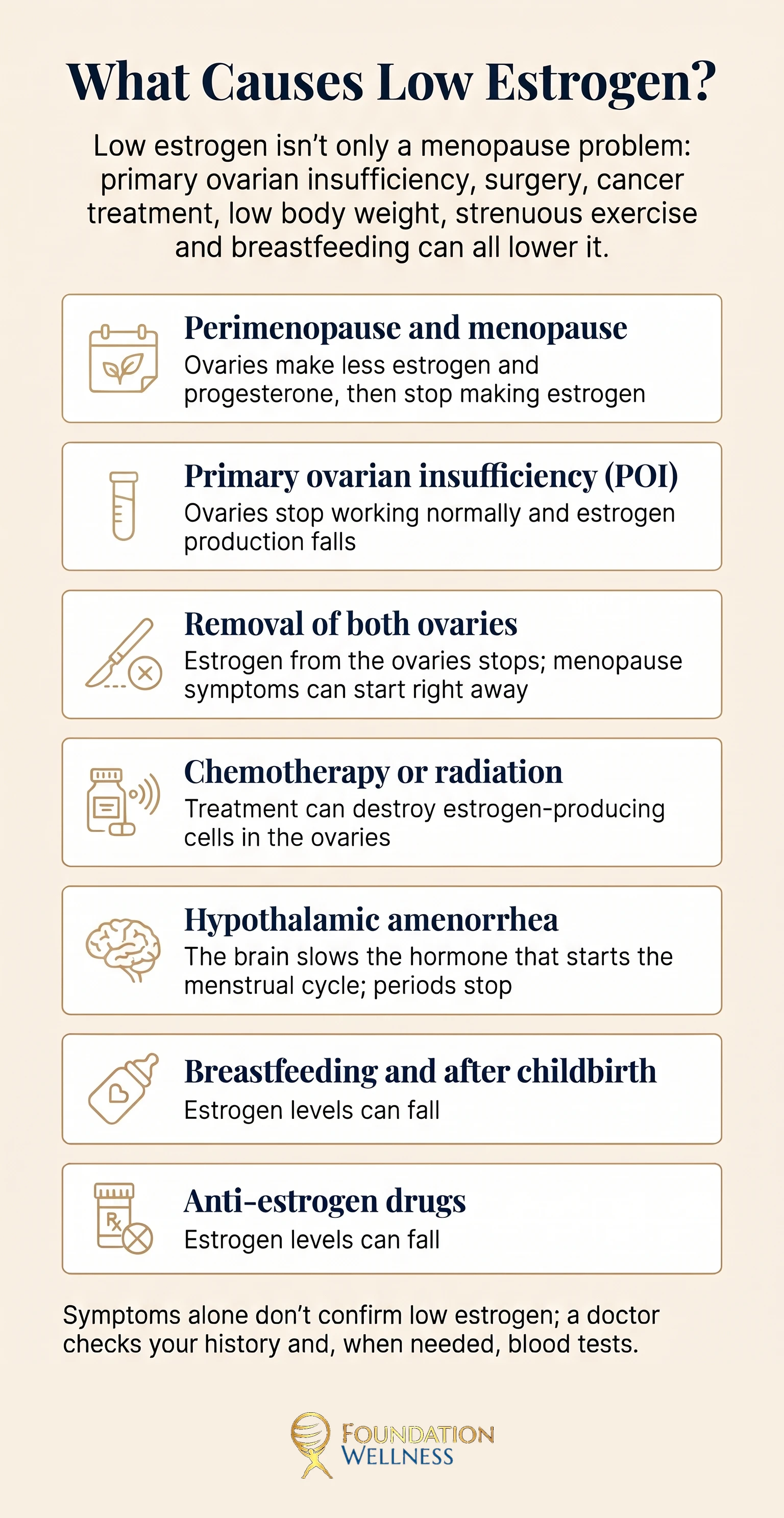
But estrogen production can drop at other times, for other reasons. This comparison table lays out the main causes by life stage.
| Cause | What happens to estrogen | Typical age |
|---|---|---|
| Perimenopause and menopause | Ovaries make less estrogen and progesterone, then stop making estrogen | Transition usually starts between 45 and 55 |
| Primary ovarian insufficiency (POI) | Ovaries stop working normally and estrogen production falls | Before 40, sometimes from the teen years |
| Removal of both ovaries | Estrogen from the ovaries stops; menopause symptoms can start right away | Any age |
| Chemotherapy or radiation | Treatment can destroy estrogen-producing cells in the ovaries | Any age; may be short-term in younger women |
| Hypothalamic amenorrhea | The brain slows the hormone that starts the menstrual cycle; periods stop | Before menopause |
| Breastfeeding and after childbirth | Estrogen levels can fall | After having a baby |
| Anti-estrogen drugs | Estrogen levels can fall | Any age |
Sources for the table: NIA, ACOG, MedlinePlus and the NICHD.
Is It Perimenopause?
If you’re in your 30s or 40s, perimenopause may be part of the picture. ACOG says that beginning in your 30s and 40s, the amount of estrogen your ovaries make begins to fluctuate. So it isn’t a steady fall. Estrogen levels rise and dip, and that shifting hormone balance is why cycles can get longer or shorter, skip, or turn lighter or heavier.
We cover this stage on its own pages. See perimenopause symptoms for what to expect, and perimenopause vs menopause for how to tell the two apart.
Can You Have Low Estrogen Before Menopause?
Yes. This is the part of the story that searches like “low estrogen symptoms in 20s” are really asking about.
Primary ovarian insufficiency. MedlinePlus explains that primary ovarian insufficiency happens when the ovaries stop working normally before age 40. It can start as early as the teen years, and it becomes more common between 35 and 40. The first sign is usually irregular or missed periods. Later symptoms can mirror natural menopause: hot flashes, night sweats, irritability, poor concentration, lower sex drive, pain during sex and vaginal dryness. In about 90% of cases, the exact cause is unknown. That’s a hard answer to get, honestly. The Endocrine Society lists known causes such as certain genetic conditions, autoimmune disease and chemotherapy or radiation. POI isn’t the same as premature menopause: some women with POI still have occasional periods.
Surgery. NIA notes that if both ovaries are removed and you aren’t taking hormones, periods stop and menopause symptoms can start immediately. Removing the uterus alone stops periods but doesn’t cause menopause, MedlinePlus says.
Cancer treatment. The NICHD says chemotherapy and radiation for some cancers can destroy estrogen-producing cells and eggs in the ovaries. In younger women, the effect may be short-term.
Low weight, strenuous exercise and stress. In hypothalamic amenorrhea, the brain slows or stops releasing GnRH, the hormone that starts the menstrual cycle. NICHD lists common features: low body weight, low body fat, very low intake of calories or fat, emotional stress and strenuous exercise that burns more calories than you eat. Eating disorders can disrupt the same system. The NIAMS names low estrogen levels from missing periods due to hormone disorders or extreme physical activity as a risk factor for osteoporosis.
Breastfeeding. ACOG notes that estrogen levels can fall after childbirth and with breastfeeding. Worth knowing if you’ve just had a baby and something feels off. It isn’t all in your head.
How Does Low Estrogen Affect Bones and Heart Health?
Symptoms are the part you feel. The long-term effects of estrogen deficiency are quieter, and that’s the part people miss.
Bones. A small amount of bone loss after 35 is normal, but ACOG says that during the first 4 to 8 years after menopause, women lose bone more rapidly because of lower estrogen levels. Too much loss leads to osteoporosis. NIAMS calls osteoporosis a silent disease, because there are usually no symptoms until a bone breaks, most often at the hip, spine or wrist. That’s the unsettling part. Younger women aren’t exempt. MedlinePlus says women with POI often develop osteoporosis without enough estrogen.
Heart. ACOG explains that the estrogen made by the ovaries before menopause protects against heart attack and stroke, and that women lose much of this protection when less estrogen is made. Not what anyone wants to hear. MedlinePlus adds that the loss of estrogen can raise cholesterol levels. For women with POI, the Endocrine Society says low estrogen early in life appears to increase the risk of heart attack as a woman ages.
This is one reason low estrogen at a young age deserves a real workup, not a wait-and-see.
How Do Doctors Check Your Estrogen Levels?
Symptoms alone don’t confirm low estrogen. NIA says it may be hard for you and your doctor to tell whether you’re in the menopausal transition. So a doctor starts with questions: your age, your symptoms, your periods and your family history. It’s how we start with women from around Utah County at our American Fork clinic, too.
Blood tests come in when the picture isn’t clear. NIA says that in some cases, for example if your periods stopped at an early age, a doctor may suggest a blood test to check hormone levels. For women under 40 with stopped or irregular periods, the Endocrine Society says the doctor asks about menstrual history and menopause-like symptoms, and blood tests check hormone levels and whether the ovaries are working. Extra tests may look for genetic or autoimmune causes. MedlinePlus adds that a pregnancy test, a physical exam and a pelvic ultrasound may be part of a POI workup. If you’re young and your periods have stopped, don’t sit on it.
For the natural transition, timing matters more than a single number. MedlinePlus says you’ve reached menopause when you haven’t had a period for 12 months.
How Is Low Estrogen Treated?

Not everyone needs treatment. MedlinePlus says you may not need it for menopause symptoms, and many women manage with lifestyle changes. When symptoms affect your life, or when low estrogen comes early, these are the main options. Your physician helps you choose. For women in Utah County, that can happen in person in American Fork or by telemedicine from anywhere in Utah.
Hormone therapy. ACOG describes hormone therapy as taking estrogen and, if you still have a uterus, a progestin to lower the risk of uterine cancer. It’s also called hormone replacement therapy. Systemic forms include pills, skin patches, gels and sprays. ACOG says systemic estrogen is the best treatment for hot flashes and night sweats, and it protects against the bone loss of early menopause. ACOG also recommends FDA-approved hormone therapy over compounded hormones. Our guides to hormone replacement therapy in Utah and bioidentical vs synthetic HRT cover the details.
Vaginal estrogen. For vaginal and urinary symptoms, low-dose vaginal estrogen is one option, the Office on Women’s Health says. ACOG notes that vaginal creams, tablets and rings deliver less estrogen than typical hormone therapy and have fewer risks.
Hormone therapy for POI. The Endocrine Society says hormone therapy is the most common treatment for POI and is usually stopped around the age of natural menopause, about 50. Risks depend on age and health: in older postmenopausal women, hormone therapy may raise some risks, while in younger women with POI those risks are thought to be much lower. Reassuring, if that’s you.
Non-hormone steps. Over-the-counter vaginal moisturizers and lubricants can ease dryness (ACOG). For hot flashes, MedlinePlus suggests dressing in layers, carrying a fan and avoiding alcohol, spicy foods and caffeine. Nonhormone prescription medicines are also available. Small steps. They do add up, though.
The sources we checked don’t support estrogen supplements or specific foods for raising estrogen, so we don’t recommend them here.
Women’s Hormone Care at Foundation Wellness in American Fork
Foundation Wellness offers women’s health and hormone care at our clinic at 456 E State Street, Suite 1400, American Fork, UT 84003, with telemedicine visits across Utah. We start with your history and the symptoms that bother you most, order labs when they’re needed, and talk through hormone therapy and other options so you can make the choice that fits your health and goals. Learn more about our Women’s Health and Hormones care.
Foundation Wellness accepts many insurance plans. Coverage depends on your plan, so check with our office first. Call us at (800) 983-1974.
Key Takeaways
- Common low estrogen symptoms include period changes, hot flashes and night sweats, vaginal dryness, urinary changes, poor sleep, mood changes, trouble concentrating and lower sex drive.
- Low estrogen isn’t only a menopause problem: primary ovarian insufficiency, surgery, cancer treatment, low body weight, strenuous exercise and breastfeeding can all lower it.
- Symptoms alone don’t confirm low estrogen; a doctor checks your history and, when needed, blood tests.
- Lower estrogen speeds bone loss and reduces estrogen’s protection for the heart, which matters most when it starts early.
- Hormone therapy, low-dose vaginal estrogen and non-hormone options are all choices to make with your physician.
Sources
- American College of Obstetricians and Gynecologists, The Menopause Years.
- American College of Obstetricians and Gynecologists, Experiencing Vaginal Dryness? Here’s What You Need to Know.
- National Institute on Aging, What Is Menopause?
- Office on Women’s Health, Menopause symptoms and relief.
- MedlinePlus, Menopause.
- MedlinePlus, Primary Ovarian Insufficiency.
- Endocrine Society, Primary Ovarian Insufficiency.
- Eunice Kennedy Shriver National Institute of Child Health and Human Development, What causes amenorrhea?
- National Institute of Arthritis and Musculoskeletal and Skin Diseases, Osteoporosis.
- MedlinePlus, Aging changes in hormone production.
November 3, 2026 · 13 min read