
Menopause Brain Fog: Why It Happens and What Helps
October 2, 2026
By Dr. Paul Frandsen, MD · October 2, 2026 · 8 min read
Medically reviewed by Dr. Paul Frandsen, MD

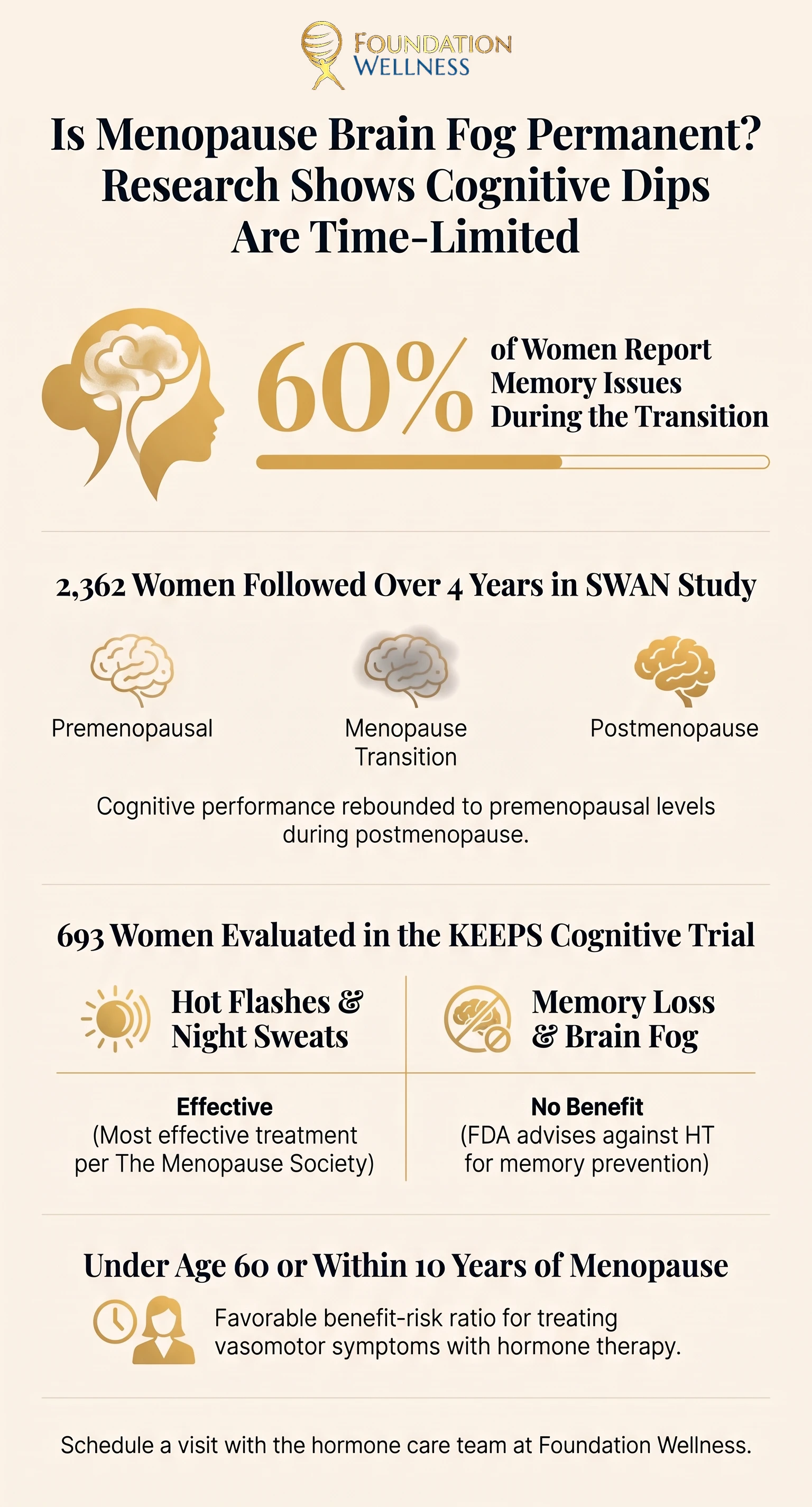
Menopause brain fog is the forgetfulness, word-finding trouble, and slow focus many women notice in perimenopause and early menopause. It’s common: about 60% of midlife women report memory problems during the menopause transition. For most, menopausal brain fog is mild, and in research these symptoms often ease after menopause.
What Does Menopause Brain Fog Feel Like?
Menopause brain fog is a name for the everyday cognitive symptoms of the menopause years. It isn’t a diagnosis. It’s one of many menopause symptoms, and a common one.
Menopausal women often describe brain fog symptoms like these:
- Losing a word or a name in the middle of a sentence.
- Walking into a room and forgetting why you came.
- Mental fatigue later in the day.
- Driving to the store in American Fork and blanking on half the list once you’re through the door.
- A general loss of mental clarity, like your mind is a little slower than usual.
It can be unsettling, especially if you’ve always been the organized one at work and at home. If you’re also juggling a job, a busy household and a commute up and down the interstate, every slip can feel bigger than it is. But this cognitive difficulty is real, and it shows up in testing too. The SWAN study found a temporary dip in processing speed and verbal memory during perimenopause.
If cognitive issues are getting in the way at work or at home, our women’s health and hormone care team can look at the whole picture with you. For more, see our guide to perimenopause symptoms.
Why Do Estrogen Changes Affect Memory?
Estrogen is a hormone that does a lot more than run your cycle. It acts on many areas of the brain, and brain cells in those areas carry estrogen receptors. So when estrogen levels change, that hormonal change can show up in brain function too.
In perimenopause, hormone levels don’t fall in one smooth line. They swing up and down, sometimes month to month. That hormonal fluctuation, more than one low number on a lab report, is what marks this stage. Your brain has to keep adjusting to a moving target, and that’s frustrating.
Encouragingly, the brain does adjust, as the next section shows.
Brain health also depends on sleep, mood, and stress. All three tend to shift during perimenopause, and each one can add to the brain fog.
When Does Brain Fog Start in the Menopause Transition?

Perimenopause brain fog usually shows up during the menopause transition, the years of changing periods before your final one. According to ACOG, the average age of menopause is 51.
Here’s the hopeful part. The menopausal transition is also when the fog is most likely to lift. One SWAN analysis followed 2,362 women for 4 years and found that the normal improvement on repeat tests rebounded to premenopausal levels in postmenopause. The researchers concluded that thinking problems tied to the transition “may be time-limited.” So menopause related brain fog may pass with time.
Surgical menopause is different. When both ovaries are removed, symptoms can start suddenly. For more on how the stages are defined, read perimenopause vs menopause.
| Stage | What women often notice | What research found | What to talk about with a clinician |
|---|---|---|---|
| Before the transition | Not reported in these sources | The comparison point: improvement on repeat tests later rebounded to premenopausal levels (Greendale 2009) | Nothing new unless symptoms appear |
| Perimenopause | Memory problems are common: about 60% of midlife women report them (SWAN) | A temporary dip in processing speed and verbal memory (SWAN) | Hot flashes, sleep, and mood alongside memory |
| Postmenopause | Not reported in these sources | The dip resolved in postmenopause (SWAN) | Any change that keeps getting worse |
| Surgical menopause | Symptoms can start suddenly after removal of both ovaries | Not reported in these sources | Hormone options and timing |
These are group results, though. Your own pattern may differ.
How Do Hot Flashes, Sleep, and Mood Play a Role?
Hot flashes and night sweats, also called vasomotor symptoms, are the menopausal symptoms most women expect. ACOG notes that night sweats may wake you up and leave you tired and sluggish during the day. And when you’re short on sleep, everything tends to feel foggier. (They don’t care about the season, either. A cold January night in Utah County can bring one on just as easily as July.)
Now for the part that surprised us. In SWAN testing, hot flashes and poor sleep weren’t linked to lower thinking scores. Mood was. Women with depressive symptoms scored lower on processing speed, and women with more anxiety had worse verbal memory.
Sleep disturbance still affects how you feel each day. But don’t let sleep problems and other menopause symptoms crowd out the rest. Mood changes, stress, and your mental health deserve the same attention. If you feel low, anxious, or under heavy stress most days, say so at your visit. Even if it feels minor, it’s part of the picture.
Is Menopause Brain Fog a Sign of Dementia?
It’s a scary question. In most cases, the answer is reassuring. A 2024 review in the journal Menopause found that when memory declines occur, scores stay within normal limits for all but a very small number of women. The SWAN results also point to a change that’s temporary, not ongoing cognitive decline.
Still, no article can judge your own memory. Signs of dementia or other cognitive impairment need a proper medical check. See a doctor soon if you notice symptoms like these:
- Getting lost in places you know well.
- Trouble with daily tasks you used to do easily.
- Family or friends noticing big changes in you.
Taking your cognitive health seriously is a sign of good sense, not panic.
Can Hormone Therapy Help Menopause Brain Fog?
It would be nice if hormones simply cleared the fog. Unfortunately, the research says otherwise. That’s a letdown, we know, especially if you were hoping a prescription would fix your memory. The KEEPS trial followed 693 recently postmenopausal women, with an average age of 52.6, for up to 4 years, and found no treatment-related benefits on cognitive outcomes. KEEPS tested estrogen with progesterone, not testosterone.
The FDA is direct: do not use hormone therapy to prevent memory loss or Alzheimer’s disease. So it isn’t a way to prevent dementia. The FDA also advises using the lowest dose that helps, for the shortest time you need it.
Where hormone replacement therapy does help is with hot flashes and night sweats. ACOG calls estrogen therapy the best treatment for their relief. And a 2022 position statement from The Menopause Society calls hormone therapy the most effective treatment for vasomotor symptoms. For women younger than 60, or within 10 years of menopause, the benefit-risk ratio is favorable for these symptoms when there’s no reason to avoid it. Feeling more rested may help how you feel day to day. That’s still not a memory treatment, though.
This decision is made with a licensed clinician. Our page on hormone replacement therapy in Utah explains the options.
Everyday Steps and Hormone Care in American Fork

A few simple habits can make menopause brain fog easier to live with:
- Use lists, calendars, and phone reminders.
- Do one task at a time.
- Keep steady sleep and wake times.
- Move your body most days. A walk on the Murdock Canal Trail counts.
- Get support for stress and low mood.
Brain fog has other causes too. Our guide to brain fog treatment covers them.
At Foundation Wellness, our Women’s Health and Hormone Optimization service offers individualized care for perimenopause, menopause, and beyond. It combines comprehensive lab work, bioidentical hormone therapy, and ongoing monitoring. Our team doesn’t prescribe hormones based on age or a single lab value. We start with detailed bloodwork, a thorough medical history, and an honest conversation about what you’re experiencing.
Here’s what that looks like in practice at our clinic:
- Lab work. The panel covers estradiol, progesterone, testosterone, DHEA-S, a thyroid panel and metabolic markers, among others. We also look at thyroid function, adrenal health and nutrient status, because these systems don’t work on their own.
- Dosing. If bioidentical hormone therapy is part of your plan, it’s dosed and adjusted based on your response, not a one-size protocol.
- Follow-up. Ongoing monitoring means regular follow-up labs and clinical check-ins.
- Mood in the same plan. Since mood and anxiety showed up so clearly in SWAN, it helps that our hormone care can be coordinated with our Mental Wellness program, Neuronova, when it makes sense. Anxiety in perimenopause can look psychiatric when hormone shifts are part of the cause.
Every treatment plan is overseen by a board-certified physician. If you’ve been told your labs are “normal” but you still don’t feel right, that’s a good reason to come in.
We see patients at 456 E State Street, Suite 1400, American Fork, UT 84003, and through telemedicine across Utah. We’re accepting new patients, and same-day appointments are often available. Foundation Wellness accepts many insurance plans. Coverage depends on your plan, so check with our office first.
If the fog is wearing on you, schedule a visit with our hormone care team.
Key Takeaways
- About 60% of midlife women report memory problems during the menopause transition.
- In SWAN, the dip came during perimenopause, was temporary, and resolved after menopause.
- Mood and anxiety were tied to lower scores more than hot flashes or poor sleep.
- Menopause brain fog is rarely a sign of dementia, but warning signs need a medical check.
- Hormone therapy treats hot flashes and night sweats. It isn’t a treatment for memory.
Sources
- Menopause (journal), SWAN progress report, El Khoudary et al. 2019.
- Neurology, Menopause transition and cognitive performance, Greendale et al. 2009.
- PLoS Medicine, KEEPS-Cog, Gleason et al. 2015.
- U.S. Food and Drug Administration, Menopause.
- American College of Obstetricians and Gynecologists, The Menopause Years.
- American College of Obstetricians and Gynecologists, Hormone Therapy for Menopause.
- Menopause (journal), Menopause and brain fog, Maki and Jaff 2024.
- The Menopause Society, 2022 hormone therapy position statement.
October 2, 2026 · 8 min read