
Perimenopause vs Menopause: How to Tell the Stages Apart
August 5, 2026
By Dr. Paul Frandsen · August 5, 2026 · 9 min read

Perimenopause is the stretch when your hormone levels swing and your periods keep coming. Menopause is the single point when you hit 12 months with no period. Same journey, two different stages. Perimenopause can run for years. Menopause lasts one day, and everything after it is postmenopause.
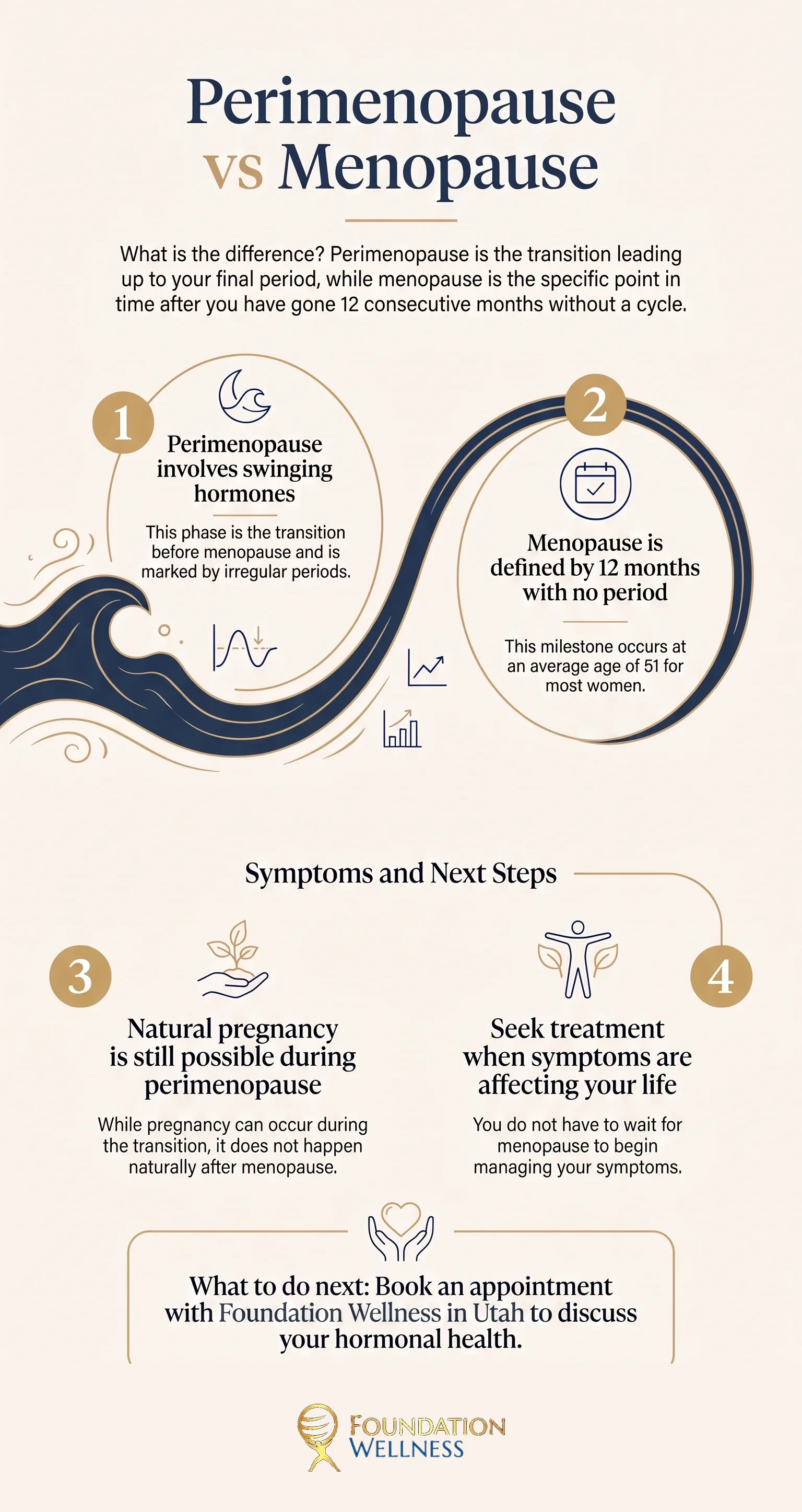
Perimenopause vs Menopause at a Glance
Here’s the short version, side by side.
| What to compare | Perimenopause | Menopause and after |
|---|---|---|
| What it is | The menopause transition, before your final period | One point in time, 12 months with no period |
| Typical age | Starts in the 40s, sometimes the late 30s | About 51 on average in the US |
| How long it lasts | 7 to 14 years, per the National Institute on Aging | One day, then postmenopause for life |
| Periods | Irregular, skipped, heavier or lighter | Stopped for good |
| Hormone levels | Estrogen levels swing high and low | Estrogen settles low and stays there |
| Fertility | Still possible, so birth control still matters | Not possible naturally |
| Lead symptoms | Hot flashes, mood swings, broken sleep, brain fog | Vaginal dryness, urinary changes, thinning bone |
| Testing | One hormone level can mislead, since it swings | FSH runs high, but the calendar is what counts |
| How it’s diagnosed | By your symptoms and your cycle pattern | By the calendar, looking backward |
| What to watch | Sleep, mood, cycle length, symptom pattern | Bone density, blood pressure, cholesterol |
| Treatment | Hormone therapy, low-dose birth control, non-hormonal options | Menopause hormone therapy, vaginal estrogen |
What Is Perimenopause?

Perimenopause is the lead-up. Your ovaries wind down, but not in a straight line. Some months they push out plenty of estrogen. Other months they barely try. That hormonal fluctuation is the whole story. It’s also why you can feel fine one week and wrecked the next.
The National Institute on Aging says this menopause transition can last 7 to 14 years. It often starts in the 40s. For some women, perimenopause starts in the late 30s.
In our Utah practice, most women reach out during this stretch rather than after menopause. Our patients usually arrive with a cluster of complaints instead of one clean symptom, and many have already been told their labs looked fine.
Your menstrual cycle is the first place it shows. In early perimenopause, the length of back-to-back cycles starts to differ by a week or more. Later in the transition, you skip 60 days or more between periods. Then the gaps stretch out, until they stop.
One thing gets missed a lot. You can still get pregnant. A perimenopausal woman who doesn’t want a pregnancy still needs birth control. That holds until 12 months have passed with no period.
What Is Menopause?
Menopause is a moment, not a phase. You reach it once you’ve gone 12 full months without a period. No test can call it for you. You only see it looking backward.
According to the American College of Obstetricians and Gynecologists, the average age of menopause in the US is about 51. The range around that number is wide and still normal. After that day, you’re postmenopausal for life.
Which Symptoms Point to Which Stage?
Both stages share most of the same list, so the symptom alone rarely tells you where you are. The pattern does. Swinging, unpredictable symptoms alongside periods that still show up point to the transition. Steady symptoms with no period for a full year point to the other side of it.
For the full run-down of what the transition feels like, how early each complaint tends to arrive, and what to do about each one, read our guide to perimenopause symptoms. This page stays on the question of which stage you are in.
When Does Bleeding Need Evaluation in Either Stage?
Sooner than most women think. In our experience, women wait far longer than they need to, usually because someone told them this was simply part of getting older. Book a visit whenever symptoms disrupt your sleep, your work, or your relationships. A few patterns deserve a faster call:
- Bleeding that soaks through a pad or tampon every hour.
- Periods that arrive closer than 21 days apart, or bleeding between them.
- Any bleeding at all after menopause. That one always needs evaluation.
- New heart palpitations, or mood changes that frighten you.
Most of these turn out to be part of perimenopause. All of them deserve a look.
What Actually Changes When You Cross Into Menopause?
Honestly, the two lists overlap almost completely. The difference is the pattern behind them.
Perimenopause symptoms come from hormonal changes that swing. Menopausal symptoms come from estrogen that has settled low and stays there. So the transition feels chaotic. The years after menopause feel steadier, for better or worse.
| Symptom | During perimenopause | After menopause |
|---|---|---|
| Hot flashes | Come in waves, tied to every hormonal change | Often ease over several years |
| Mood changes | Unpredictable, linked to the cycle | Usually steadier once hormones level off |
| Sleep | Broken by sweats and 3 AM wakeups | Often improves as flashes fade |
| Periods | Irregular and unpredictable | Gone |
| Vaginal dryness | Comes and goes | Gets worse without treatment |
| Urinary symptoms | Occasional urgency | Incontinence and infections more likely |
| Bone | Loss starts to speed up | Fastest in the first 5 to 7 years |
What Happens to Your Hormone Levels?

Your reproductive hormones stop keeping a schedule. Estrogen levels spike and crash. They no longer rise and fall on a monthly rhythm. Progesterone drops earlier, because cycles without ovulation get more common. FSH climbs as the brain works harder to wake the ovaries up.
Here’s why a single blood draw can mislead you. A hormone level drawn on a Tuesday can look nothing like the same test two weeks later. A normal result doesn’t rule out perimenopause. According to the Mayo Clinic, the diagnosis comes from your symptoms and your cycle history, not one lab value.
Thyroid disease muddies this further. It causes fatigue, weight changes, mood changes, and poor sleep too. Good care checks both. That’s why our team runs a full thyroid panel alongside sex hormone levels, and reads the results next to your cycle history rather than on their own.
When Is Menopause Early or Premature?
Timing matters more than most people realize.
- Early menopause means your final period arrives between ages 40 and 45.
- Premature menopause means it arrives before 40. About 1 percent of women experience this, often from primary ovarian insufficiency.
- Induced menopause follows surgery to remove the ovaries, or some cancer treatments. It can land overnight, with severe symptoms and severe hot flashes.
Early menopause isn’t just an earlier finish line. Fewer years of estrogen mean a higher lifetime risk of bone loss and heart disease. So hormone therapy is usually recommended at least until the average age of natural menopause. The exception is a medical reason to avoid it.
What Changes After Menopause?
Some things get better. Many menopause symptoms ease within a few years, hot flashes included. Periods and cramps are over. Two changes still deserve your attention.
Bone comes first. The National Institutes of Health reports that women can lose up to 20 percent of their bone density in the 5 to 7 years after menopause. That loss stays quiet until a fracture makes it loud.
Heart health comes second. Cardiovascular risk climbs after menopause. Blood pressure, lipids, and blood sugar deserve a closer look than they used to get.
What Menopause Treatment Options Actually Help?
You’ve got real choices. Which one fits depends on the symptoms bothering you. Our patients usually end up with some combination of the options below rather than one single fix.
Menopause hormone therapy. Also called menopausal hormone therapy or hormone replacement therapy, this is the most effective menopause treatment for hot flashes and night sweats. It protects bone as well. The Menopause Society, formerly the North American Menopause Society, backs it for healthy women under 60, or within 10 years of their final period. For that group, the benefits generally outweigh the risks when vasomotor symptoms are bothersome or bone loss is a real concern.
Vaginal estrogen. A low-dose cream, tablet, or ring treats vaginal dryness, painful sex, and repeat urinary tract infections. Very little reaches the bloodstream. That makes it an option for many women who skip systemic hormone therapy.
Non-hormonal prescriptions. Certain antidepressants and other medications reduce menopause symptoms for women who can’t use hormones, or would rather not.
Perimenopause-specific options. During the transition, low-dose birth control can smooth out an erratic menstrual cycle. It quiets symptoms and still prevents pregnancy.
Foundations. Strength training, protein, sleep habits, and less alcohol won’t replace medical treatment. They do make everything else work better.
How Foundation Wellness Can Help
We treat perimenopause and the years after it. A symptom doesn’t wait for a diagnosis to make your life harder. Our patients rarely arrive with a tidy diagnosis, and you don’t need one to get started here.
Start with a real workup. We begin by reviewing your symptom pattern and your cycle history, then run full bloodwork, including thyroid and sex hormone levels. Our team reads those numbers against how you actually feel. From there we build a plan. Hormone therapy if it fits, other tools if it doesn’t, and follow-up labs to check the dose. We adjust it as symptoms change, since a plan that suits you in early perimenopause often needs a second look a year later.
Not sure where you sit in all this? Our guide to the signs of hormone imbalance is a good place to start. You can also read our hormone replacement therapy in Utah guide. Or compare bioidentical and synthetic HRT, and see the full women’s health and hormone program.
Foundation Wellness serves American Fork and patients across Utah, from Provo and the rest of Utah County up to Salt Lake, in the clinic and by telehealth. Reach out when your symptoms start. You don’t have to earn the help first.
Key Takeaways
- Perimenopause is the transition, with swinging hormone levels and irregular periods. Menopause is the single point of 12 months with no period.
- The transition can last 7 to 14 years. It often starts in the 40s, sometimes the late 30s.
- The symptom lists overlap. The pattern is the tell: chaotic during perimenopause, steadier after menopause.
- Hot flashes and night sweats last a median of about 7 years. Waiting them out is a long strategy.
- A normal hormone test doesn’t rule out perimenopause, because levels change week to week.
- Menopause before 40 is premature menopause. Between 40 and 45, it’s early menopause. Both raise the stakes for bone and heart health.
- Treatment works in both stages, from hormone therapy to local estrogen to non-hormonal options.
- You don’t have to reach menopause to get treated. Care in either stage follows what you feel, not the date on the calendar.
Sources
- The Menopause Society, menopause.org, 2022 Hormone Therapy Position Statement.
- American College of Obstetricians and Gynecologists, The Menopause Years.
- National Institute on Aging, National Institutes of Health, What Is Menopause?.
- Mayo Clinic, Menopause: Symptoms and Causes.
- Avis NE et al., Study of Women’s Health Across the Nation, JAMA Internal Medicine, 2015.
Dr. Paul Frandsen
August 5, 2026 · 9 min read