
Progesterone for Sleep: What Research Shows Around Menopause
October 5, 2026
By Dr. Paul Frandsen, MD · October 5, 2026 · 11 min read
Medically reviewed by Dr. Paul Frandsen, MD

Progesterone may help some women in perimenopause and menopause sleep better, mostly as oral micronized progesterone taken at bedtime. The evidence comes from small trials, and it isn’t an FDA sleep drug. Think of it as one tool a clinician may use for poor sleep, not a sleeping pill.
What Is Progesterone for Sleep?
Progesterone for sleep means using a prescribed form of the hormone, usually an oral capsule at night, to ease broken sleep in the years around menopause. It isn’t a sedative made for insomnia. As ovulation slows down, your ovaries make less of this hormone, and progesterone levels drop.
Many women first hear about it after months of 3 am wake-ups, the kind where you’re wide awake and the house is quiet. That’s frustrating, and it wears you down. Others are already on estrogen and learn that the progesterone in their plan may also help them sleep. Either way, the question is the same. How strong is the evidence, and is it right for you?
If you want that answer built on your labs and your history, our women’s health and hormone care team can talk it through with you. That can be in person in American Fork or by telemedicine from anywhere in Utah, from Logan down to St. George. The sections below cover what the studies found, which form they used, when to take it, and when poor sleep has another cause.
Does Progesterone Help You Sleep?
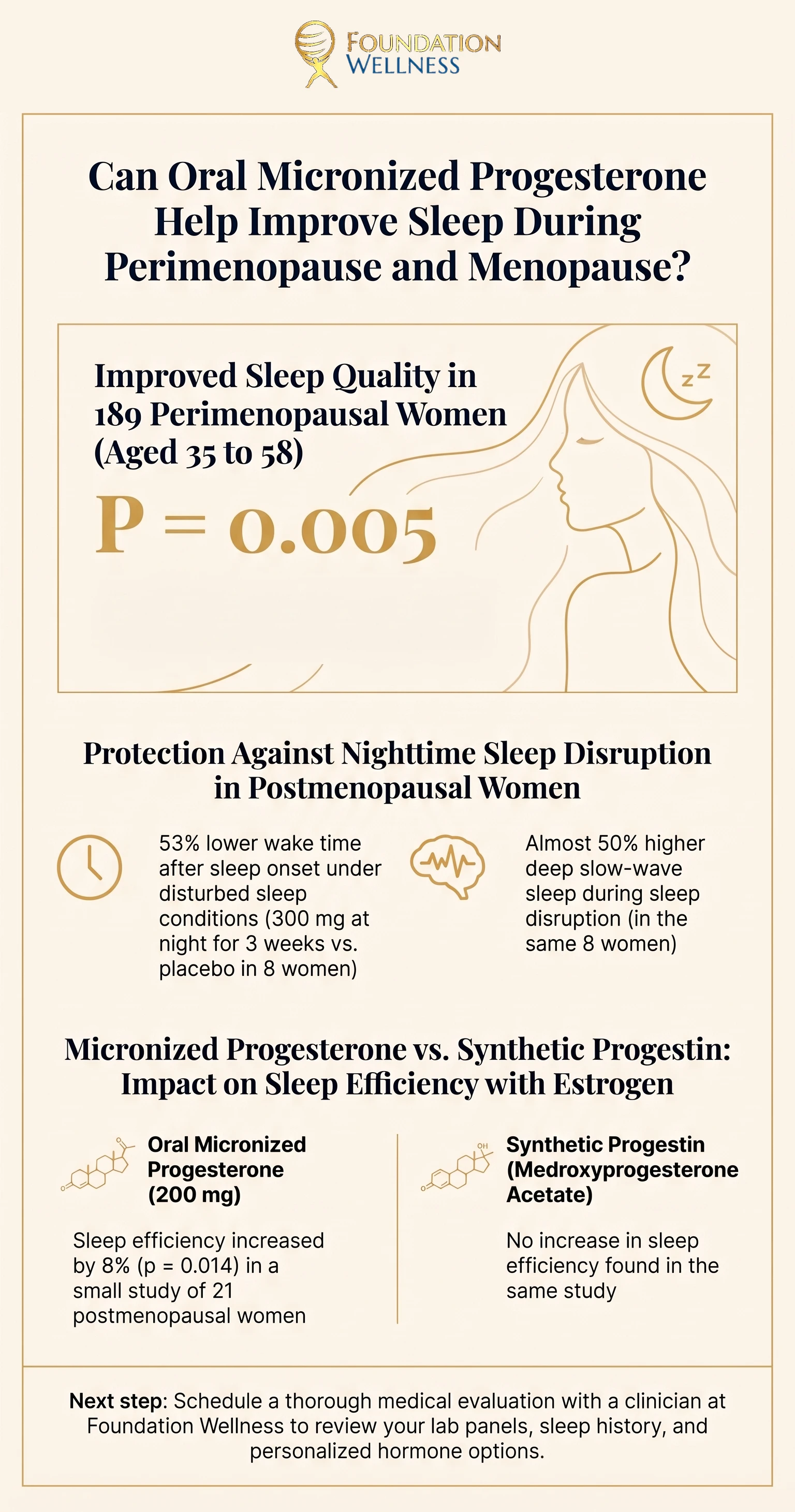
For some women, it seems to. In a randomized trial of 189 perimenopausal women aged 35 to 58, those who took 300 mg of oral micronized progesterone at bedtime reported improved sleep quality (P = 0.005) compared with placebo over 3 months. That’s how the women rated their own sleep. Encouraging, honestly. It’s a real signal. But it’s one trial, not a cure.
A quick word on that P value, because it trips up a lot of readers. A number below 0.05 means the difference between the groups is unlikely to be chance alone. It doesn’t tell you how big the change felt night to night. And it can’t tell you whether you’ll respond the same way.
A smaller study in the Journal of Clinical Endocrinology and Metabolism looked at sleep architecture, meaning how deep sleep and lighter stages fit together through the night. In 8 healthy postmenopausal women taking 300 mg at night for 3 weeks, progesterone had no effect on normal sleep. But when the researchers disturbed their sleep, wake time after sleep onset was 53% lower and slow-wave sleep almost 50% higher than on placebo. Slow-wave sleep is the deep, restorative sleep your body relies on.
So the pattern is genuinely interesting, and a little surprising. Progesterone didn’t make good sleep better. It helped protect sleep under sleep disruption, which is closer to what many women live with around menopause. Still, eight women is a very small group, so treat this as a clue about sleep disturbance rather than proof.
Now, why would a hormone do this? The same research team notes that “a number of neuroactive progesterone metabolites produce sedative-like effects.” That also helps explain the drowsiness many women feel. It doesn’t mean progesterone resets your sleep cycles, and no study here promises that.
Why Do Sleep Issues Start in Perimenopause?

Perimenopause is a time of big hormonal change. Hormone levels swing from month to month, and ACOG lists “sleep problems, and night sweats” among the symptoms of the years around menopause. So if you’ve been blaming yourself for lying awake, please don’t. Sleep issues are common, not a personal failing.
Declining progesterone is one plausible part of it. As ovulation becomes less regular and the menstrual cycle changes, progesterone levels fall, and with them the calming metabolites described above. That progesterone decline is a reasonable link. It isn’t a proven cause for every woman, though. Estrogen changes, night sweats, stress and shifts in your circadian rhythm all play a part too.
This article stays on sleep. If you want the wider picture, our guide to perimenopause symptoms covers the full range, and we explain other low progesterone symptoms and how low progesterone is tested in a separate article.
Can Progesterone Help Night Sweats and Nighttime Awakenings?
Night sweats are one of the most common reasons for nighttime awakenings. In the same perimenopause trial, the main hot flush score did not differ by therapy. Unfortunately, progesterone didn’t beat placebo on that measure. That’s disappointing if hot flashes are what keep you up. And a night sweat on a hot July night in Utah County, with the swamp cooler barely keeping up, is its own kind of miserable.
What changed was how women felt about their nights. Women perceived that progesterone caused decreased night sweats (P = 0.023), along with the better sleep quality described above, and no serious adverse events occurred. A perceived benefit is worth knowing about. It’s also smaller than a cure for hot flashes, and it’s fair to say so.
For postmenopausal women, the sleep data come from the smaller studies covered above. Every woman’s pattern is different. So menopausal women with heavy night sweats need an individual plan, not a copy of someone else’s prescription.
Which Form of Progesterone Is Best for Sleep?
The form matters more than most people expect. The sleep studies used micronized progesterone, which is the same molecule your body makes. You may see it called bioidentical progesterone or natural progesterone. A synthetic progestin is a different, lab-made compound.
One small study in the journal Menopause compared the two in 21 postmenopausal women who were also taking estrogen. With 200 mg of micronized progesterone, sleep efficiency increased by 8% (p = 0.014), with no such increase in the medroxyprogesterone acetate group. Medroxyprogesterone acetate is a synthetic progestin.
| Form | What it is | Sleep evidence found | Uterine protection with estrogen | Notes |
|---|---|---|---|---|
| Oral micronized progesterone | Capsule, same molecule as the body’s progesterone | Sleep efficiency up 8% at 200 mg with estrogen; better self-rated sleep quality at 300 mg | Yes, an FDA label use | Taken at bedtime; contains peanut oil |
| Synthetic progestin (medroxyprogesterone acetate) | Lab-made progestin | No sleep efficiency gain in the same study | Yes, ACOG says a progestin is used with estrogen | Not reported |
| Progesterone cream | Cream on the skin | No sleep evidence found in this research | Not reported | Not reported |
| Vaginal progesterone | Vaginal product | No sleep evidence found in this research | Not reported | Not reported |
Oral progesterone is the only form with sleep data here. That doesn’t mean the other forms are useless for other goals. For the wider debate, read our comparison of bioidentical and synthetic HRT.
When Should You Take Progesterone for Sleep?
Thankfully, timing is simple, and that’s part of why nighttime progesterone suits sleep. MedlinePlus says oral progesterone is taken “once a day in the evening or at bedtime” and that it “may make you dizzy or drowsy”, so if it does, you take your daily dose at bedtime.
The FDA label for oral micronized progesterone says it “should be taken as a single daily dose at bedtime.” Taken this way, the drowsiness tends to work with your night instead of against your day.
Your clinician sets the dose and the schedule for your progesterone therapy. Some plans use it every night, others on set days of the month. Please don’t change the timing or the amount on your own, even if one night goes badly.
Give it a fair trial and keep notes. Write down when you took it, how long it took to fall asleep, how many times you woke, and how you felt the next morning. That record makes your follow-up visit far more useful than memory alone. A notebook on the nightstand works fine. So does a notes app, if you can resist scrolling in the middle of the night.
Is Progesterone Safe to Take for Insomnia?
It can be part of a safe plan. But insomnia on its own isn’t what it’s approved for. The FDA label lists only two uses: “prevention of endometrial hyperplasia in nonhysterectomized postmenopausal women who are receiving conjugated estrogens tablets” and “secondary amenorrhea”. Better sleep is a welcome effect, not the labeled purpose.
One more thing from the FDA label: the oral progesterone capsules contain peanut oil. If you’re allergic to peanuts, tell your clinician before anything else.
If you take estrogen and still have a uterus, the progestogen in your plan has a safety job. ACOG says you “will need a hormone called progestin,” because it “helps reduce the risk of uterine cancer that can occur when estrogen is used alone.” That protection of the uterine lining is a core part of menopausal hormone therapy. It applies whether your plan is standard hormone replacement therapy or bioidentical hormone replacement therapy.
Feeling a little nervous about side effects is normal. Drowsiness and dizziness are the ones to plan around with oral progesterone. Don’t drive until you know how it affects you. That includes the early commute through Lehi or over the Point of the Mountain. And never start, stop or change hormone therapy without your clinician.
A few questions are worth bringing to that visit. Why is progesterone a fit for me, and what else could explain my sleep? Do I need it with estrogen, or on its own? What should I do if I feel groggy in the morning? And when will we check whether it’s working?
When Is Poor Sleep Something Else?
Not every bad night is hormonal. Loud snoring, gasping or choking at night, or heavy daytime sleepiness can point to sleep apnea. Other sleep disorders, low mood and some medicines can also cause poor sleep.
Progesterone doesn’t treat sleep apnea, and it doesn’t protect you from it. If a partner notices pauses in your breathing, that can be scary to hear. It needs its own evaluation, separate from any hormone plan.
Keep a short sleep diary for two weeks before your visit. Note your bedtime, wake-ups, night sweats and how you feel in the morning. In practice, it gives your clinician far more to work with than “I sleep badly.”
Sleep and Hormone Care at Foundation Wellness

Our Women’s Health & Hormone Optimization service is built on comprehensive lab work, bioidentical hormone therapy, and ongoing monitoring. We don’t prescribe hormones based on age or a single lab value. If progesterone fits your situation, we start from your labs and history. Then we check in with follow-up labs and adjust.
Our team in American Fork also looks at thyroid function and metabolic markers, because poor sleep isn’t always about one hormone. And if your sleep points to another cause, we’ll be honest with you about that.
Here’s what that care looks like in practice:
- Who we see. Our hormone service is for women in perimenopause or menopause dealing with things like hot flashes, night sweats, disrupted sleep, mood changes or brain fog. We also work with younger women whose hormones are affecting their energy, menstrual health or quality of life.
- The first visit. We start with detailed bloodwork, a thorough medical history, and an honest conversation about what you’re experiencing and what matters to you.
- The lab panel. It covers estradiol, progesterone, testosterone, DHEA-S, a thyroid panel and metabolic markers, among others. We also look at adrenal health and nutrient status.
- Dosing. If bioidentical hormone therapy is part of your plan, it’s carefully dosed and adjusted based on your response, not a one-size protocol.
- Coordinated care. Your hormone care can be coordinated with our weight management and mental wellness services when it makes sense.
Every treatment plan is overseen by a board-certified physician. If you’ve been told your labs are “normal” but you still don’t feel right, that’s a good reason to come in.
We see patients at our clinic at 456 E State Street, Suite 1400, American Fork, UT 84003, and by telemedicine across Utah. We’re accepting new patients, and same-day appointments are often available. Foundation Wellness accepts many insurance plans. Coverage depends on your plan, so check with our office first.
To start, call (800) 983-1974 or visit our women’s health and hormone care page.
This article is general information, not medical advice. Talk with a licensed clinician about your own sleep and hormone options.
Key Takeaways
- In one trial, oral micronized progesterone at bedtime improved how perimenopausal women rated their sleep quality.
- A small study found deeper sleep and less waking, but only when sleep was disturbed.
- Progesterone isn’t an FDA sleep drug, and insomnia isn’t a labeled use.
- Micronized progesterone, not a synthetic progestin, showed the sleep efficiency gain in one comparison.
- This research found no sleep evidence for progesterone cream or vaginal progesterone.
- Snoring, gasping or daytime sleepiness need a sleep apnea check, not just hormones.
Sources
- Scientific Reports (PMC), Oral micronized progesterone for perimenopausal night sweats and hot flushes: a Phase III randomized placebo-controlled trial (2023).
- Menopause, Sleep in menopause: differential effects of two forms of hormone replacement therapy (2001).
- Journal of Clinical Endocrinology and Metabolism (PubMed), Progesterone prevents sleep disturbances and modulates GH, TSH, and melatonin secretion in postmenopausal women (2011).
- MedlinePlus, Progesterone.
- DailyMed (NLM), Oral micronized progesterone capsules, prescribing information.
- American College of Obstetricians and Gynecologists, Hormone Therapy for Menopause.
October 5, 2026 · 11 min read