
Red Light Therapy Utah Guide: What the Research Shows
October 9, 2026
By Dr. Paul Frandsen, MD · October 9, 2026 · 6 min read
Medically reviewed by Dr. Paul Frandsen, MD
Red light therapy is a non-invasive treatment that shines red and near infrared light on your skin. Your cells absorb the light, and small studies link it with less inflammation, some pain relief and skin repair. If you want red light therapy in Utah, Foundation Wellness offers red light sessions to its patients. So what does this red light therapy Utah guide cover? How it works, what the research shows and what a session is like.
What Is Red Light Therapy, and How Does It Work?
Red light therapy, also called photobiomodulation, uses specific wavelengths of red and near infrared light. A 2017 review explains that the main light absorber is cytochrome c oxidase in mitochondria, the energy centers of your cells. The same review says the light can also increase ATP, the fuel cells use for cellular repair. Its authors frame photobiomodulation as a way to stimulate healing, ease pain and calm inflammation.
Dose matters. Low levels of light stimulate cells, and high levels can hold them back. So in practice, more isn’t always better. And much of the tissue repair research comes from the lab or from animals. That last part is a bit deflating, honestly, given how confidently red light gets talked about. We’d rather say it plainly than oversell it.
What Has Red Light Therapy Been Studied For?
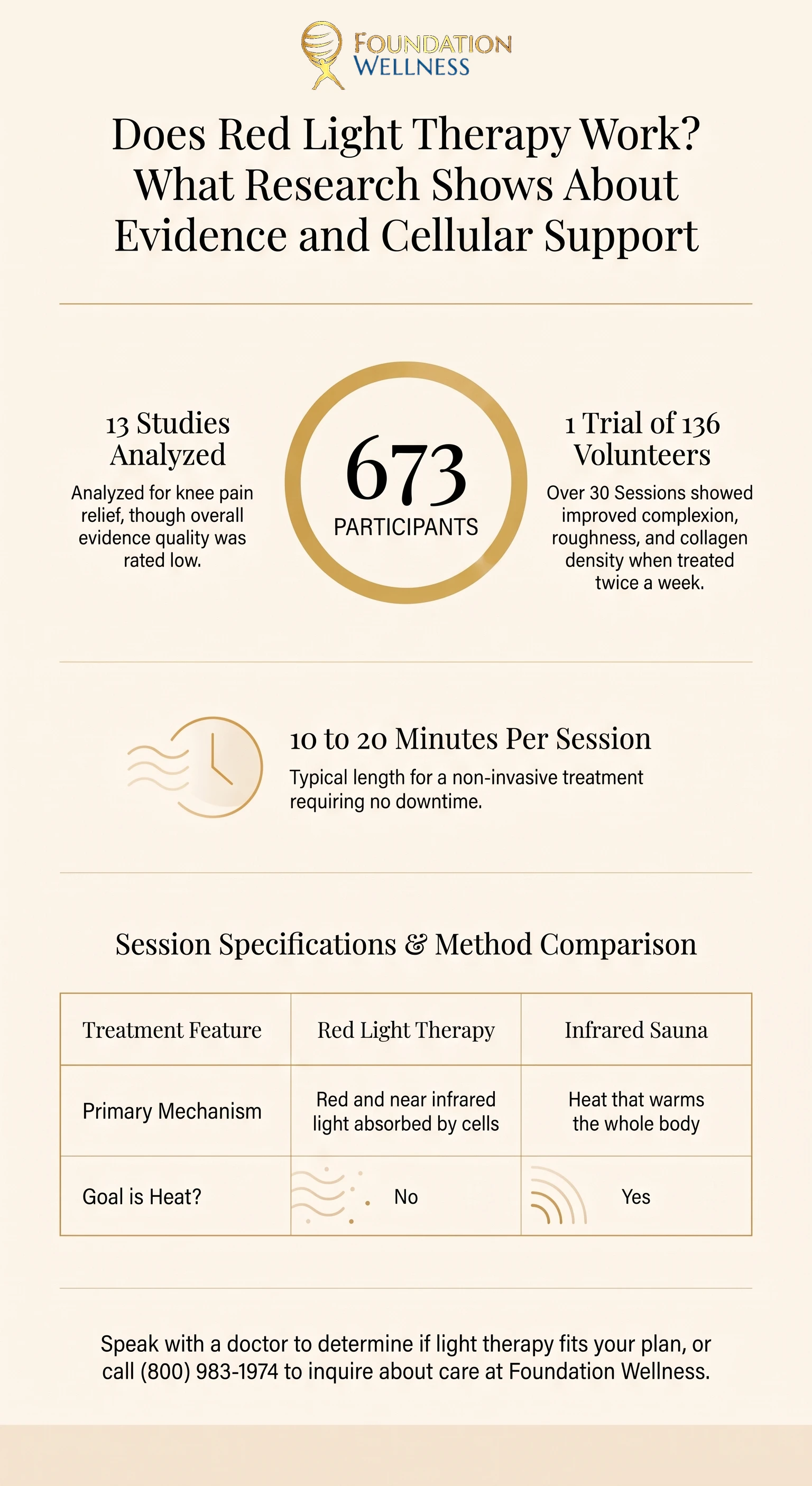
Reduced inflammation is one of the most repeated findings, mostly in the lab. In people, knee joint pain has some of the best data. That’s the part to read closely if your knees grumble after a hike up American Fork Canyon or a winter of shoveling snow on the Wasatch Front. A 2024 analysis of 13 studies with 673 participants found light therapy relieved pain better than a sham, but not function or stiffness, and rated the evidence quality as low.
Here’s the part people miss: these clinical trials mostly used low-level lasers, not consumer red light panels. Which is a little maddening if you already bought a panel for home use. A dermatology review also mentions wound healing, in this case the healing of burns. For other conditions, such as chronic pain or muscle recovery, our sources give no clear human data. People also tend to lump red light in with the bright light boxes sold for the winter blues (a fair thing to want during a gray inversion week in Utah County). They aren’t the same tool, and nothing in our sources tests red light for mood. So if you’re weighing it for joint health or pain management, see it as one piece to discuss with your doctor, not the whole plan.
Can Red Light Therapy Help Your Skin?

Skin health has more human research, with benefits reported for wrinkles, plus skin conditions like acne scars and raised scars. In one controlled trial of 136 volunteers, treated groups had light twice a week. After 30 sessions, skin complexion, skin roughness and collagen density had improved. But that was one study’s schedule, not a plan we prescribe.
Skin tone results vary, and stretch marks aren’t well studied in these sources. If skin rejuvenation is your goal, it pays to keep your hopes realistic. Not thrilling advice, we know. Then again, Utah’s dry air and strong high-altitude sun are rough on skin, so it makes sense if this is the section you skipped ahead to.
How Is Red Light Therapy Different From Blue Light and an Infrared Sauna?
| Feature | Red light therapy | Blue light | Infrared sauna |
|---|---|---|---|
| What it is | Red and near infrared light absorbed by cells | A shorter wavelength of light | Heat that warms the whole body |
| Goal is heat? | No | Not reported | Yes |
| Studied for (our sources) | Knee pain, inflammation, skin | Not reported | See our sauna guide |
These treatments aren’t interchangeable. For the heat side, read our infrared sauna in Utah guide.
Is Red Light Therapy Safe?
Thankfully, negative side effects are rare in the research. One review points to its non-invasive nature and almost complete absence of side effects.
Still, protect your eyes. Ask your doctor first if you are pregnant, sensitive to light, take a light-sensitizing medicine or have had skin cancer. Not sure one applies? Ask anyway.
What Happens in a Red Light Therapy Session, and Where Can You Book in Utah?
A red light session typically runs 10 to 20 minutes. It’s non-invasive, painless and needs no downtime. For a lot of people, that’s the appeal. You lie back, the light does its thing, and you’re back on State Street before you’ve really settled in. Think of it as support for your body’s own repair and overall wellness, not a cure.
At Foundation Wellness, red light and infrared sauna make up our onsite wellness service. We chose them as recovery therapies aimed at inflammation and cellular repair, not as spa extras. Here’s how red light usually fits into care with us:
- You start as a patient. Our care begins with a full evaluation: lab work, your medical history and lifestyle factors.
- Your clinical team weighs in. Red light can be a standalone session or part of your treatment plan, based on what your team recommends.
- It can sit next to other care. Someone in our weight optimization program might add red light to help with recovery as they get more active. Someone in hormone optimization might use the infrared sauna for stress reduction.
- Already a patient? Ask about onsite wellness at your next appointment.
Every treatment plan at Foundation Wellness is overseen by a board-certified physician.
Sessions are open to all Foundation Wellness patients at 456 E State Street, Suite 1400, American Fork, UT 84003, the nearest clinic for Lehi and all of Utah County. Our team can talk through whether red light fits your treatment plan. We also offer telemedicine across Utah, and we’re accepting new patients. Same-day appointments are often available. If you send a message through our contact page, our team typically responds within one business day.
Foundation Wellness accepts many insurance plans. Coverage depends on your plan, so check with our office first. See our red light and sauna page, book a visit, or call (800) 983-1974.
Key Takeaways
- Red light therapy uses light your cells absorb, not heat.
- Knee pain and skin have the most human data, but quality is often low.
- Side effects are rare. Protect your eyes and ask your doctor if you are pregnant or light sensitive.
- Foundation Wellness patients can book sessions at our American Fork clinic.
Sources
- AIMS Biophysics (PMC), Mechanisms and applications of the anti-inflammatory effects of photobiomodulation.
- Seminars in Cutaneous Medicine and Surgery (PMC), Low-level laser (light) therapy (LLLT) in skin: stimulating, healing, restoring.
- Photomedicine and Laser Surgery (PMC), A Controlled Trial to Determine the Efficacy of Red and Near-Infrared Light Treatment in Patient Satisfaction, Reduction of Fine Lines, Wrinkles, Skin Roughness, and Intradermal Collagen Density Increase.
- Aging Clinical and Experimental Research (PMC), A systematic review and network meta-analysis on the optimal wavelength of low-level light therapy (LLLT) in treating knee osteoarthritis symptoms.
October 9, 2026 · 6 min read