
Semaglutide vs Tirzepatide: Which Is Better for Weight Loss?
July 21, 2026
By Dr. Paul Frandsen · July 21, 2026 · 11 min read

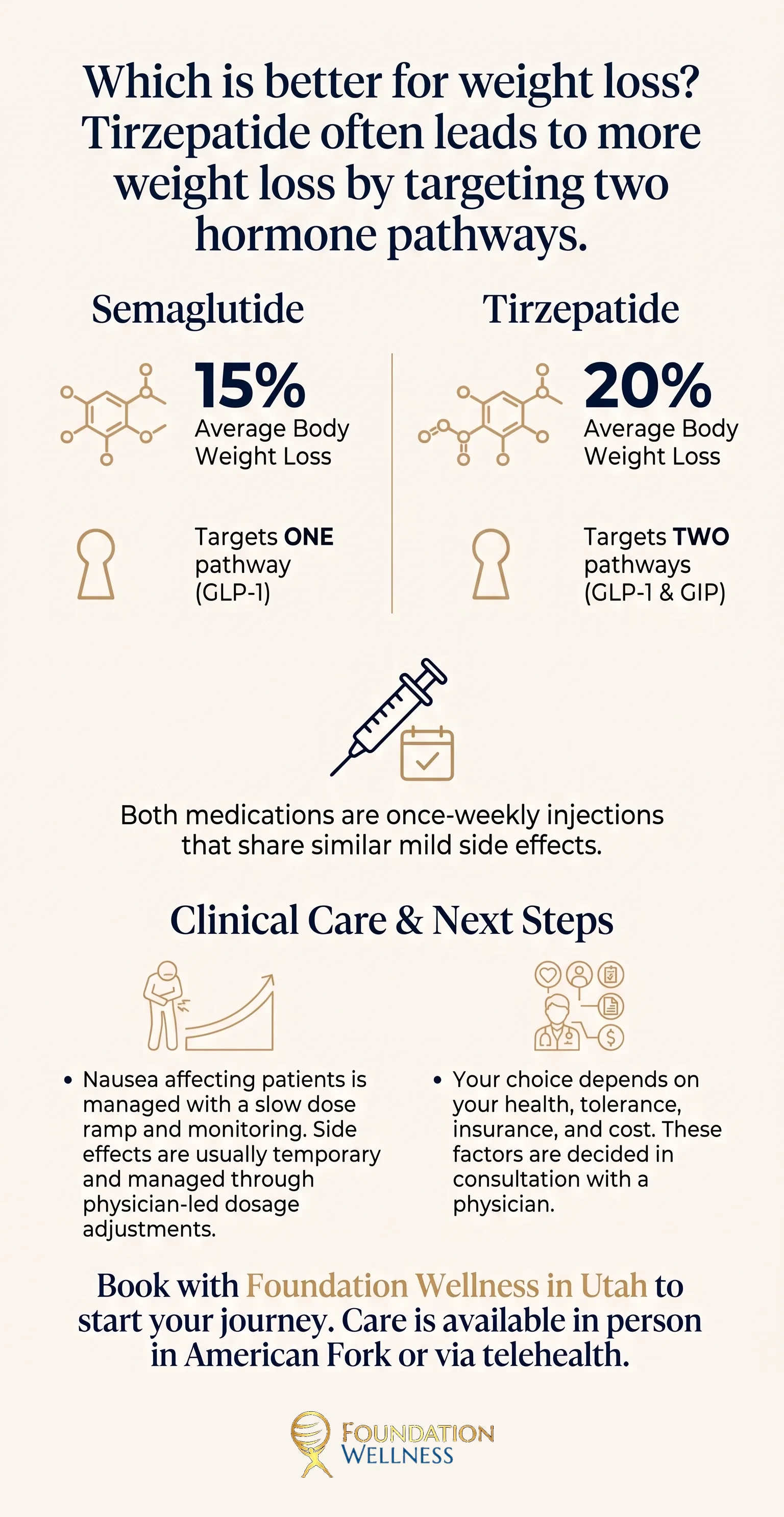
Semaglutide and tirzepatide are both prescription GLP-1 weight loss medicines you inject once a week. The short answer: in the one head-to-head obesity trial, tirzepatide produced more weight loss. The right pick still depends on your health, your side effects, and your budget. Here’s how they compare, and how we help you choose at Foundation Wellness in Utah.
What Are Semaglutide and Tirzepatide?
Both drugs copy hormones your gut releases after a meal. They quiet hunger signals in your brain. They slow how fast your stomach empties. And they steady your blood sugar. So you feel full sooner, stay full longer, and eat less without white-knuckling it all day.
The difference sits in how many pathways each drug touches.
Semaglutide works on one pathway. It is a GLP-1 receptor agonist, made by Novo Nordisk. You may know it as Ozempic or Rybelsus for type 2 diabetes, or as Wegovy for weight management.
Tirzepatide hits two targets at once. It acts on that same GLP-1 pathway plus a second gut hormone pathway called GIP. Eli Lilly makes it. The company sells it as Mounjaro for type 2 diabetes and as Zepbound for weight management. Researchers think the extra GIP action helps explain the larger average results. The full story is still being worked out.
Both drugs also nudge insulin secretion upward when your blood sugar levels climb after a meal. Then they ease off when levels fall. That is why they rarely cause low blood sugar on their own. As weight comes down, insulin sensitivity usually improves too.
Semaglutide vs Tirzepatide: Side-by-Side Comparison

Here is an honest comparison, drawn from the approved product labels and published trials.
| Feature | Semaglutide | Tirzepatide |
|---|---|---|
| Maker | Novo Nordisk | Eli Lilly |
| Hormone pathways | GLP-1 receptor agonist | GLP-1 and GIP receptor agonist |
| Weight-management brand | Wegovy (FDA approved 2021) | Zepbound (FDA approved 2023) |
| Approved for type 2 diabetes | Ozempic (2017), Rybelsus (2019) | Mounjaro (2022) |
| How you take it | Once-weekly injection | Once-weekly injection |
| Starting dose | 0.25 mg | 2.5 mg |
| Highest weight-management dose | 2.4 mg | 15 mg |
| Step-up schedule | About every 4 weeks | About every 4 weeks |
| Head-to-head result at 72 weeks | 13.7 percent of body weight | 20.2 percent of body weight |
| Common side effects | Nausea, diarrhea, constipation, reflux | Nausea, diarrhea, constipation, reflux |
| Extra approved use | Cutting heart attack and stroke risk in adults with heart disease | Moderate to severe sleep apnea with obesity |
| Oral version | Yes (Rybelsus, for diabetes) | No |
The FDA has approved both for adults who meet medical criteria. Each one is meant to be paired with a lower-calorie diet and more activity. Neither works well as a standalone fix.
How Much Weight Can You Lose on Each?
This is the question our patients ask more than any other. Here are the actual figures from the big clinical trials, not marketing copy.
- STEP 1, published in the New England Journal of Medicine in 2021. Adults with obesity took semaglutide 2.4 mg for 68 weeks. They lost about 15 percent of body weight, against about 2 percent on placebo.
- SURMOUNT-1, published in 2022. Adults took tirzepatide 15 mg for 72 weeks. They lost about 21 percent, against about 3 percent on placebo.
- SURMOUNT-5, published in 2025. This one is the direct comparison. 751 patients took one drug or the other at the highest dose they could tolerate, for 72 weeks. Tirzepatide averaged 20.2 percent. Semaglutide averaged 13.7 percent.
That last study is the cleanest answer available today. In it, 81.6 percent of the tirzepatide patients lost at least 10 percent of their body weight. Among the semaglutide patients, that figure was 60.5 percent.
Averages hide a wide spread, though. Some people in both arms lost far more than the headline number. Others lost very little. Your own result depends on your starting weight, how high a dose you tolerate, and how steady you are with food, sleep, and movement. Plateaus are frustrating, and they happen on both drugs.
Our patients land all across that range. Two people can start the same month on the same dose and sit in very different places half a year later. So we judge progress against your own trend line rather than a trial average.
There was an earlier comparison too. The SURPASS 2 trial did that back in 2021, reported in N Engl J Med. It put the two drugs head to head in patients with type 2 diabetes. Tirzepatide won on both weight and blood sugar control there as well. One catch: that study used semaglutide at 1 mg, well below the dose used for weight management. So it tells you less about weight loss treatment than SURMOUNT-5 does.
What Do They Do for Blood Sugar?
Both started life as diabetes drugs, and that history still matters. If you have type 2 diabetes along with extra weight, either medication can do double duty.
In type 2 diabetes trials, tirzepatide has produced slightly larger drops in A1c than semaglutide. A1c is a running average of your blood sugar over about three months. Both drugs improve insulin sensitivity as body fat comes off. Both blunt the after-meal spikes that wear out your pancreas over time.
If your A1c sits above target and you also carry extra weight, one weekly shot that moves both numbers is simpler than stacking two separate drugs, which is one reason treatment often starts here.
Do you take insulin or a sulfonylurea? Your prescriber usually lowers those doses when you start. That is a routine part of treatment. Our team coordinates that change with whoever manages your diabetes care, so the adjustment happens on purpose rather than by accident. It is also one more reason this belongs with a physician rather than a mail-order form.
Do They Have Different Side Effects?
Not really. The gastrointestinal side effects are close to the same, because they come from one place: your digestion slowing down. Nausea tops the list. Diarrhea, constipation, burping, and reflux show up too. Most of it stays mild. Thankfully, it fades over a few weeks for most patients.
Slow dosing is what keeps this manageable. Each medication starts low and steps up about every four weeks. If a step feels rough, we hold you there longer instead of pushing ahead. We learned to treat a bad week as a reason to pause, not a reason to power through. The line we repeat at check-ins: “the right dose is the highest one you can live with, not the highest one printed on the pen.” Skipping the ramp is the most common reason people quit early.
Serious problems are uncommon but real. Both drugs carry a boxed warning about thyroid C-cell tumors seen in rodent studies. Neither is used if you or a close relative has had medullary thyroid cancer or MEN 2. Pancreatitis and gallbladder trouble are listed risks for both. Dose increases are also when symptoms tend to flare, so that is when we check in.
Will You Lose Muscle Along With Fat?
Some muscle loss comes with any rapid drop in weight, and these drugs are no exception. When appetite falls sharply, protein intake usually falls with it. Lean tissue then pays part of the bill.
You can protect most of it. Eat protein at every meal. Lift weights two or three times a week. And do not chase the fastest possible drop on the scale. The scale alone hides this, because a pound of lost muscle and a pound of lost fat read exactly the same on it, which is why we check body composition instead. One patient can come down steadily and hold on to nearly all of their muscle. Another can lose the same weight with a real chunk of lean tissue in it. From a bathroom scale, those two look identical. Muscle loss then shows up early enough to correct. A reduced appetite is the point of the medication. It should not turn into months of undereating.
What About Compounded Semaglutide and Tirzepatide?

For a couple of years, compounded semaglutide was everywhere online, sold cheaply by telehealth outfits. That window has mostly closed. The FDA declared the tirzepatide shortage resolved in December 2024. It declared the semaglutide shortage resolved in February 2025. Legal compounding of straight copies wound down through the spring of 2025.
Be careful with anyone still pushing cheap copies. The FDA has warned about dosing errors with compounded medications sold in vials. Some patients drew up far more than they meant to. The agency has also flagged sellers using salt forms, such as semaglutide sodium. Those are not the same ingredient as the approved drug. A compounded medication is not bad by definition. It should come from a licensed prescriber who can tell you exactly what is in the vial.
Does Insurance Cover Either One?
Insurance coverage is the deciding factor for a lot of people, and it is uneven. Both drugs are approved for chronic weight management. Plenty of commercial plans still exclude that category outright, while covering the same molecule for diabetes.
A few things worth knowing.
- List prices for both sit above $1,000 a month without coverage. Both makers now run direct self-pay programs at lower rates.
- Medicare Part D is barred by law from covering a drug used only for weight loss. Wegovy became coverable for some patients after it earned the heart-disease approval in 2024.
- Many plans require documented prior attempts, a qualifying BMI, or step therapy before approving a weight loss injection.
Plans change their rules every January, so a denial last year does not settle the question, and we resubmit for patients whose employer added coverage in the new plan year. Our patients get that benefits check before they commit to anything. Then we tell you plainly what your plan is likely to do. If neither drug is affordable for you, we say so, and we talk about what else can help.
Which One Is Right for You?
No single drug wins for every patient, and any clinic that says otherwise is selling something. The better question is which one fits your body, your history, and your budget.
Tirzepatide tends to make sense when the largest possible weight loss is the goal. It helps if you tolerate the step-ups well. Semaglutide has a longer safety record, an oral option for diabetes, and the heart-disease approval behind it. Cost and coverage often settle the argument before biology does.
Your healthcare provider should weigh your other medicines and your kidney and thyroid history. Any past pancreatitis matters, along with your tolerance for nausea. Switching later is common and reasonable. Some patients start on one weight loss medication, stall out or feel rough, and move to the other. That transition restarts at a low dose rather than matching the old one.
One more honest point. Injectable medications are a tool, not a cure. Appetite comes back when you stop, so treatment has to include food, strength training, and sleep from day one. In our experience, the people who do best treat the drug as one part of a plan. You can see how we build that plan on our GLP-1 weight loss in Utah page. The wider program sits on our medical weight optimization page.
How to Start With Foundation Wellness
Getting started is simple. Book a free consult, get proper lab work, and meet with a physician who reviews your results and goals. If a GLP-1 fits, we help you choose between a semaglutide or tirzepatide injection. That call rests on your labs and your budget, not a stock script. We start patients at the lowest dose, and we revisit your treatment goals at every visit. If a GLP-1 does not fit, we tell you and point you toward what will help.
Want the numbers first? Our GLP-1 cost breakdown for Utah walks through pricing. Our guide to GLP-1 side effects in the first month covers what the ramp-up actually feels like. Whether you come down from Salt Lake County or up from Provo, that first visit looks the same. We serve American Fork and all of Utah, in person and by telehealth.
Key Takeaways
- Semaglutide and tirzepatide are both once-weekly GLP-1 shots that curb appetite, slow digestion, and support weight loss.
- Semaglutide works on one hormone pathway; tirzepatide works on two, GLP-1 and GIP, which helps explain its larger average results.
- In the 2025 head-to-head trial, tirzepatide averaged 20.2 percent body-weight loss against 13.7 percent for semaglutide over 72 weeks.
- Side effects are nearly the same, mostly digestive, and are managed with a slow ramp and unhurried dose increases.
- Compounded copies are largely off the table since the FDA resolved both shortages in late 2024 and early 2025.
- Insurance coverage, not biology, decides the choice for a lot of people, so check your plan before you pick.
- Foundation Wellness serves American Fork and all of Utah, in person and by telehealth.
Sources
- New England Journal of Medicine, STEP 1, SURMOUNT-1, SURMOUNT-5 and SURPASS-2 trial reports.
- U.S. Food and Drug Administration, drug approvals and compounding guidance.
- National Institute of Diabetes and Digestive and Kidney Diseases, prescription medicines to treat overweight and obesity.
- Mayo Clinic, patient drug information for semaglutide and tirzepatide.
- Cleveland Clinic, GLP-1 agonist overview.
Dr. Paul Frandsen
July 21, 2026 · 11 min read