
Signs of Low Testosterone in Men: Symptoms and Blood Tests
October 22, 2026
By Dr. Paul Frandsen, MD · October 22, 2026 · 9 min read
Medically reviewed by Dr. Paul Frandsen, MD

The most common signs of low testosterone in men are a low sex drive, erection problems, sleep problems, loss of muscle size and strength, more body fat, bone loss, depression and trouble concentrating. Some men also notice enlarged breasts, less face or body hair, or a low sperm count. MedlinePlus notes that some men with low testosterone have no symptoms at all, and many of these signs have other causes.
So treat the list below as a reason to get checked, not a diagnosis. A blood test, not a symptom quiz, is what confirms low testosterone. We know that’s not the quick answer most men are hoping for. But it’s the accurate one.
What Is Low Testosterone in Men?
Testosterone is a hormone made mainly by the testicles. It drives sex drive and erections, keeps bones and muscles strong, shapes hair growth and where fat sits on the body, and helps make sperm and red blood cells. It also boosts energy and mood. That’s a long job list for one hormone, which is why a drop can show up in so many different places.
Low testosterone, often shortened to low T, means testosterone production has dropped below what the body needs. Doctors also call it testosterone deficiency or male hypogonadism, a condition in which the testes make little or no hormone. The cause can sit in the testicles themselves or in the parts of the brain (the hypothalamus and pituitary) that control them.
The Endocrine Society is clear about what counts. A diagnosis needs symptoms of low testosterone plus consistently low, accurately measured testosterone levels in the blood. Both of them, not one or the other. Honestly, that rule works in your favor. Nobody should get labeled off one rough morning.
What Are the Signs of Low Testosterone in Men?

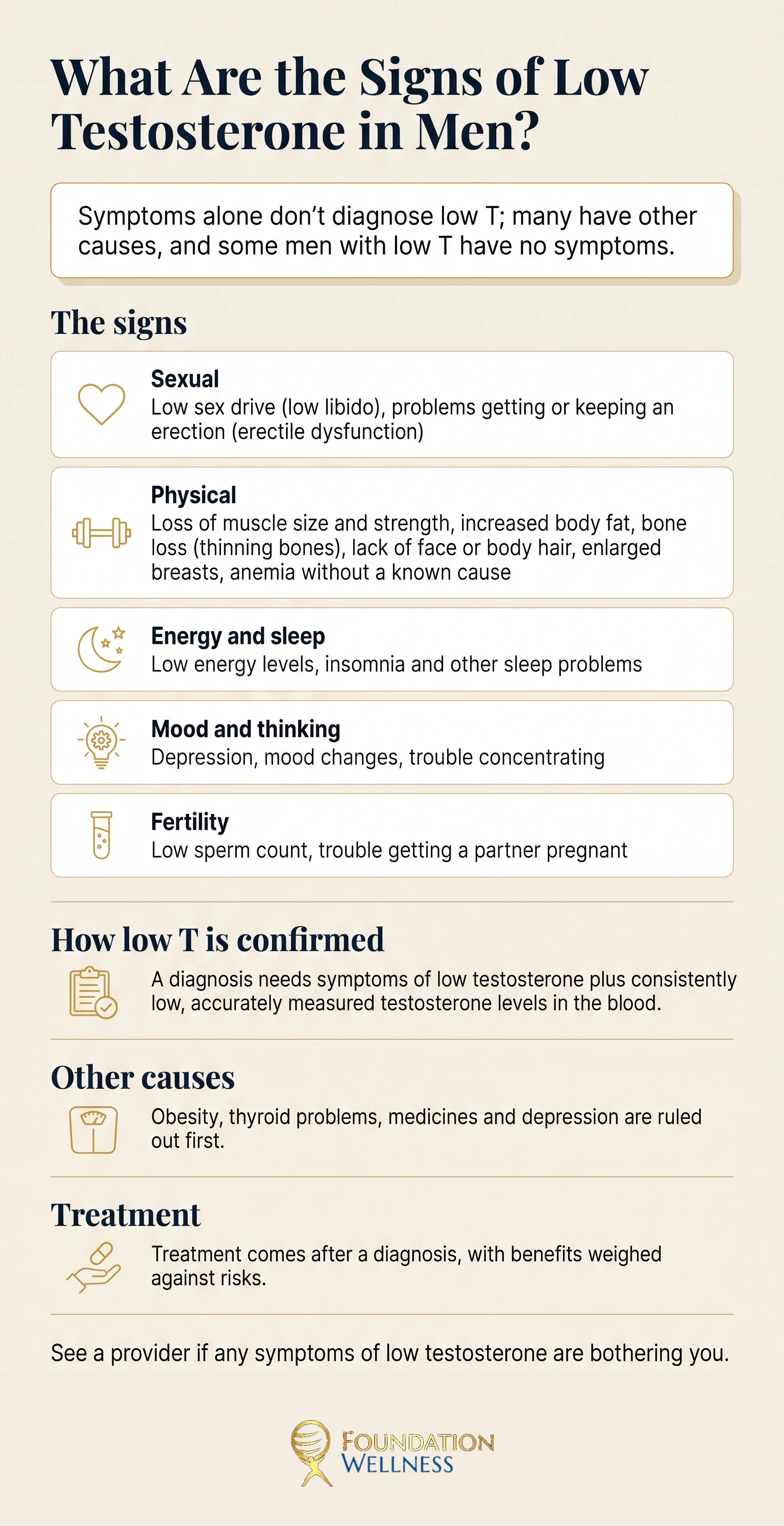
The signs fall into five groups. The table below pulls them together from MedlinePlus, along with the job testosterone normally does in each area.
| Sign group | What men notice | Why it happens |
|---|---|---|
| Sexual | Low sex drive (low libido), problems getting or keeping an erection (erectile dysfunction) | Testosterone helps maintain sex drive and erections |
| Physical | Loss of muscle size and strength, increased body fat, bone loss (thinning bones), lack of face or body hair, enlarged breasts, anemia without a known cause | Testosterone keeps bones and muscles strong, sets hair growth and fat placement, and helps make red blood cells |
| Energy and sleep | Low energy levels, insomnia and other sleep problems | Testosterone helps boost energy |
| Mood and thinking | Depression, mood changes, trouble concentrating | Testosterone helps boost mood |
| Fertility | Low sperm count, trouble getting a partner pregnant | Testosterone is needed to make sperm |
One sign on its own says little. Plenty of men are tired. Raising kids, a long commute on I-15, a crazy season at work… it all adds up. Low T symptoms tend to show up as a cluster, such as low sex drive with less muscle mass and tiredness. If that pattern sounds familiar, and you live in American Fork, Pleasant Grove or anywhere in Utah County, our Men’s Health and TRT team in American Fork can check your levels properly.
What Are the Early Signs of Low T Most Men Miss?
Low T usually creeps in rather than arriving overnight. MedlinePlus says testosterone levels may start to drop slowly from around age 30 to 40, so early changes are easy to chalk up to work, kids or a bad stretch of sleep. Sound familiar? Honestly, that’s the frustrating part: the changes are real, but they’re easy to explain away.
Sex drive is a good example. It’s normal to feel less interested in sex as you get older, but MedlinePlus says it’s not usually normal to have no interest in sex. Other quiet signs are poor sleep, a harder time focusing, and body fat that creeps up even though your habits haven’t changed. And sometimes the first clue isn’t something you feel at all. It’s a routine blood test that shows anemia without a known cause.
Mood is the sign men talk about least. That’s a shame, because it counts just as much as the others. Depression is on the symptom list, and we cover that link in detail in can low testosterone cause depression.
How Is Low Testosterone Diagnosed?
Symptoms alone are not diagnostic, according to the Endocrine Society, because low energy, libido and mood are common in men and have many causes. In most cases, diagnosis starts with a talk about your symptoms and a check for other causes, then blood work. We get it. When you feel lousy, you want an answer today, and waiting on labs can be annoying.
The Endocrine Society says a diagnosis should rest on at least two early-morning, fasting testosterone tests. Timing matters, more than most guys expect. MedlinePlus explains that blood is drawn in the morning, between 7 and 10, when testosterone levels are typically highest. So yes, that means an early alarm and skipping breakfast. Not fun, but worth it.
Total testosterone, which counts both bound and free testosterone, is the most common test. The Endocrine Society guideline recommends a free testosterone test when total testosterone is near the lower limit of normal or when a condition alters the protein that carries testosterone in the blood.
The lab matters too. The Endocrine Society warns that the same blood sample can read low or normal depending on the lab and method, and that assays certified by the CDC HoST program give results that line up. It’s a surprising detail, and it’s one more reason a single borderline number shouldn’t settle anything. Your provider may also check other hormone levels, such as LH, FSH and prolactin, along with thyroid tests, iron, anemia and sperm count.
What Testosterone Level Counts as Low?
The Endocrine Society describes the common clinical threshold as near 300 ng/dL. The American Urological Association guideline also bases the diagnosis on total testosterone levels read together with symptoms and signs.
Here’s the catch, though. Near 300 ng/dL is a guide, not a universal cut-off. Many testosterone tests use different methods and reference ranges, so a result is read with your symptoms and repeated before anyone calls it low.
Age also changes what’s typical. MedlinePlus notes that the normal range is much lower in a man aged 50 to 60 than in a man aged 20 to 30. For numbers by decade, see our guide to testosterone levels by age.
What Else Can Cause the Same Symptoms?
Several conditions either lower testosterone or cause the same symptoms. Your provider will want to rule these out.
- Aging, since levels fall slowly over time.
- Too much body fat (obesity).
- Low thyroid function.
- Side effects of medicines such as chemotherapy, corticosteroids or opioids.
- Depression (yes, it’s on the symptom list too).
- High blood pressure or diabetes.
- Testicle injury or cancer.
- Problems with the pituitary gland or hypothalamus.
- Chronic liver or kidney disease, and alcohol use disorder.
According to the Endocrine Society, reversible contributors, such as obesity and medicines like corticosteroids or opioids, should be ruled out first. Low energy, libido and mood have many causes, so tell your provider about stress, sleep and workload too. It can feel like oversharing. It isn’t.
Do the Signs of Low T Differ by Age?
The signs are the same at any age. The Endocrine Society says the approach and definition of the diagnosis are the same for a man of any age, whether he’s in his 20s, 30s, over 40 or over 55.
What changes with age is the background. A slow decline in testosterone levels is natural from around 30 to 40, and some symptoms, like a lower interest in sex, can be a normal part of aging. But a younger man with clear signs deserves the same blood tests as an older one. Being young doesn’t rule it out. We’d hate to see a guy in his early 30s brush off clear symptoms because he figures he’s too young for this. Typical ranges by age are covered above.
When Should You See a Doctor About Low Testosterone Symptoms?

See a provider if any symptoms of low testosterone are bothering you. MedlinePlus lists these as reasons for men to call: breast enlargement, impotence, loss of body hair, problems with sex drive, weakness, and problems getting a partner pregnant.
Feel fine? Then you don’t need a test. That’s the good news. The Endocrine Society finds no support for screening men who have no symptoms.
How Is Low Testosterone Treated?
Treatment depends on the cause. When low testosterone is due to being overweight or obese (BMI over 27) with no other cause, the Endocrine Society says weight loss is typically the first-line therapy. It’s not the answer some men walk in hoping for, but it’s where the guidance starts.
For other men, testosterone replacement therapy (TRT), a form of hormone replacement therapy, may help. The FDA approves testosterone products only for men who lack or have low testosterone levels together with an associated medical condition. MedlinePlus says TRT can be given as a pill, gel, patch, injection or implant. If symptoms don’t change after 3 months, TRT is less likely to help. That can be a letdown to hear, but it’s better to know up front. The Endocrine Society says benefits must be weighed against risks, and long-term safety, including for prostate cancer, isn’t yet established.
Learn more in our guides to TRT side effects and how long TRT takes to work.
Low T Testing and Care at Foundation Wellness in American Fork
At Foundation Wellness, we start a low testosterone visit with your history and proper morning lab work. If testosterone therapy fits, we prescribe it and follow up with regular checks. If something else explains your symptoms, we’ll tell you that too. That second answer is just as useful, even if it isn’t the one you expected. This guide was written and reviewed by Dr. Paul Frandsen, a Foundation Wellness physician.
Our clinic is at 456 E State Street, Suite 1400, American Fork, UT 84003. Pleasant Grove is served from this same American Fork clinic, and if the drive doesn’t work for you, we offer telemedicine visits across Utah. See TRT in Utah for how care works here. Foundation Wellness accepts many insurance plans. Coverage depends on your plan, so check with our office first.
Call (800) 983-1974 to book an evaluation.
Key Takeaways
- Signs of low testosterone in men fall into five groups: sexual, physical, energy and sleep, mood and thinking, and fertility.
- Symptoms alone don’t diagnose low T; many have other causes, and some men with low T have no symptoms.
- Low T is confirmed with at least two early morning, fasting blood tests, with a common threshold near 300 ng/dL.
- Obesity, thyroid problems, medicines and depression are ruled out first.
- Treatment comes after a diagnosis, with benefits weighed against risks.
Sources
- MedlinePlus, Low testosterone
- MedlinePlus, Testosterone Levels Test
- MedlinePlus, Hypogonadism
- Endocrine Society, Statement on Testosterone Replacement Therapy (2026)
- Bhasin S, et al. Testosterone Therapy in Men With Hypogonadism: An Endocrine Society Clinical Practice Guideline. J Clin Endocrinol Metab. 2018 (PMID 29562364)
- Mulhall JP, et al. Evaluation and Management of Testosterone Deficiency: AUA Guideline. J Urol. 2018 (PMID 29601923)
- FDA, FDA issues class-wide labeling changes for testosterone products (2025)
October 22, 2026 · 9 min read