
Testosterone Pellets vs Injections vs Gel: Which Is Best?
July 24, 2026
By Dr. Paul Frandsen · July 24, 2026 · 9 min read
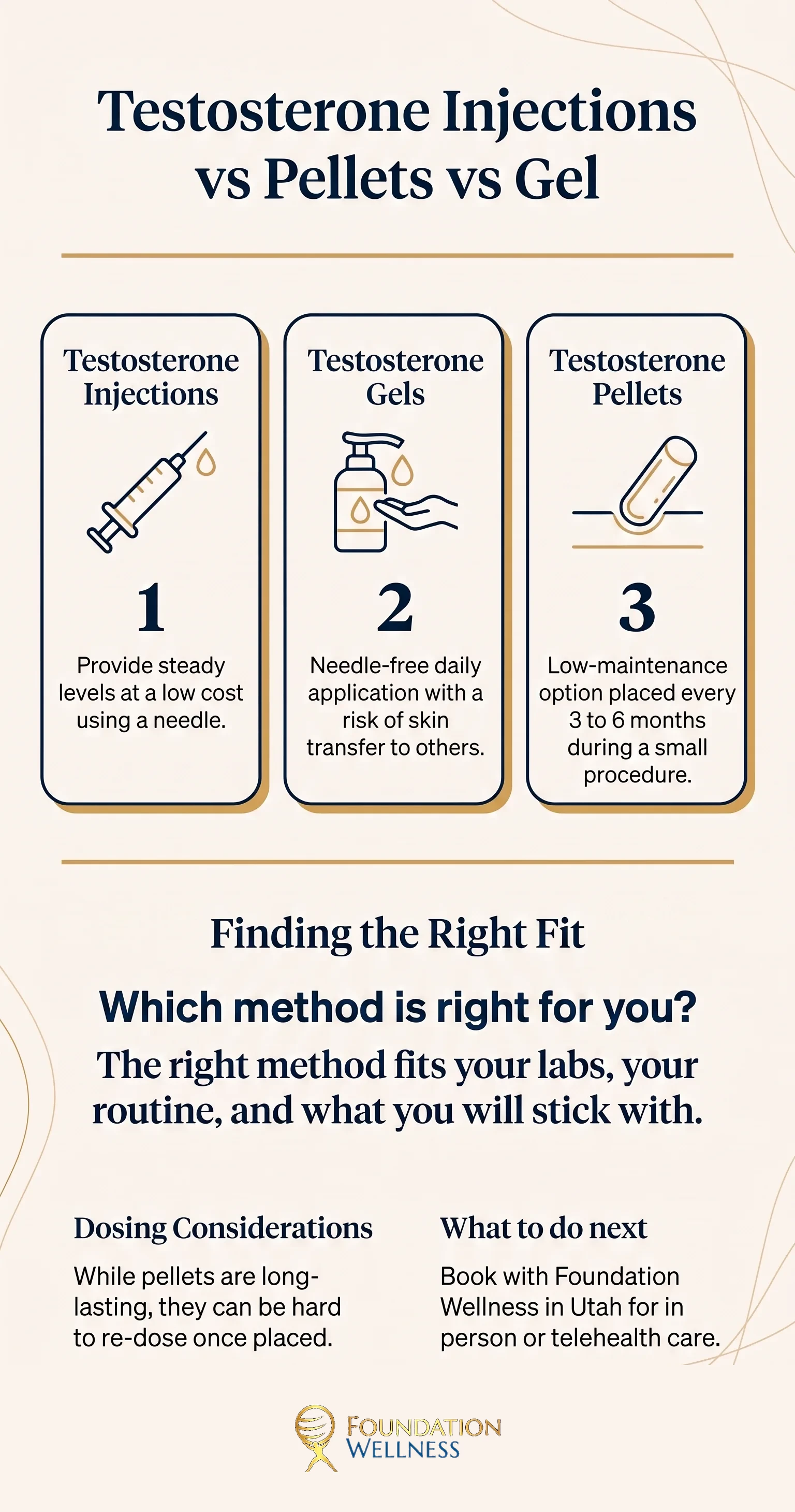
Testosterone pellets, injections, and gel all treat low testosterone. They differ in how often you dose and how steady your levels stay. Pellets last 3 to 6 months with no daily routine. Injections cost the least and adjust the fastest. Gel is needle free but has to go on every day. Here’s how the three compare.
Why Does the Delivery Method Matter?
Getting a prescription is the easy part. How the hormone actually gets into your body shapes your week, your budget, and how even you feel between doses. Some men want the lowest price. Others hate needles. Plenty just want to think about it twice a year and be done. Our patients ask about pellets more than the other two options, usually after a friend at the gym quit doing weekly shots.
There’s no single right answer here. According to the Endocrine Society, testosterone replacement should be matched to the patient and monitored with follow-up labs rather than run off a template. So let’s compare each hormone delivery method honestly, including what each one costs you in effort.
How Do Testosterone Injections Work?
Injections remain the most common form of testosterone replacement therapy. You inject testosterone cypionate or enanthate into muscle, or just under the surface with a much smaller needle, every 1 to 2 weeks. Each injection takes a minute. The price is usually the lowest of any option.
The trade-off is the needle and the rhythm. Levels peak after a dose and drift down before the next one, which some men feel and others don’t notice at all. Splitting the weekly amount into two smaller shots smooths that curve. And if your dose needs changing, it changes with the very next injection.
In our experience, the men who stay on injections for years tie the shot to a fixed day. Sunday morning, before anything else starts, tends to stick. The ones who struggle left it floating somewhere in the week.
How Do Testosterone Gels and Creams Work?
Gel is the needle free route. You rub a measured dose onto your shoulders, upper arms, or abdomen once a day, and it absorbs through the skin. Creams work the same way. For a man who dreads needles, that one fact often settles the decision.
Two catches come with daily gels. First, they only work if you use them every day, without skipping. Second, testosterone can transfer to another person through skin contact before it dries. According to the U.S. Food and Drug Administration, testosterone gels carry a boxed warning about secondary exposure in children. Women and kids at home are exactly why that warning exists, so cover the area and wash your hands.
What About Testosterone Patches?
Patches are the fourth option, and the least used today. You wear one on clean skin daily and it releases a steady amount overnight. Irritation at the patch site is common enough that plenty of men abandon them within a few months. Still worth knowing about, because some insurance plans cover patches when they balk at other forms of hormone therapy.
What Are Testosterone Pellets?
Testosterone pellets are small solid cylinders of crystalline testosterone placed under the skin, usually in the upper hip or buttock. They dissolve slowly and release testosterone for roughly 3 to 6 months. Testopel is the FDA approved version for men, and compounded testosterone pellet implants are also widely used.
Because they sit quietly under the surface doing their job, there’s nothing to remember. No weekly shot. No morning gel. Many men report more even energy on testosterone pellet therapy than on a weekly cycle, since the release curve is flatter from week to week.
One thing we learned watching men run full pellet cycles is that the end of the cycle is the part they feel, not the start. One patient notices the taper near month 4 while another holds steady past month 6. That spread is why we time the next insertion off symptoms and labs rather than the calendar alone.
What Happens During Pellet Insertion?
Pellet insertion is a short in-office procedure. Your provider numbs a small area, makes a tiny opening, and uses a trocar to slide the tiny pellets in below the fat layer. The visit runs about 10 to 15 minutes. A dressing covers the site, and most men head back to desk work the same afternoon.
Our team goes over aftercare in the room before you leave. The questions that come up two days later are usually simple: showering, lifting, and how long the soreness lasts. Skip heavy lifting, hot tubs, and swimming for a few days while the site closes. Then you’re finished until the next round. Ask about pellet extrusion before you book, too. Once in a while one pellet works its way back out through the opening, and that means a repeat visit.
Is Bioidentical Testosterone the Same Thing?
Mostly yes, and the label carries less weight than the marketing suggests. Bioidentical testosterone has the same molecular structure as what your body makes, so hormone pellet therapy and bioidentical hormone replacement therapy often describe the same product. Synthetic hormones are close in shape but not identical.
Here’s the part worth pinning down. Compounded hormone pellet products are not FDA approved, which means dose consistency isn’t verified the same way. That’s not a reason to rule them out. It is a reason to ask which product your clinic uses and to keep your blood work on schedule. Our guide to hormone replacement therapy in Utah digs further into that distinction.
Testosterone Pellets vs Injections vs Gel: A Side by Side Look
Here’s an honest comparison across the things men actually ask about.
| Feature | Injections | Gel or cream | Testosterone pellets |
|---|---|---|---|
| How often | Every 1 to 2 weeks | Once a day | Every 3 to 6 months |
| Steadiness | Good, with mild peaks | Even day to day | Very even, tapers at the end |
| Dose changes | Immediate | Immediate | Hard until they dissolve |
| Effort | Weekly routine | Daily routine | Two visits a year |
| Transfer risk to others | None | Yes, through skin | None |
| Procedure needed | Self injection | None | Minor in-office insertion |
| Cost pattern | Lowest per month | Middle | Higher per visit |
Read that table by row, not by column. The row that matters most to you decides your method, and for a lot of men it’s the effort row.
Who Is a Good Fit for Testosterone Pellet Therapy?
Testosterone pellet therapy suits men with confirmed testosterone deficiency who want the lowest maintenance option and already know their dose. If your labs have been stable for a while and the weekly rhythm wears on you, this is a strong fit.
It fits less well at the start. While your dose is still moving, injections give your provider room to adjust every week or two. Women use pellet therapy as well, at much smaller doses, so ask about that if you and your partner are both being treated.
What Should You Expect After Starting?
Give it a real runway. Testosterone levels climb within days of the first dose, but how you feel lags behind the lab result. Libido and mood often shift inside the first few weeks. Energy, strength, and muscle mass take longer, sometimes three to six months. Men who started because of erectile dysfunction see mixed results, since low testosterone is only one of several causes.
Sexual health, sleep, and body composition are what most men end up tracking. Keep a short log on your phone. It makes your follow-up far more useful than trying to recall how the last two months felt. We recheck bloodwork about 6 to 8 weeks after a dose change. Once your numbers hold, we move to a longer rhythm. Patients who bring that log get a sharper conversation at each visit. Our how long TRT takes to work guide lays out a realistic timeline.
What Are the Side Effects and Risks?
Every form of testosterone treatment shares a core set of risks, plus a few tied to delivery. Testosterone can push your red blood cell count up, which is why hematocrit gets checked. Some of it converts to estrogen, so breast tenderness or fluid retention can show up. Acne and worsening sleep apnea affect some men.
Two rules apply no matter which method you pick. Testosterone therapy is not appropriate for men with known or suspected prostate cancer, per FDA labeling. Fertility can also drop during treatment, so speak up if you want kids in the next few years. Pellets add their own site risks: bruising, infection, and the extrusion mentioned above. Our TRT side effects guide covers the full list.
How Do You Choose the Right Method?
Start with three questions. Do needles bother you? How much daily effort are you willing to spend? What does your budget look like month to month? Your answers usually narrow the field to one or two options in about a minute.
Then look at your numbers. Two separate morning tests need to show low testosterone. Paired with symptoms like flat libido, low energy, or lost strength, that is what justifies treatment. According to the Mayo Clinic, testosterone declines gradually with age, and symptoms alone don’t confirm a hormonal imbalance. A single low reading doesn’t prove a hormone imbalance either. Blood tests, repeated, do.
How Foundation Wellness Handles Testosterone Replacement Therapy
We start with blood work rather than a sales pitch. Dr. Paul Frandsen reviews your testosterone level, your symptoms, and your history, then walks you through injections, gel, and testosterone pellets with the real trade-offs attached. If your hormone levels sit on the border, we retest before treating anything. Our clinic sits in American Fork and treats men and women from Lehi, Pleasant Grove, Provo, and along the Wasatch Front, in person and by telehealth across Utah.
Plenty of our patients start on injections while we dial in the dose, then move to testosterone pellet therapy once their hormone levels hold. In our experience, the men happiest with pellets are the ones whose dose stopped changing months ago. That order buys you steady testosterone levels without locking in a dose too early. Compare pricing on our TRT cost in Utah guide, get the basics on our TRT in Utah page, and see the full program under men’s health and TRT services. Call us if you want a straight answer about which method fits your week.
Key Takeaways
- Injections, gel, and testosterone pellets all treat low testosterone, just on different schedules.
- Injections cost the least and let your provider change the dose immediately.
- Gel is needle free but needs daily use and can transfer to others through skin contact.
- Testosterone pellets last 3 to 6 months and hold steady levels, but the dose is fixed once placed.
- Placing the pellets is a 10 to 15 minute office visit, with bruising or extrusion as the main site risks.
- Women use pellet therapy too, at much smaller doses than men.
- Testosterone therapy is not for men with known or suspected prostate cancer, per FDA labeling.
- Foundation Wellness serves American Fork and all of Utah, in person and by telehealth.
Sources
- Endocrine Society - endocrine.org
- U.S. Food and Drug Administration (FDA) - fda.gov
- Mayo Clinic - mayoclinic.org
Dr. Paul Frandsen
July 24, 2026 · 9 min read