
TRT in American Fork, Utah: Your Local Clinic Guide
July 8, 2026
By Dr. Paul Frandsen · July 8, 2026 · 10 min read

Foundation Wellness runs a physician-led TRT clinic on State Street in American Fork, Utah. If you searched “TRT American Fork” and want real clinical guidance instead of an anonymous online script, you’re in the right place. We draw bloodwork onsite, read your lab results with you, and build a treatment plan around your numbers and your goals. No mail-in kits. No guessing.
What Is Testosterone Replacement Therapy, and Why Treat It Locally?
Testosterone replacement therapy tops up the testosterone your body no longer makes enough of. It’s medical treatment for a measurable shortage. It isn’t a shortcut, and it isn’t steroid abuse. A man’s level drops slowly with age, and for some guys that slide is steeper than it should be. When levels fall, the symptoms creep in. Low energy. Brain fog. Mood swings your family notices before you do. You lose muscle mass and put on weight around the middle, so your whole body composition shifts. Sleep gets worse. Sex drive and sexual function fade. According to the Cleveland Clinic, those are common symptoms of low testosterone in men. They also overlap with other health conditions worth ruling out.
Not every man with those signs needs hormone therapy. That’s why lab testing comes first. According to the American Urological Association, a low reading should be confirmed with more than one morning blood test before treatment begins. A clinic that follows that standard won’t hand you a script off a web form. It won’t read one number apart from your health history, either.
So why choose a local wellness clinic over a subscription site? TRT is ongoing care, not a one-and-done prescription. Therapy works best when someone can draw your labs, examine you in person, and tune the dose over months. When the clinic is close, follow-ups are a short drive instead of another video call with a stranger. You get clinical guidance from the same physician who read your first panel, and if your bloodwork drifts, we catch it early. Testosterone also plays a role in bone health and muscle, so the long game matters more than the first refill.
Plenty of men around here get told their labs are “normal” and still feel flat, which is frustrating. In our experience, that gap between a technically fine panel and how a man actually feels is what brings most of our patients through the door in the first place. Local care means somebody looks at your whole health picture instead of one line on a printout.
What Happens at Your First Visit?

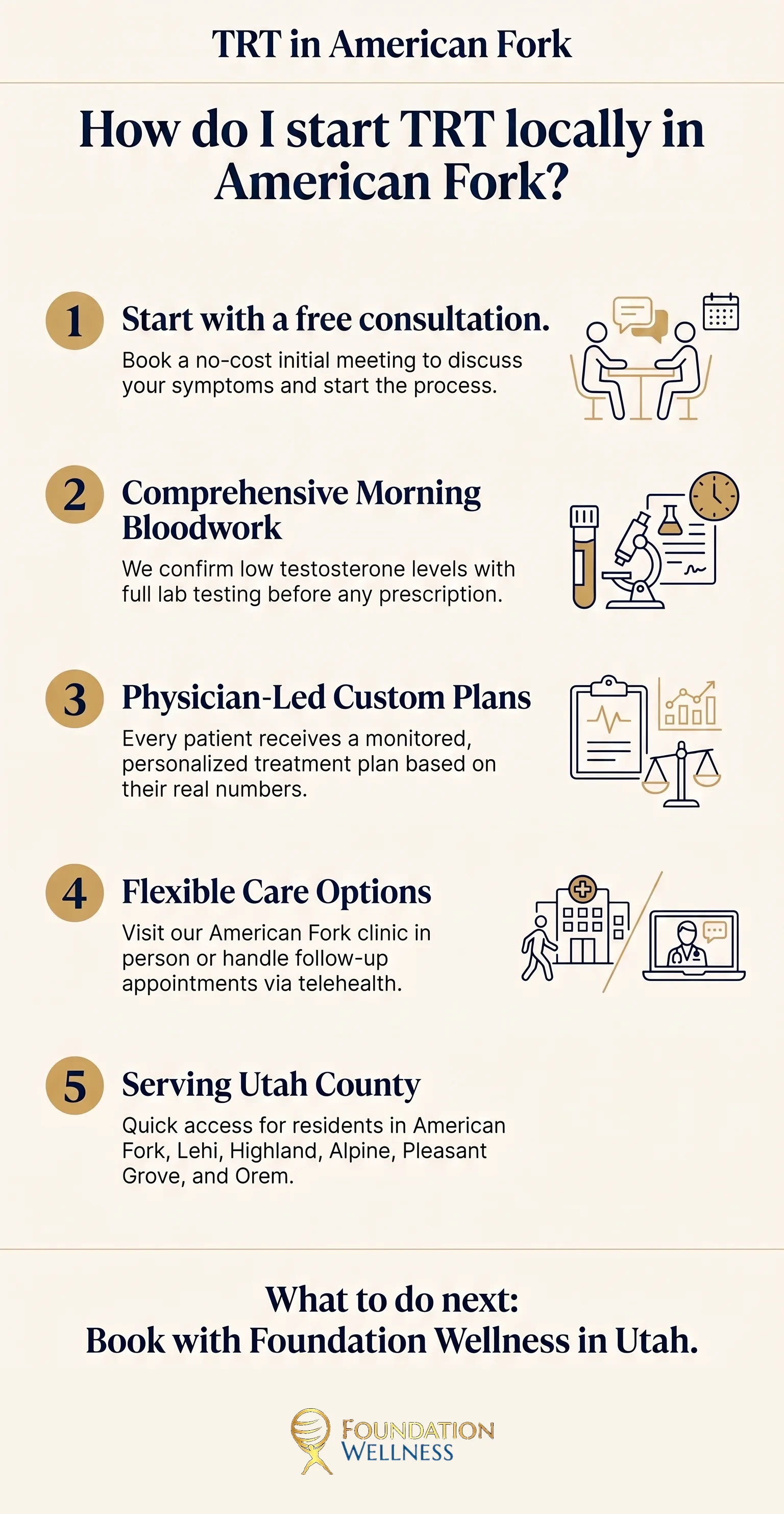
Your first visit is a conversation, not a sales pitch. Plenty of men walk in nervous about it, and that settles fast. During your free consultation we go through your symptoms, your health history, and what you actually want to fix. Tired all the time? Losing muscle even though you train? Dealing with low libido or erectile dysfunction? Watching your weight climb for no clear reason? We want the full picture before anyone talks about treatment.
Then we test before we treat. Lab testing happens onsite and covers total testosterone, free testosterone, estradiol, and safety markers like hematocrit and PSA. Our team looks at metabolic health too. Blood sugar, lipids, and thyroid can produce the same heavy, foggy feeling that low T does. One number on one morning isn’t a diagnosis.
Once your lab results come back, we build a treatment plan that fits you. In our American Fork practice we usually start most of our patients on a weekly injection rather than a long-acting option, because a weekly rhythm is easier to fine-tune. Some prefer pellet therapy so there’s no dose to manage at home. If your goals reach past testosterone, peptide therapy is on the table. Every protocol is custom, and every patient gets watched.
What Do Your Lab Results Actually Mean?
Numbers on a page don’t treat anybody. What matters is how your lab results line up with how you feel, and what each marker changes about your therapy. Here’s the panel we run and why.
| Marker | Why we check it | What it changes |
|---|---|---|
| Total testosterone | Confirms a true shortage, drawn in the morning on two separate days | Whether treatment starts at all |
| Free testosterone | The fraction actually available to your tissues | Starting dose and injection frequency |
| Estradiol | Testosterone converts to estrogen, and either extreme causes problems | Whether we adjust the dose or add support |
| Hematocrit | Testosterone can thicken the blood | Dose reduction, blood donation, or a pause |
| PSA | Prostate safety marker | Whether we refer you out before starting |
| A1c and lipids | Baseline metabolic health | Nutrition guidance and weight management |
| Thyroid panel | Rules out a look-alike cause of fatigue | Whether testosterone is the right target |
The Endocrine Society recommends confirming a low reading with a repeat morning sample, and checking hematocrit and PSA before and during treatment. We follow that. When we begin TRT, monitoring runs at baseline, again around 6 to 8 weeks, then every 6 to 12 months once you’re steady. Over the years we found that the follow-up draws matter as much as the first prescription, because the dose a man starts on in week 1 is often not the dose he settles on by month 6. Living 15 minutes from the office makes those visits easy to keep. That consistency is what separates real results from a prescription nobody reviews.
We start conservative and adjust from your lab results, not from a guess. Small steps held inside a healthy range beat chasing a big number. Your long-term health depends far more on stability than on peak levels.
Can I Get a Same-Week TRT Appointment?
Usually, yes. One honest perk of a local TRT clinic is speed. Most new patients book inside the same week. Blood gets drawn here, so you skip the mail-in kit and the shipping delay that comes with it.
You’re not sitting in limbo for a month wondering where you stand. We move your bloodwork quickly, review it with you in plain English, and begin treatment when the numbers support it.
We still don’t rush the medicine. Fast access doesn’t mean cutting corners on testing or safety. It means your symptoms don’t drag on while you sit on a waitlist. Treatment starts when the labs and the symptoms agree, and not before.
Should You Choose In-Person Labs or Telehealth for TRT?

Both work. The right pick depends on how far you live from the office and how hands-on you want your care. Men in the north end of the county usually prefer coming in for face-to-face time and onsite labs. Men who live farther out lean toward telehealth. Here’s how the two compare.
| What matters | In person at American Fork | Statewide telehealth |
|---|---|---|
| Bloodwork | Drawn onsite in one visit | Sent to a lab near you |
| First consultation | Face to face with the physician | Video call |
| Physical exam | Yes, included | Not included |
| Dose adjustments | Reviewed in person | Handled by phone or video |
| Follow-up labs | Drawn onsite every 6 to 12 months | Drawn at a partner draw site |
| Clinical guidance | Same physician at every visit | Same team, over video |
| Best for | Men who want local, hands-on care | Men far from American Fork |
If you live outside driving range, our statewide TRT guide for Utah explains how remote treatment works across the state. If you’re nearby, in-person is hard to beat.
Which Utah County Towns Does the Clinic Serve?
We sit near the middle of the north county, so men drive in from:
- Lehi - about 10 minutes north.
- Highland and Alpine - a short drive east.
- Pleasant Grove - just south of us.
- Orem - roughly 15 to 20 minutes down I-15.
- Spanish Fork and Saratoga Springs - farther out, but still an easy trip for local testosterone therapy.
Wherever you start from, the drive is short. And because we treat the whole picture, you’re not boxed into testosterone alone. We handle what tends to travel with low testosterone, from lost muscle to erectile dysfunction. We can add supportive therapy when it fits your plan and your health goals.
How Does TRT Change Mood, Weight, and Sexual Wellness?
Most men book for one complaint and end up fixing three. Low testosterone rarely shows up alone. Energy, weight, and sexual wellness tend to move together, which is why we track all of them instead of one lab value.
Mood swings and a short fuse are often the first thing a partner mentions. Our patients often tell us a spouse or a coworker noticed the change weeks before they did. Bringing levels back into a healthy range tends to steady mood, and men usually describe it as feeling like themselves again. If depression is the real driver, we’ll say so and refer you out, because testosterone isn’t an antidepressant.
Weight management is the slow part. Testosterone supports lean muscle, so body composition often changes before the scale does. Therapy doesn’t replace food and training, and any clinic promising otherwise is selling something. Paired with real habits, though, corrected levels make weight management less of an uphill fight, and metabolic health markers frequently improve alongside.
Sexual wellness is more than one symptom, and sexual health is worth taking seriously for its own sake. Trouble with erections can be an early sign of a vascular or heart health problem. It belongs in the conversation even when testosterone looks like the obvious suspect. Sex drive often picks up in the first month or two. Erectile function can take longer, since blood flow, stress, and other medication matter as much as hormones do. When erectile dysfunction sticks around after your levels are corrected, that calls for a separate workup, not a bigger dose. Getting libido and erectile function back together is realistic for a lot of men. It isn’t automatic, though. We’d rather set that expectation up front than oversell the treatment.
| What men report | Typical timing | What it depends on |
|---|---|---|
| Energy and mood | 3 to 6 weeks | Sleep, stress, dose consistency |
| Libido | 3 to 6 weeks | Baseline levels, other medication |
| Erectile function | 6 weeks to 3 months | Blood flow, health conditions, stress |
| Body composition | 3 to 6 months | Training and nutrition |
| Overall vitality | 3 to 6 months | Adherence and follow-up therapy visits |
Getting your overall vitality back is the point of all this. No panel measures overall vitality, so at every follow-up we ask about sleep, training, drive, and libido, then weigh your answers next to the numbers. If the numbers look fine and you still feel flat, that’s a signal to keep digging, not a reason to raise the dose.
How to Start TRT in American Fork
Getting started is simple. Maybe you’re a man in American Fork or a town close by. Maybe you’ve felt flat, foggy, or just not like yourself for a while. The first step is a proper workup, not a guess.
Book your free consultation at Foundation Wellness, 456 E State Street, Suite 1400, American Fork, UT 84003, or call (800) 983-1974. Our team can often see you the same week. Self-pay therapy here generally runs about $100 to $200 a month depending on your protocol. To see how our physician-led program handles lab testing, dosing, and long-term health, read more about our men’s health and TRT services.
You deserve treatment from a real clinic with a real address and a real physician, not a subscription box. We’re right down the road.
Key Takeaways
- Foundation Wellness offers physician-led TRT at a local clinic in American Fork, serving Lehi, Highland, Alpine, Pleasant Grove, and Orem.
- Your first consultation is free, blood gets drawn onsite, and no referral is needed.
- We confirm low T on more than one morning sample before any treatment starts.
- Ongoing monitoring runs at baseline, around 6 to 8 weeks, then every 6 to 12 months.
- Energy, weight, and sexual wellness improve on different timelines, so we track each one.
- In-person care gives you onsite labs and face-to-face dosing. Telehealth covers men who live farther away.
- Treatment can include injections, pellet therapy, or peptide therapy when it suits your health goals.
- We test before we treat, and we’ll tell you honestly when therapy isn’t the answer.
Sources
Dr. Paul Frandsen
July 8, 2026 · 10 min read