
TRT and Fertility: What Testosterone Therapy Does to Sperm
October 12, 2026
By Dr. Paul Frandsen, MD · October 12, 2026 · 10 min read
Medically reviewed by Dr. Paul Frandsen, MD

Testosterone replacement therapy lowers sperm production because outside testosterone switches off the brain signals your testes need to make sperm. For most men the effect reverses after stopping. But recovery can take months, and sometimes up to 2 years. So if you have fertility goals, now or later, sort out the TRT and fertility question before your first dose.
What Does Testosterone Replacement Therapy Do to Male Fertility?
Testosterone replacement therapy, or TRT, is a prescription hormone that raises testosterone levels in your blood. That eases the symptoms of low testosterone (doctors call it testosterone deficiency). It also sends your brain a message that says “we have enough.” And that message is the root of the problem for male fertility.
Here’s how the system normally works. Your pituitary gland releases two hormones. Luteinizing hormone (LH) drives natural testosterone production in the testes. Follicle stimulating hormone (FSH) supports spermatogenesis, the process of sperm production. (That’s one reason we check LH and FSH in the first workup, before treatment starts.)
When you add exogenous testosterone, meaning external testosterone from a shot, gel or patch, the brain notices the higher hormone levels. So it turns down both signals. A 2019 review in the World Journal of Men’s Health explains that exogenous testosterone “can negatively affect the hypothalamic-pituitary gonadal axis and inhibit the production of follicle stimulating hormone and luteinizing hormone.”
The result is a strange split, and honestly a confusing one. The testosterone levels in your blood can look normal or even high. Meanwhile, testosterone production inside the testes drops. Sperm cells need that intratesticular testosterone to grow and mature, so spermatogenesis slows and fewer of them make it.
That’s why testosterone therapy and fertility planning belong in the same conversation. New to TRT? Our guide to what every man should know before starting TRT covers the basics. You can also see how we monitor treatment on our men’s health and TRT services page.
How Low Can Sperm Counts Drop on Testosterone?
Lower than most men expect. In many cases the sperm count falls all the way to zero, which doctors call azoospermia.
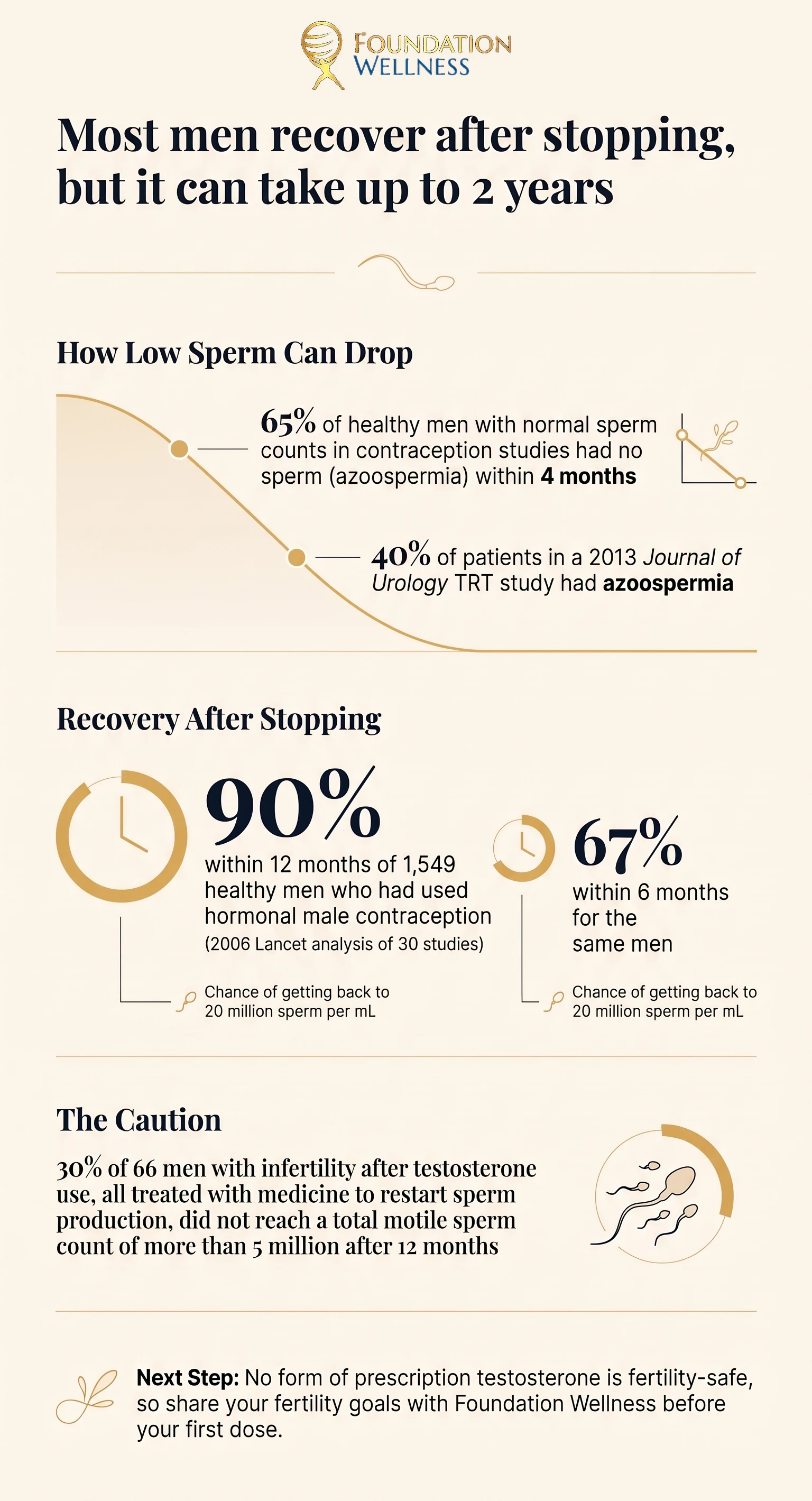
The clearest numbers come from studies that tested testosterone as a male birth control method. In those trials, testosterone led to azoospermia in 65% of normospermic men within 4 months of use. Keep the context in mind, though. These were healthy men with normal sperm counts in contraception studies, not men being treated for low testosterone.
Studies of men on TRT point the same way. A 2013 study in the Journal of Urology states that TRT impairs sperm production, “leading to azoospermia in 40% of patients.” Plenty of other men don’t hit zero. They end up with a low sperm count and poorer sperm quality instead, which can still cause male infertility.
Here’s the surprising part. TRT can cause infertility, yet it isn’t reliable birth control. The 2019 review states plainly that “the contraceptive effect of testosterone is not reliable.” So a man on TRT can have very few sperm and still father a pregnancy. Don’t use it as contraception, and don’t assume you’re fertile either. Only a semen test tells you where you stand.
Does TRT Cause Testicular Shrinkage?

Often, yes. Testicular shrinkage is one of the most common physical changes men notice on TRT, and it can be scary to see if you weren’t warned about it.
The reason is simple anatomy. About 80% of testicular volume is the tissue that makes sperm. When spermatogenesis slows, that tissue shrinks, and the 2019 review notes that this atrophy “reflects the loss of both spermatogenesis and Leydig cell function.” Put another way, smaller testes are a visible sign that sperm production has dropped.
It can be confusing, because low testosterone can do the same thing. The Endocrine Society lists shrinkage of testes as a symptom of testosterone deficiency, even before any treatment. So a change in size, before or during treatment, is worth telling your clinician about. Your testosterone levels alone won’t explain it.
For the wider list of what to expect on treatment, see our guide to TRT side effects.
How Long Does Sperm Recovery Take After Stopping TRT?
For most men, sperm recovery happens. It just takes patience (sometimes quite a lot of it).
The biggest pool of data comes from a 2006 analysis in The Lancet that combined 30 studies of 1,549 healthy men who had used hormonal male contraception. The chance of getting back to 20 million sperm per mL was 67% within 6 months, 90% within 12 months, 96% within 16 months, and 100% within 24 months. That’s a reassuring curve.
The 2019 review adds that stopping exogenous testosterone reverses hormone-induced azoospermia “in 64% to 84% of men with a median time of about 110 days.” It also notes that it “took up to 2 years for some men to recover.”
Now, the honest caution. Those numbers come from controlled trials in healthy men who used testosterone treatment for a limited time. Unfortunately, real life can be slower. One study followed men with infertility after testosterone use, all treated with medicine to restart sperm production. In that group, “Thirty percent of the 66 men were not able to achieve a total motile sperm count of more than 5 million after 12 months.” The review links slower recovery with older age.
So a fixed timeline isn’t something anyone can promise. That’s frustrating if you’re planning a family, but it’s the truth. If preserving fertility matters to you, never stop or change your dose on your own. Talk with your clinician first so you can plan the steps and track your sperm count with repeat tests.
Can You Protect Fertility While on Testosterone?
Sometimes. The main tool studied is human chorionic gonadotropin, or hCG.
hCG acts like LH. It tells the testes to keep up their own testosterone production, which helps sperm production carry on while you stay on TRT. In a small retrospective study of 26 men on TRT plus low-dose hCG, no patient became azoospermic, and “Nine of 26 men contributed to pregnancy with the partner during followup.” The men received hCG 500 IU every other day along with gel or weekly injections. It’s encouraging. Still, it’s one small study, not a guarantee.
The 2019 review agrees that “Adjunctive hCG and clomiphene can be used with TRT to maintain testicular size and intra-testicular testosterone concentrations.” It also says that “Referral to a reproductive urologist should be considered” for a man with low testosterone who wants children.
What does that mean for you? Fertility preservation is a real option to raise. In practice, though, it’s specialized care. Hormone therapy for fertility, and any fertility treatment, may need a specialist in reproductive medicine. You can ask us about these options, and we can talk through whether a referral makes sense for your plan.
Should You Bank Sperm Before You Start?
It’s worth thinking about. And the first step is a test.
A semen analysis measures the quantity and quality of semen and sperm. To prepare, you avoid any sexual activity that ends in ejaculation for 2 to 7 days before the sample. Because results vary from day to day, you may need two or more semen samples within a week or two.
The 2019 review says every man of reproductive age should have a baseline semen analysis before starting TRT. That baseline matters. It shows whether your sperm count was already low before treatment, and it gives you a reference point later. If your numbers drop on TRT, you’ll know what “normal” looked like for you.
The same review says a semen analysis and possible cryopreservation of sperm “should be offered” when TRT is prescribed to men who want to keep their fertility. Sperm banking, also called sperm freezing, stores a sample for later use. It is not offered at our clinic, but it is a fair question to raise if children are part of your future and you want a backup before treatment starts.
Do Testosterone Gel, Injections, and Other Forms Differ for Fertility?
Every prescription form adds supplemental testosterone, so every form can lower sperm. Testosterone supplementation through a shot, gel or patch sends the same “enough” signal to the brain. Contraception research suggests some forms suppress sperm more strongly than others. But none is considered fertility-safe.
| Form | How it is given | What studies report about sperm | Fertility note |
|---|---|---|---|
| Injections | Shot into a muscle | Among the “strongest contraceptive formulations” (2019 review) | Not fertility-safe |
| Testosterone gel | Rubbed on the skin | “Mixed results” as a contraceptive (2019 review) | Not fertility-safe |
| Patch | Worn on the skin | An “ineffective contraceptive” in one study (2019 review) | Not reported as safe for fertility |
| Testosterone undecanoate | Used in Chinese contraception studies | Studied as a contraceptive because it suppresses sperm (2019 review) | Not fertility-safe |
The review states that “transdermal and intramuscular testosterone seem to be the strongest contraceptive formulations.” In the 2013 hCG study, results didn’t differ between gel and injections.
One side note. Over-the-counter testosterone supplements sold in stores aren’t prescription synthetic testosterone or medical testosterone replacement, so treat them as a separate topic. For a full side-by-side of delivery methods, read our comparison of testosterone injections, pellets, and gels.
What About Your Partner, Sex Drive, and Pregnancy?
Here’s a trap a lot of couples fall into. TRT often improves sex drive and sexual function, so things feel better in the bedroom. The 2019 review notes that despite its positive effects on sexual function, testosterone has a negative effect on fertility.
So a good sex life isn’t proof that you’re fertile. If you’re trying for a pregnancy, a test is how you actually find out your sperm count.
Fertility is also a two-person question. Trouble conceiving isn’t always down to male infertility. Female fertility plays a big part in how long it takes, too. So if you’ve been trying for a while, it usually makes sense for both partners to get checked. Bring your partner into the plan early, before you start treatment.
TRT and Fertility Goals at Foundation Wellness

The most useful thing you can do is tell us about your fertility goals before you start. The Endocrine Society is direct about this: if you are planning fertility, you should not use testosterone therapy, and it lists decreased sperm production as a possible risk. Its clinical guideline recommends against starting testosterone therapy in men who are planning fertility in the near term.
Our approach to low testosterone focuses on safety and sustainability. We monitor comprehensive bloodwork, tailor dosing individually, and look at the full picture, including sleep, stress and metabolic health, not just hormone levels on a lab report. If a referral to reproductive medicine fits your plan better, we can talk that through with you.
Our clinic is at 456 E State Street, Suite 1400, American Fork, UT 84003, and we offer telemedicine visits across Utah. We are accepting new patients. Foundation Wellness accepts many insurance plans. Coverage depends on your plan, so check with our office first. When you’re ready, visit our men’s health and TRT page to book a visit.
Key Takeaways
- TRT lowers the LH and FSH signals your testes need, so sperm production falls while you take it.
- In contraception studies, 65% of healthy men had no sperm within 4 months, yet testosterone is not reliable birth control.
- Most men recover after stopping, but it can take up to 2 years, and recovery is not guaranteed for everyone.
- A baseline semen analysis, sperm banking and hCG are options to discuss with your clinician before you start.
- No form of prescription testosterone is fertility-safe, so share your fertility goals before your first dose.
Sources
- World Journal of Men’s Health (PMC), Testosterone Is a Contraceptive and Should Not Be Used in Men Who Desire Fertility.
- The Lancet (PubMed), Rate, extent, and modifiers of spermatogenic recovery after hormonal male contraception: an integrated analysis.
- Journal of Urology (PubMed), Concomitant intramuscular human chorionic gonadotropin preserves spermatogenesis in men undergoing testosterone replacement therapy.
- Endocrine Society, Hypogonadism in Men.
- Journal of Clinical Endocrinology and Metabolism (PubMed), Testosterone Therapy in Men With Hypogonadism: An Endocrine Society Clinical Practice Guideline.
- MedlinePlus, Semen Analysis.
October 12, 2026 · 10 min read