
TRT Doctor Near Me: How to Choose One in Utah
November 5, 2026
By Dr. Paul Frandsen, MD · November 5, 2026 · 7 min read
Medically reviewed by Dr. Paul Frandsen, MD

Searching for a TRT doctor near me? The right one confirms low T with repeated morning blood tests before prescribing. They screen for reasons not to start, ask about your plans and history, and set up follow-up labs. A healthcare provider who skips those steps is a reason to keep looking, however close the testosterone replacement therapy clinic is.
Distance matters, sure. But it shouldn’t be the whole decision. For Utah men, Foundation Wellness offers men’s health and TRT care in American Fork and by telemedicine across Utah.
What Does a Testosterone Replacement Therapy Doctor Do?
A TRT doctor diagnoses testosterone deficiency, decides whether hormone therapy is right for you, prescribes it and then monitors it. Testosterone replacement therapy is one kind of hormone replacement therapy, the broader term you’ll also see.
Several kinds of providers do this work: primary care and internal medicine doctors, urologists, endocrinologists and men’s health clinics. There’s no single “right” specialty, which can feel frustrating when you just want a clear answer. The Endocrine Society even lists “Should I see an endocrinologist or urologist?” as a question to ask your own provider, because the answer depends on you.
At Foundation Wellness, you’d see Dr. Paul Frandsen, MD. He earned his MD at the University of Utah and is board-certified in Emergency Medicine and Addiction Medicine. Our care focuses on the whole picture of your health, not one number.
What Lab Testing Should a TRT Doctor Do Before Prescribing?

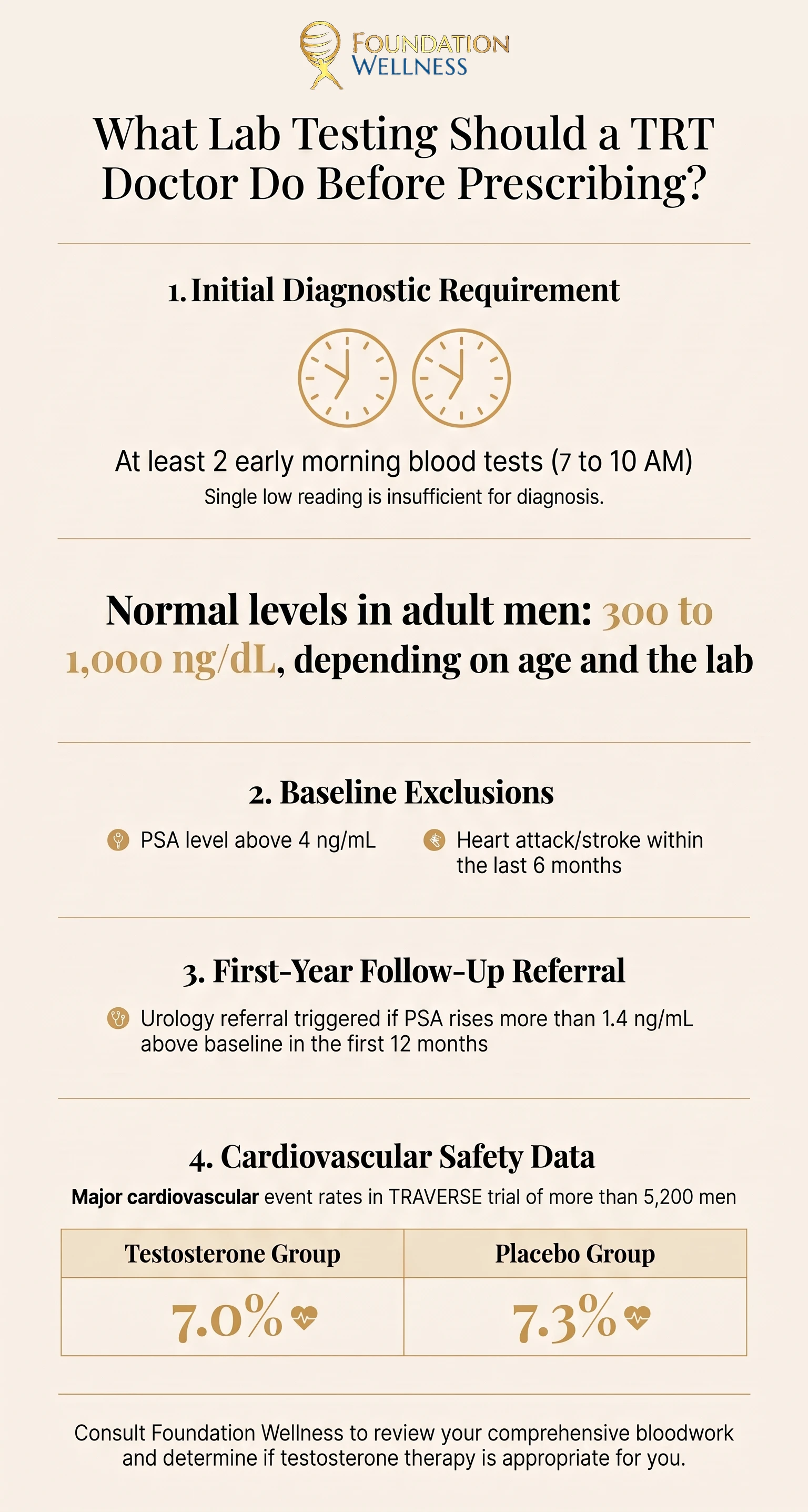
Here’s the clearest standard you can hold any clinic to. The Endocrine Society says a diagnosis needs at least two early morning (7-10 AM) blood tests that show low testosterone, along with typical signs and symptoms. “Testosterone must be measured more than once,” it adds. So one low reading isn’t enough on its own, however convincing it looks. Normal levels in adult men run about 300 to 1,000 ng/dL, depending on age and the lab.
The Endocrine Society clinical guideline says the same thing, just in more clinical terms. Doctors should confirm the diagnosis by repeating the measurement of morning fasting total T, and treat only men with symptoms and “unequivocally and consistently low” levels. At Foundation Wellness, we don’t diagnose based on a single total testosterone level either.
Why mornings? MedlinePlus notes that testosterone levels are typically highest between 7 and 10 a.m. It also says a testosterone test “alone can’t diagnose any health conditions.” Low hormone levels have causes worth finding, such as testicle problems, chronic liver or kidney disease, or a pituitary disorder. A careful doctor takes a full medical history and reads your lab results in that context, not in isolation.
Which Low Testosterone Symptoms Should You Bring Up?
Lab testing only means something next to your symptoms, so tell your doctor everything that’s changed. If bringing up sex drive or erections with a new doctor makes you nervous, that’s understandable. Say it anyway. The Endocrine Society lists these low testosterone symptoms:
- A drop in sex drive.
- Erectile dysfunction and other sexual health changes.
- Trouble concentrating (what many men call brain fog).
- Irritability or a depressed mood.
- Loss of muscle bulk.
Mention your weight and sleep too. They’re easy to leave out. The Endocrine Society notes that some causes of low T, such as obesity, can be reversible without testosterone, so body fat is part of the conversation. For some men, that’s a relief.
These symptoms overlap with other conditions, so changes in mood, mental clarity or sexual function can have more than one cause. That’s why no symptom list can diagnose low T on its own, and why the testing standard above matters so much.
What Questions Should You Ask Before Testosterone Therapy Starts?
Before any testosterone therapy begins, a careful doctor should screen for reasons not to start. The Endocrine Society guideline lists specific conditions where it recommends against therapy. Use this checklist at your visit. Bring it on your phone if that’s easier.
| Question to ask | Why it matters | Source |
|---|---|---|
| Were my low results confirmed on more than one morning test? | Guideline confirms by repeat morning fasting total T | Endocrine Society guideline |
| Am I planning children soon? | Guideline advises against starting in men planning fertility soon | Endocrine Society guideline |
| Has my PSA been checked, and is it above 4 ng/mL? | PSA above 4 is on the guideline list of reasons not to start | Endocrine Society guideline |
| Is my hematocrit elevated? | Elevated hematocrit is a reason not to start | Endocrine Society guideline |
| Do I have untreated severe sleep apnea, uncontrolled heart failure, or a heart attack or stroke in the last 6 months? | All are on the guideline list | Endocrine Society guideline |
| Do I have a blood clotting disorder (thrombophilia)? | On the guideline list | Endocrine Society guideline |
| What follow up screenings will I need? | Question from the Endocrine Society patient list | Endocrine Society patient page |
Also ask which treatment option the doctor suggests, such as injections or gels, and why. Low testosterone treatment isn’t one-size-fits-all, and a good doctor will usually walk you through the trade-offs in plain language. If children are in your plans, read our guide to TRT and fertility before you decide on testosterone treatment.
How Should Your Doctor Monitor Testosterone Replacement?

Starting testosterone replacement is the beginning, not the end. The Endocrine Society guideline says your doctor should check your response, side effects and adherence after you start. If your PSA rises more than 1.4 ng/mL above baseline in the first 12 months, the guideline calls for a urology referral. That can sound scary. But a referral isn’t a diagnosis. It means a urologist takes a closer look.
Blood pressure matters too. In February 2025, the FDA required class-wide labeling changes for testosterone products, adding a warning about increased blood pressure for all of them. So blood pressure checks belong in your follow-up.
On heart risk, the FDA reports that in the TRAVERSE trial of more than 5,200 men, major cardiovascular events occurred in 7.0% on testosterone and 7.3% on placebo. Then in June 2026, the FDA requested label updates that removed the limitation of use for age-related low testosterone.
At Foundation Wellness, we monitor comprehensive bloodwork and look at sleep, stress and metabolic health, not just a number on a lab report. We track hematocrit, estradiol, PSA and metabolic markers at regular intervals, too. For a closer look at risks, see our page on TRT side effects.
What Are the Red Flags at a Testosterone Replacement Therapy Clinic?
The Endocrine Society guideline names “suboptimal testosterone prescribing practices” as a concern. Here’s what that can look like at a clinic:
- A prescription after one test, or after a symptom quiz alone.
- Promises that you’ll “feel young again,” see “real results” fast or get your vitality back. That’s marketing, not medicine.
- Bundles that add HGH therapy or peptide therapy to every plan.
- No talk of PSA, hematocrit, fertility or sleep apnea before you start.
- No plan for follow-up labs.
Unfortunately, those promises can be tempting when you just want to feel like yourself again. A good doctor will be glad you asked. A clinic that rushes you past these questions is telling you something. And if TRT isn’t the right fit for you, we’ll say so.
Can Patients See a TRT Doctor by Telemedicine in Utah?
Yes. Foundation Wellness sees patients in person in American Fork and by telemedicine across Utah, and we’re accepting new patients. Lab work still needs an in-person blood draw, since that part can’t happen over video. For how visits work locally, see TRT in American Fork.
Our clinic is at 456 E State Street, Suite 1400, American Fork, UT 84003. Call (800) 983-1974.
Foundation Wellness accepts many insurance plans. Coverage depends on your plan, so check with our office first. For what affects cost, read TRT cost in Utah. New to the topic? Start with TRT explained.
Still deciding? That’s fine. The checklist above usually makes a good starting point, whoever you end up seeing. If you’re searching for a TRT doctor near me in Utah, you can book a men’s health visit with our team.
Key Takeaways
- A good TRT doctor confirms low T with at least two early morning tests plus symptoms.
- Ask about PSA, hematocrit, sleep apnea, heart history and fertility plans before starting.
- Follow-up should include blood pressure checks after the FDA’s 2025 class-wide warning.
- Be wary of “feel young again” promises and HGH or peptide bundles.
Sources
- Endocrine Society, Hypogonadism in Men
- Endocrine Society, Testosterone Therapy for Hypogonadism Guideline Resources
- Bhasin S et al., Testosterone Therapy in Men With Hypogonadism: An Endocrine Society Clinical Practice Guideline, J Clin Endocrinol Metab, 2018
- MedlinePlus, Testosterone Levels Test
- U.S. Food and Drug Administration, FDA issues class-wide labeling changes for testosterone products
- U.S. Food and Drug Administration, Testosterone Information
November 5, 2026 · 7 min read