
What Is TRT? What Every Man Should Know Before Starting
September 6, 2026
By Dr. Paul Frandsen · September 6, 2026 · 7 min read

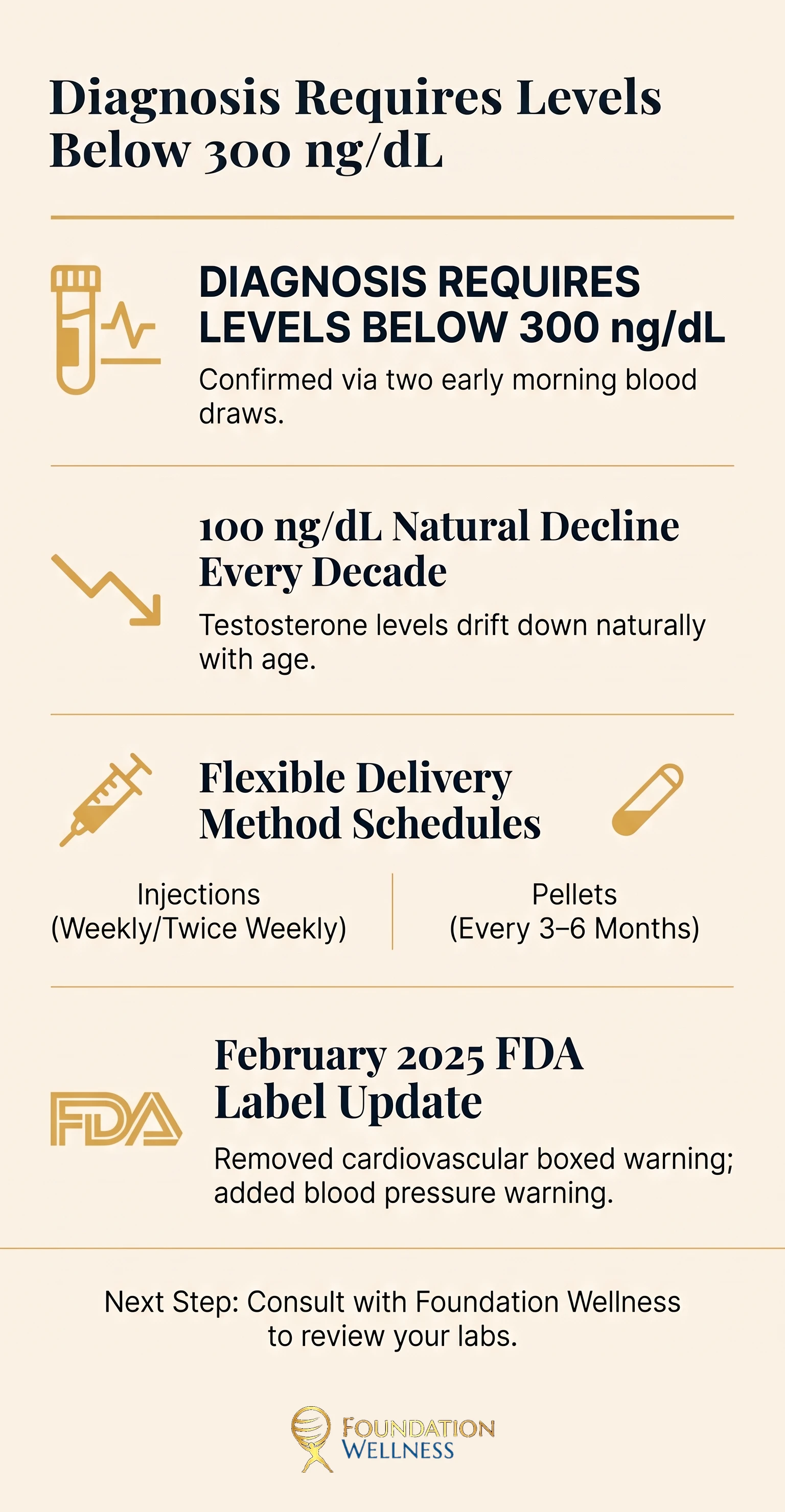
Testosterone replacement therapy restores testosterone that your body no longer makes in normal amounts. It treats a measured deficiency, not a mood. Diagnosis takes two early morning blood draws below 300 ng/dL plus symptoms that match the labs. Done properly, TRT is ongoing medical care with regular bloodwork, not a prescription you fill and forget.
Podcasts and clinic ads have made testosterone sound either miraculous or reckless. Neither framing survives contact with the actual guidelines.
What Is TRT, Exactly?
TRT puts back a hormone your testes have stopped producing at healthy levels. That’s the whole idea. It isn’t anabolic steroid use, and the doses sit in a very different range.
Testosterone drifts down with age. StatPearls puts that drift at roughly 100 ng/dL every 10 years, which is why a man at 55 can sit well below where he was at 25.
Low testosterone carries the clinical name hypogonadism. Libido gets the headlines, but the hormone also touches energy, mood, muscle mass, bone density, and how your body handles glucose. Effects reach across systems, which is why the symptom list looks so scattered.
Good treatment aims for a normal range. Not higher. Men who chase supraphysiological numbers are doing something else entirely, and they usually pay for it in hematocrit and fertility.
Who Actually Qualifies for TRT?
Two things have to line up: the labs and the symptoms. The American Urological Association sets total testosterone below 300 ng/dL as a reasonable cut-off, taken twice on separate early mornings. Its guideline is blunt that diagnosis needs low levels combined with symptoms or signs.
A reasonable workup includes:
- Two early morning draws, ideally between 8 and 10 AM, when levels peak.
- Total and free testosterone, plus SHBG, since binding protein changes what your tissues can actually use.
- LH and FSH, which separate a testicular problem from a pituitary one.
- PSA before you start if you are over 40, which StatPearls treats as standard.
- A complete blood count, because testosterone raises red blood cell production.
Symptoms should tell a coherent story alongside those numbers. Fatigue, low drive, poor concentration, lost muscle, added fat around the middle, and worse sleep are the usual complaints. Not all of them have to be present.
Telehealth mills that prescribe from a questionnaire skip this entirely. Honestly, that’s the part of the current boom that worries our team most.
Did the FDA Change Its Position on TRT?
Yes, and it matters. On February 28, 2025 the agency issued class-wide labeling changes for testosterone products. Three things happened at once.
Language about increased cardiovascular risk came out of the boxed warning. Results from the TRAVERSE trial went into every product label. A new warning about raised blood pressure went in for products that lacked one.
Read that carefully, because it cuts both ways. The old blanket claim that testosterone wrecks your heart did not survive the evidence. In exchange, blood pressure is now a labeled concern across the class, so your cuff readings belong in the monitoring plan.
The agency also kept its limitation of use for age-related hypogonadism. Feeling older is not by itself a diagnosis.
What About Prostate Cancer and Fertility?
Men ask these two questions more than any others, and the answers differ.
On prostate cancer, the AUA tells clinicians to inform patients of the absence of evidence linking testosterone therapy to developing the disease. That’s a carefully built sentence, and it isn’t the same as proof of safety. PSA monitoring stays in the protocol either way.
Fertility is the harder one. Exogenous testosterone suppresses sperm production, and the AUA states plainly that it should not be prescribed to men currently trying to conceive. Recovery after stopping is usual but slow. StatPearls reports two-thirds of men recover within 6 months, while 10% take longer than a year.
A workaround exists. hCG stimulates the Leydig cells to make testosterone without shutting down sperm production, so it can run alongside therapy or replace it during a conception window. Raise fertility at the first visit, not the fifth.
Which TRT Method Should You Choose?
Delivery changes the rhythm of treatment more than the destination. Each format trades convenience against stability.
| Method | Typical schedule | Level stability | Main tradeoff |
|---|---|---|---|
| Intramuscular or subcutaneous injection | Weekly or twice weekly | Peaks and troughs, smoother twice weekly | Highest polycythemia risk of the formats |
| Transdermal gel | Daily | Steady day to day | Transfer risk to partners and children |
| Pellets | Every 3 to 6 months | Very steady, fixed once implanted | Minor procedure, hard to adjust mid-cycle |
Injections stay the most common choice in our clinic, mostly on cost. StatPearls notes injectable testosterone carries the highest polycythemia risk among these options, which is why hematocrit gets watched closely on that route.
Our fuller comparison of testosterone injections, pellets, and gel walks through each one in detail.
What Does Real Monitoring Look Like?
Programs quietly fail here. Writing a prescription is easy. Watching what it does to you over years is the actual work.

| What we check | Why it matters | When |
|---|---|---|
| Total and free testosterone | Confirms you landed in range, not above it | Weeks 6 to 8, then quarterly |
| Hematocrit and hemoglobin | Rising red cell mass thickens blood | Weeks 6 to 8, then quarterly |
| Estradiol | Some testosterone converts to estrogen via aromatase | With each testosterone check |
| PSA | Standard prostate surveillance after 40 | Baseline, then annually |
| Blood pressure | A labeled class warning since 2025 | Every visit |
| Symptoms and sleep | Numbers can read fine while you feel flat | Every visit |
Hematocrit deserves its own line. StatPearls advises against therapy when hematocrit sits above the upper normal limit, and lists a pretreatment value over 50% among the contraindications. That figure is easy to check and easy to act on.
Estradiol confuses people. Men need some estrogen, and crushing it produces joint pain, low libido, and mood problems of its own. Balance beats zero.
Untreated obstructive sleep apnea and uncontrolled heart failure also appear on the StatPearls contraindication list. Screening for both belongs before the first injection rather than after.
How Do You Spot a Good TRT Provider?
Four signals separate careful medicine from a subscription service.

- They test before they treat. Two morning draws, not a symptom quiz.
- They ask about fertility first. A man who wants children in three years needs a different plan.
- They recheck on a schedule. Labs at six to eight weeks, then quarterly, then annually once stable.
- They look past testosterone. Thyroid, sleep apnea, iron, and metabolic health move the same symptoms.
At Foundation Wellness in American Fork, we run the full panel before anyone starts, and we follow patients across Utah by telehealth. Cost questions arrive early too, which is why we published a TRT cost breakdown for Utah.
In our clinic, most men notice the first real change around six to eight weeks rather than days. Our guide on how long TRT takes to work sets out the usual sequence, and the side effects worth watching are covered separately.
If the labs come back normal and you still feel flat, the answer sits somewhere else. Thyroid, iron, sleep, and mood are the usual suspects, and our piece on signs of hormone imbalance covers what else to check.
Key Takeaways
- TRT treats a documented deficiency, confirmed by two early morning draws below 300 ng/dL plus matching symptoms.
- Testosterone drifts down roughly 100 ng/dL per decade, so age alone does not make the diagnosis.
- In February 2025 the FDA pulled cardiovascular risk language from the boxed warning, added TRAVERSE results, and added a blood pressure warning.
- The AUA advises telling patients there is no evidence linking testosterone therapy to developing prostate cancer.
- Testosterone suppresses sperm production, so raise fertility plans before the first injection.
- Monitoring means hematocrit, estradiol, PSA, and blood pressure on a schedule, not one follow-up call.
- Foundation Wellness treats men in American Fork, Provo, and across Utah County.
Sources
- U.S. Food and Drug Administration, class-wide labeling changes for testosterone products, February 28, 2025 - fda.gov.
- U.S. Food and Drug Administration, Testosterone Information - fda.gov.
- American Urological Association, Testosterone Deficiency Guideline, statements 1, 2, 3, 16, 17, 18 and 23 - auanet.org.
- Male Hypogonadism, StatPearls, National Center for Biotechnology Information - ncbi.nlm.nih.gov.
This page is general information rather than medical advice for your situation. Bring your labs and your questions to a clinician who knows your history.
Dr. Paul Frandsen
September 6, 2026 · 7 min read