
TRT in Pleasant Grove, Utah | Testosterone Therapy
July 10, 2026
By Dr. Paul Frandsen · July 10, 2026 · 11 min read

Typing “TRT Pleasant Grove” into your phone? The nearest physician-led option is Foundation Wellness in American Fork, a few minutes down the road. We treat men who have low testosterone with supervised testosterone replacement therapy. You get in-person labs plus telehealth follow-ups, so care stays close to home and easy to keep up with.
What Is TRT?
TRT stands for testosterone replacement therapy. The therapy replaces the testosterone your body has stopped making in healthy amounts. The goal is to bring your levels back to a normal range, not push them sky high.
Testosterone does more than most guys realize. It shapes energy levels, focus, mood, sleep, muscle, bone density, and sex drive. When it drops, called low T, you feel it across your overall health. According to the Cleveland Clinic, low testosterone can show up as fatigue, brain fog, weight gain, and low libido. Those signs are easy to blame on stress or age.
There’s usually more going on underneath. Men with low levels more often show insulin resistance and weaker metabolic health, so we look at that whole picture instead of one hormone. Testosterone interacts with immune function too, though that science is still young and isn’t a reason on its own to start therapy.
Our patients rarely walk in asking about a hormone. They come in because sleep stopped working, or the gym stopped paying off, or their patience runs out by dinner. We learned to ask about those daily details first, since they frame a lab number better than the lab number frames itself. Most men we treat at Foundation Wellness in American Fork are in their forties or fifties, though plenty are younger.
Here’s the good news. It’s measurable, and it’s treatable. You don’t have to guess. Treatment isn’t automatic, though. A low reading on its own doesn’t earn a prescription from us. For a deeper look at how the therapy works and who it fits, our men’s health and testosterone service page walks through the full picture.
How Close Is the American Fork Clinic to Pleasant Grove?

Very close. Foundation Wellness sits a short hop up the road. The drive is usually 8 to 12 minutes, depending on your neighborhood. We’re right along the road that links the two towns. So you’re not fighting freeway traffic or hunting for parking downtown.
That matters more than it sounds. A big reason men put off treatment is the hassle. If a TRT clinic feels far away or hard to reach, appointments slip. Labs get skipped, and progress stalls. Being one town over removes that excuse.
We saw that pattern often enough that the commute now comes up in the first visit. From most of Pleasant Grove the drive runs 8 to 12 minutes, while the far side of Salt Lake County can stretch past an hour. That difference rarely matters in the first month. It shows up half a year in, when the follow-up lab is the thing that quietly gets skipped.
You get the depth of a real physician-led clinic without a big-city commute. Same careful bloodwork, same advanced TRT protocols, minutes from your driveway. Want to compare the local option against what’s available statewide? Our statewide TRT in Utah guide lays out how care works region by region.
We see plenty of men from town. We also treat neighbors in Lindon, Lehi, Highland, and Alpine. If you already run errands or drive through American Fork, a lab draw fits easily into your week. No day off is needed, and no full afternoon is lost. That ease is often the difference between a treatment plan you stick with and one you quietly drop.
Can You Start TRT Here Without a Long Commute?
Mostly, yes. We built our care around real life, so most of the therapy runs from home.
Your first visit is in person. We want an accurate baseline. That means a morning blood draw and a real talk about your symptoms and goals. After that, a dedicated clinician manages your protocol. Most check-ins can move to secure video calls. You come back for periodic labs, and that ongoing monitoring is what keeps therapy safe over the long run.
So a local patient might drive in a few times a year for bloodwork. Everything else, like dose questions, symptom updates, and refills, can happen from the couch. That mix of in-person testing and telehealth follow-up is what makes staying consistent realistic.
Our team runs it the same way for most local patients. Labs and the first exam happen in American Fork, and the rest moves to video. Men driving up from Provo, Orem, or across the Wasatch Front follow the same schedule, just with a longer trip on lab days.
In our experience, most men want a clear schedule. At our American Fork clinic, we typically draw labs at baseline, again around 6 to 8 weeks, and then every 6 to 12 months. Energy levels tend to shift first, often in 2 to 6 weeks, with fuller effect by about 3 months. According to the Endocrine Society, doctors should treat low testosterone only when a man has both low blood readings and clear symptoms. That clinical guidance is why we don’t start therapy off a single number.
| What You Need | Best Handled | Typical Trips Per Year |
|---|---|---|
| Initial evaluation and bloodwork | In person at American Fork | 1 to start |
| Reviewing lab results and setting your dose | In person or video | Included in first visits |
| Dose adjustments and symptom check-ins | Telehealth video call | 0, done from home |
| Prescription refills | Telehealth or pharmacy | 0 |
| Periodic safety bloodwork and ongoing review | In person at American Fork | 2 to 4 per year |
What Should You Expect at Your First Visit?

No pressure, and no guesswork. The first visit is about getting real numbers and hearing your story.
We draw a full panel of labs, not just one testosterone reading. We check total and free testosterone, plus the markers that fill in the picture. Common ones include estradiol, LH, FSH, and a red blood cell count. Then we talk through what’s actually bothering you. Low energy? Poor sleep? Changes in muscle or weight? Trouble with drive or erections?
We compared enough panels over the years to stop trusting a single number. Two men can sit in the same American Fork exam room with nearly identical total testosterone and describe very different weeks. So we weigh that conversation as heavily as the draw, rather than treating one result as the verdict.
If sexual wellness is part of why you came in, we take it seriously and without awkwardness. Testosterone plays a role in libido, sexual function, and healthy blood flow. Blood flow is central to erectile function. Low T is just one possible cause of erectile dysfunction, so we screen honestly instead of assuming testosterone will fix it all. When erectile dysfunction really does trace back to hormones, therapy often helps.
Your lab results come back within a few days, and we walk through them with you instead of emailing a PDF. From there we build a personalized treatment plan around your numbers and your life. You leave knowing exactly what the next step is.
Which Delivery Method Fits Your Life?
Not every man needs the same one. Every route delivers the same hormone, so the therapy itself doesn’t change, only how it reaches your bloodstream. Your labs, your schedule, and how you feel about needles all matter here.
| Method | How Often | Worth Knowing |
|---|---|---|
| Injections | Weekly or twice weekly | Steady levels, lowest cost, and you can do them at home |
| Oral TRT | Daily capsules taken with food | FDA-approved oral TRT avoids the liver risk of older oral androgens, but blood pressure needs watching |
| Gels and creams | Applied daily to the skin | Simple, though the medication can transfer to a partner or child through skin contact |
| Pellets | Placed under the skin every 3 to 6 months | Nothing to remember, but the dose can’t be adjusted between visits |
When we begin TRT with someone new, we usually start on weekly injections rather than a longer-acting option, since a weekly dose is simple to adjust in the first few months. Our patients who fly out of Salt Lake City most weeks often move to oral TRT instead of living by a needle schedule.
Injections cover most of our patients. Oral TRT tends to suit men who travel constantly or want nothing to do with syringes. We can also add support like vitamin B12 injections when your bloodwork points that way. Whichever route we pick, treatment plans get revisited at each check-in, because bodies and schedules change.
What Does Monitoring Look Like Once You Start?
Starting is the easy part. Staying on it safely is where clinician guidance earns its keep. Treatment that goes unchecked is treatment you shouldn’t trust.
Testosterone ordered off a website or handed over at a gym skips every safety check. Without medical supervision, your blood counts, prostate, and heart risk go unwatched. That’s the part that concerns us, not the therapy itself.
| What We Track | Why It Matters | How Often |
|---|---|---|
| Total and free testosterone | Confirms your dose lands in a normal range | Baseline, 6 to 8 weeks, then every 6 to 12 months |
| Hematocrit and hemoglobin | Testosterone can thicken the blood, so we watch this closely | Same schedule as your testosterone labs |
| Estradiol | Affects mood, libido, and sexual function | When symptoms suggest it |
| PSA and prostate check | Standard safety step, especially past 40 | Baseline, then yearly |
| Lipids, A1c, blood pressure | Tracks metabolic function and heart risk | Yearly |
| Bone density scan | Years of low testosterone can thin bone | Only if your history or labs call for it |
We tracked hematocrit closest of everything on that list, because thickened blood is the change we run into most often at the 6 to 8 week recheck. Honestly, it’s also the one men least expect when they start. Catching it early usually means a dose adjustment instead of stopping therapy.
Real results show up in two places: on the lab report and in how your week actually feels. Sleep gets better. Workouts stop feeling pointless. Men tend to describe it as overall vitality coming back rather than a sudden jolt. Nothing here is instant, and anyone promising that is selling something.
Your dose isn’t permanent either. We adjust it, and sometimes we stop. If treatment isn’t moving your numbers or your symptoms after a fair trial, we’ll say so rather than keep refilling it. Therapy also suppresses sperm production, so if you’re planning a family, say that up front and we’ll change the approach.
How Soon Can You Get Started?
Faster than most people expect. Because we’re right next door, you’re not waiting weeks for an opening at a clinic two counties away.
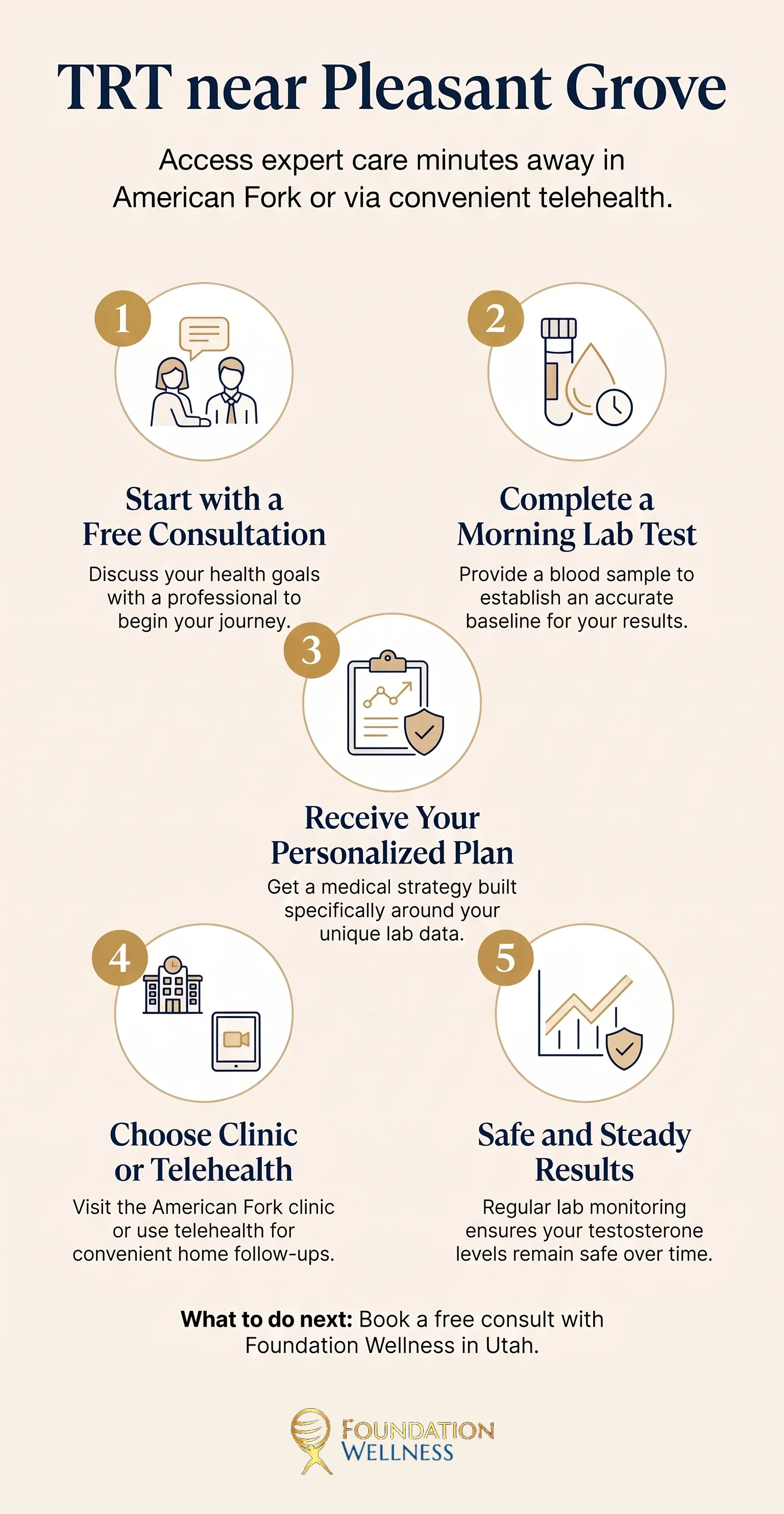
The usual path looks like this. You book a consultation, come in for your first visit and labs, and we review those numbers together. Once your baseline is clear and a protocol is set, ongoing care shifts to telehealth. From that point, most of your care happens at home. You check in with a dedicated clinician by video and come back only for periodic bloodwork.
We found the men who treat follow-up labs as part of the therapy, rather than an errand, tend to have the smoothest first year. That’s a habit, not a talent. Living 10 minutes out in Pleasant Grove, Lindon, or Highland makes the habit easier to keep than driving across Utah County twice a year.
There’s no long runway of red tape. Self-pay TRT in Utah often runs roughly $100 to $400 a month, depending on your protocol and dose. Our goal is to get you evaluated properly, start therapy safely if it’s the right call, and keep the process light on your calendar. Local access isn’t just a nice extra here. It’s a big part of why treatment actually works long term.
Getting Started
If you live in Pleasant Grove and you’ve been feeling off, the hardest part is just booking the visit. We’re right in American Fork, minutes away, and we make the first step easy.
Start with a free consultation. We’ll talk through your symptoms, explain what proper testing looks like, and lay out whether testosterone therapy is even the right move for you. If it isn’t, we’ll tell you straight and point you toward what is. Plenty of men come to us about one symptom and leave with a clearer read on their overall wellness.
You can book your consultation here, or read more on our men’s health and TRT page first. Either way, real answers are a short drive down the road, not a project.
Key Takeaways
- The closest physician-led TRT clinic to Pleasant Grove is Foundation Wellness in American Fork, roughly 8 to 12 minutes away.
- Your first visit and bloodwork happen in person; most follow-ups can be done by telehealth from home.
- A real diagnosis of low testosterone needs a morning blood draw, not just symptoms.
- Delivery options include weekly injections, oral TRT, gels, and pellets, matched to your labs and your week.
- Low testosterone can affect energy, mood, blood flow, and erectile function, and therapy works best with steady lab follow-up.
- Testosterone therapy can be adjusted or stopped, and it suppresses fertility, so raise family plans early.
- A free consultation is the simplest first step.
Sources
- Cleveland Clinic: Low Testosterone (Male Hypogonadism)
- Endocrine Society: Hypogonadism patient resources
- Mayo Clinic: Testosterone therapy: Potential benefits and risks as you age
Dr. Paul Frandsen
July 10, 2026 · 11 min read