
Testosterone Therapy Side Effects: What to Expect on TRT
July 28, 2026
By Dr. Paul Frandsen · July 28, 2026 · 13 min read

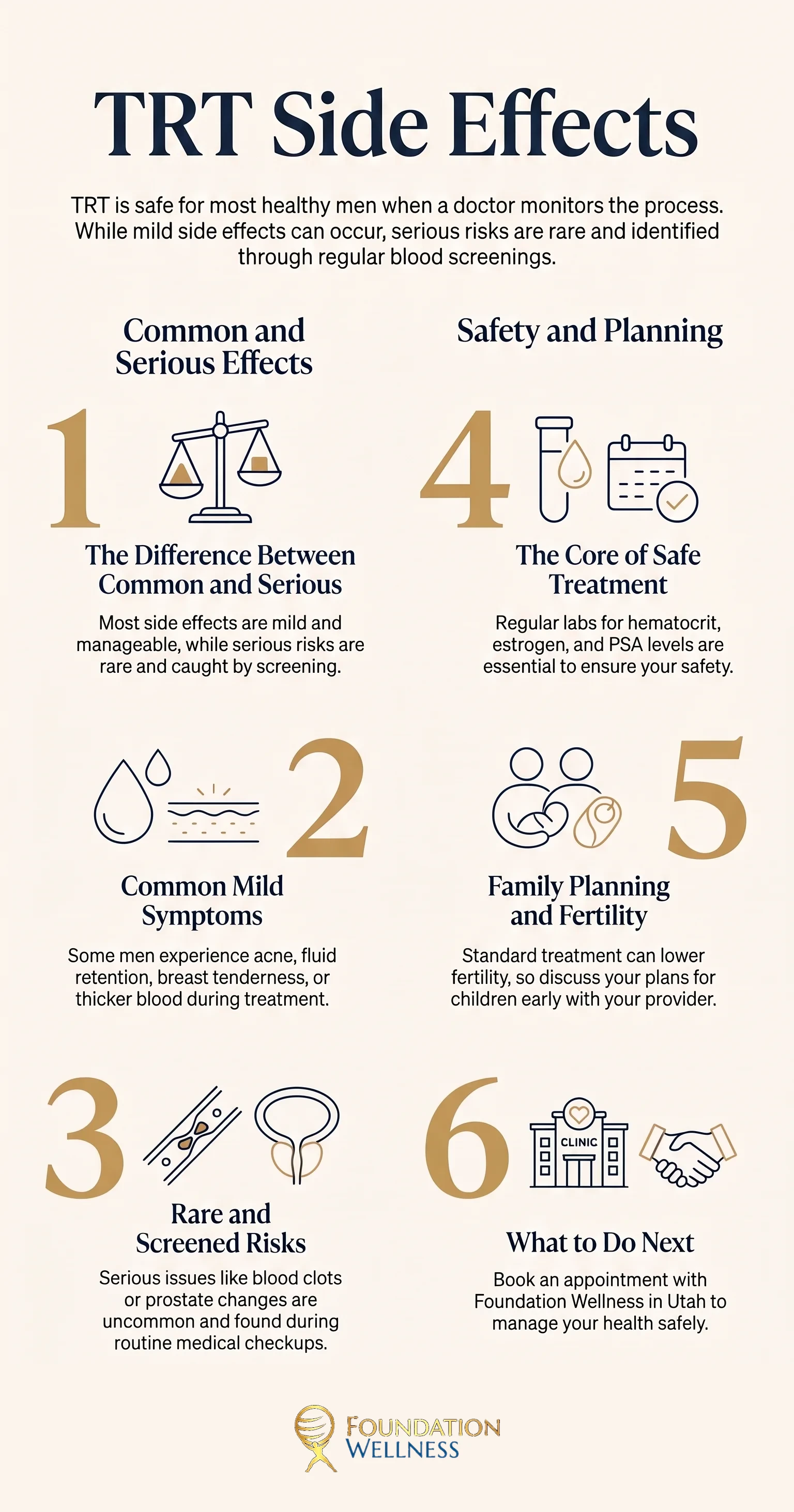
Most testosterone therapy side effects are mild and easy to manage. Acne, oily skin, mild fluid retention, and a slow rise in red blood cell count are the usual ones. Serious problems stay uncommon. Routine bloodwork catches nearly all of them early, which is why monitored testosterone replacement therapy looks nothing like a mail-order prescription.
Are Side Effects Common on TRT?
Some are. Most are minor.
Plenty of men notice something in the first few months. Acne across the shoulders, slightly puffy ankles, or a lab report showing red cells creeping upward. Those are the ordinary ones, and a dose adjustment usually settles them.
According to the Mayo Clinic, testosterone therapy can cause acne, enlarge breast tissue, and limit sperm production. It can also make sleep apnea worse, spur growth of the prostate, and push red cell counts high enough to raise clot risk. That list is short and specific. It’s also the exact list a careful clinic screens for before you start.
Our patients tend to worry about the rare, serious items on that list first, and that instinct is fair. In our experience, though, what men actually report in the first three months is acne, puffy ankles, or a lab number that moved a little. The serious problems are the ones we screen for before the first dose, precisely because they are the ones you cannot feel coming.
Here’s the framing we give our patients in American Fork. Any hormone therapy is a real medication with real trade-offs, and testosterone therapy is no exception. Skipping labs is what turns a manageable trade-off into a problem, and most of the horror stories you have read started right there.
What Are the Most Common Testosterone Therapy Side Effects?

These show up often enough that you should plan on at least one.
- Acne and oily skin. Strongest in the first 8 to 12 weeks, then it usually calms down.
- Fluid retention. Mild puffiness in the hands, ankles, or face.
- Breast tenderness. Some of the hormone converts into estrogen, and estrogen does that.
- Higher red blood cell count. The most consistent lab change on testosterone treatment.
- Site reactions. Soreness after a testosterone injection, or skin irritation from gels.
- Smaller testicles. Your own production quiets down while you’re on therapy.
| Side effect | How often | What we do about it |
|---|---|---|
| Acne, skin changes | Common, early | Lower or split the dose, basic skin care |
| High hematocrit | Common over time | Recheck labs, cut the dose, donate blood |
| Breast tenderness | Occasional | Check estradiol, adjust the dose |
| Fluid retention | Occasional | Usually settles within a few weeks |
| Reduced fertility | Expected | Plan ahead if you want children |
| Blood clot, sleep apnea flare | Uncommon | Screen first, then monitor |
| Prostate growth, higher PSA | Uncommon | Exam plus PSA before and during |
Notice how many of those fixes are the same fix. Lower the dose, spread it out, recheck the labs. That covers most of the job.
Why Does TRT Raise Your Red Blood Cell Count?
Testosterone treatment tells your bone marrow to make more red cells. That helps in small amounts and turns risky past a point, because thicker blood moves more slowly.
The number we track is hematocrit, the share of your blood made up of red cells. The Endocrine Society recommends checking it before you start, again at 3 to 6 months, then once a year. A hematocrit above 50% at baseline counts as a relative reason to hold off. Above 54% during treatment, the guidance is to stop, look for sleep apnea or another cause of low oxygen, and restart at a lower dose.
One lab value drives a surprising number of dosing decisions. Patients who smoke, snore heavily, or live at Utah altitude tend to run higher counts to begin with, so testosterone replacement therapy gets dosed more cautiously for them. Most of the Wasatch Front sits above 4,000 feet, which means that caveat applies to a good share of our patients, from American Fork and Provo up through the Salt Lake valley. We recheck hematocrit at every panel rather than waiting for a symptom, because thick blood rarely announces itself.
Is There a Heart Attack Risk With Testosterone Replacement Therapy?
This question deserves a straight answer, because the story changed.
For roughly a decade, the labels carried boxed-warning language about heart risk, built on a few small and badly designed studies. Then came TRAVERSE, published in the New England Journal of Medicine in 2023. Researchers randomized 5,246 hypogonadal men aged 45 to 80. Every man in the trial already had heart disease or a high risk of it.
The results were reassuring. A first major cardiac event occurred in 182 men (7.0%) on testosterone replacement therapy and 190 men (7.3%) on placebo. Treatment was noninferior to placebo, which in plain English means it did not raise the rate of heart attack or stroke in that group.
The trial also found honest downsides. Blood clots in the lung, atrial fibrillation, and acute kidney injury each showed up slightly more often in the treated group. So the U.S. Food and Drug Administration did two things in February 2025. It dropped the heart-risk language from the boxed warning. It also required a new warning that these medicines raise blood pressure.
Read that second part again. Your cuff reading is now the heart number worth watching on T therapy, and it takes a minute to check at home. We ask our patients to bring a week of home readings to every visit, and we take a pressure in the office at each one.
Does Testosterone Therapy Cause Prostate Cancer?
Current evidence does not show that testosterone replacement therapy causes prostate cancer.
The old theory said the hormone feeds prostate cancer, so replacing it had to be dangerous. Decades of data have not supported that. What testosterone treatment can do is stimulate growth of a tumor that already exists, and enlarge the gland itself, which doctors call benign prostatic hyperplasia. Those are different problems from causing new prostate cancer, and they call for different responses.
Screening is how we stay ahead of it. The guideline says to hold off if your PSA sits above 4 ng/mL. That cutoff drops to 3 ng/mL for men at high risk of prostate cancer, until a urologist has weighed in. Untreated prostate cancer is a reason to hold off entirely. Once you’re on therapy, prostate cancer risk gets checked during the first year, then on a schedule.
If your PSA jumps, that’s information, not a verdict. Testosterone replacement therapy raises PSA modestly in many men, and a urologist sorts out which rises matter.
How Does Testosterone Replacement Affect Fertility?
This is the side effect most men hear about last, and it belongs near the front.
Testosterone replacement therapy switches off the signal that drives your own production. Less signal means less of the hormone inside the testicles, and sperm production depends on that internal supply. Standard replacement therapy lowers sperm counts, and in some men it drops them to zero.
The good news is that it usually reverses. Research on recovery after stopping hormone therapy suggests most men return to normal counts within 6 to 12 months, though a minority take up to two years. Adding hCG alongside treatment keeps the testicles working, and it protects fertility for men who want children while staying on therapy.
Tell your provider before your first testosterone injections, not after. Our team asks about family plans at the first visit, before anyone writes a prescription, and men who say “maybe in a few years” get a different starting plan than men who are done having children. Patients who raise fertility early get options. Patients who raise it two years in get a harder conversation.
Do Side Effects Depend on How You Take It?
They do, and the difference is mostly about how steady your hormone level stays.
| Form | Typical schedule | Side effect pattern |
|---|---|---|
| Testosterone cypionate injection | Weekly or twice weekly | Steady when split, more acne at peaks |
| Testosterone undecanoate injection | Every 10 weeks | Fewer shots, rare cough reaction after dosing |
| Gel or cream | Daily | Skin irritation, risk of transfer to a partner or child |
| Pellets | Every 3 to 6 months | Very steady, but the dose is hard to undo |
| Oral testosterone medication | Twice daily with food | Carries specific hypertension warnings |
The form of testosterone replacement therapy you choose changes which problems you meet. Injections are the workhorse. Splitting a weekly dose into two smaller ones flattens the peaks, and flatter peaks mean less acne, less fluid, and slower rises in hematocrit. In our experience, that split is the first adjustment we reach for when a patient calls about breakouts or comes back with a hematocrit trending up, and it often works without cutting the weekly total at all. Gels avoid needles but carry a transfer risk, so patients using them wash their hands and cover the site. Pellets are convenient right up until you want to change something.
One warning about over-the-counter testosterone supplements. Those bottles are not regulated as medicine, they rarely move testosterone levels, and some have contained ingredients that were not on the label. Real testosterone replacement starts with a diagnosis, not a purchase at a gas station.
How Long Do Side Effects Last?

Most of them fade. A few need a decision.
Men often ask how long testosterone therapy takes to settle, and the honest answer is that it follows a rough arc.
- Weeks 1 to 4. Injection-site soreness, mild acne, and a small lift in energy. Sex drive often moves first.
- Weeks 4 to 12. Acne peaks and then declines. Fluid retention settles. Mood steadies as your testosterone level stops swinging.
- Months 3 to 6. Hematocrit reaches its new normal. Muscle mass and strength gains become obvious. Erectile dysfunction improves for the men it was going to help.
- Months 6 and beyond. What’s left is what you manage long term, usually hematocrit and PSA.
Most patients see the acne fade by month three. Two things do not fade on their own. Sperm counts stay suppressed as long as you’re on treatment, and a rising hematocrit keeps rising until the dose changes. Everything else tends to shrink over the first three months.
Hormone therapy is not a set-and-forget prescription. Patients who treat the first 90 days as a tuning period end up on lower doses than the men who set it and forget it.
Who Should Avoid Testosterone Therapy?
Some men should wait, and a few should not start at all.
- Untreated prostate cancer or breast cancer.
- A PSA above 4 ng/mL without a urology workup.
- Hematocrit above 50% before treatment.
- Severe untreated sleep apnea.
- Uncontrolled heart failure, or a cardiac event or stroke in the past 6 months.
- A known clotting disorder.
- Wanting to conceive in the near term.
That list comes straight from the clinical practice guideline. It’s also why a real workup takes more than an online form. We screen for each item on it before writing a first prescription: two morning testosterone levels, a hematocrit, a PSA, a blood pressure reading, and a real conversation about snoring and family plans. When something on the list turns up, that usually means treat it first and revisit testosterone after, not close the door for good.
Other health conditions matter too. Poorly controlled hypertension, heavy drinking, and untreated depression all change the math.
What Does Safe Monitoring Look Like?
Nearly every risk on this page is caught by a blood draw and a conversation.
- Baseline. Two morning testosterone levels, plus hematocrit, PSA, estradiol, and a full symptom review.
- 6 to 8 weeks in. Recheck testosterone levels and hematocrit, then adjust the dose.
- 3 to 6 months. Full panel again, including bioavailable testosterone if your results look odd.
- Every 6 to 12 months. Testosterone level, hematocrit, PSA, blood pressure, and how you actually feel.
Two morning draws matter more than men expect. A single low testosterone level can reflect a bad night’s sleep or an afternoon blood draw. The guideline asks for two fasting morning results below the reference range before anyone calls it testosterone deficiency. Men with genuinely low testosterone levels feel the difference, and men with borderline numbers often don’t.
In our experience, the men who skip the 8-week recheck are the ones who end up over-dosed. The story we hear often enough to name it goes like this. A man feels great for two months on a dose someone set without follow-up. Then a real lab draw comes back with a hematocrit in the mid-50s that no provider had rechecked. That’s the failure mode, and it’s preventable with one blood test.
Ask us for the schedule in writing, and ask for your actual numbers at each visit instead of a “looks normal.” Testosterone replacement therapy without a lab calendar is guesswork.
What About Mood, Sleep, and Sexual Health?
Men expect the physical problems and get surprised by the rest.
Mood is the honest one. Correcting a genuine hormonal imbalance often lifts irritability and low motivation, and men with low testosterone levels frequently report better mental health once their numbers normalize. Push the dose too high and the effect flips. Mood swings, edginess, and broken sleep show up when levels overshoot the normal range instead of landing inside it.
Sexual function usually improves, though not as fast as men hope. Sex drive and sexual desire tend to respond within weeks, which is why low libido is often the first complaint to lift. Erectile dysfunction is slower and more complicated, because blood flow, vascular health, medication, and stress all play a role. Testosterone therapy helps erectile dysfunction most when low testosterone levels were the main driver, and least when they weren’t.
Sleep apnea deserves its own flag. Testosterone replacement therapy can worsen it, and worse apnea drives hematocrit higher, which loops back into clot risk. If your partner says your snoring got louder, say so at your next visit.
When Should You Call Your Doctor?
Call the same day for chest pain, shortness of breath, a fast or irregular heartbeat, or swelling and pain in one calf. Those point to a clot, and they are the one group of adverse effects that will not wait.
Patients often ask which problems mean stop. These are the ones.
Mention at your next visit: acne that isn’t settling, breast tenderness or swelling, mood swings, new snoring, headaches, or a sex drive that dropped instead of rising. None of those are emergencies. All of them change the plan.
Every potential side effect on this page has a response. The men who do well on hormone therapy report things early, keep their lab appointments, and treat the dose as adjustable. You can read how the treatment works in our TRT in Utah guide. Compare the delivery methods in our injections, pellets, and gels breakdown. The whole program sits on our men’s health and TRT services page. Women weighing the same questions can start with our hormone replacement therapy in Utah guide, since the same lab logic drives hormone therapy at any age.
Key Takeaways
- Most TRT side effects are mild: acne, skin changes, fluid retention, breast tenderness, and a rising red blood cell count.
- Hematocrit is the lab value that drives dosing. Above 54% means stop, investigate, and restart lower.
- TRAVERSE followed 5,246 hypogonadal men in 2023 and found no rise in major cardiac events, so the FDA dropped that boxed-warning language in 2025.
- Blood pressure is the newer warning on the label, and a home cuff checks it in a minute.
- Testosterone replacement does not appear to cause prostate cancer, but it can enlarge the gland and raise PSA, so screening continues.
- Sperm counts drop on treatment and usually recover in 6 to 12 months, and hCG can protect fertility along the way.
- Hormone therapy earns its keep through monitoring, so ask for the lab calendar before your first dose.
- Foundation Wellness serves American Fork and all of Utah, in person and by telehealth.
Sources
- Mayo Clinic, Testosterone therapy: potential benefits and risks as you age. mayoclinic.org.
- Endocrine Society, Testosterone Therapy in Men With Hypogonadism: Clinical Practice Guideline. academic.oup.com.
- U.S. Food and Drug Administration, class-wide labeling changes for testosterone products, February 2025. fda.gov.
- Lincoff AM et al., Cardiovascular Safety of Testosterone-Replacement Therapy, New England Journal of Medicine, 2023. nejm.org.
Dr. Paul Frandsen
July 28, 2026 · 13 min read