
TRT in Utah: Your Complete Testosterone Therapy Guide
July 7, 2026
By Dr. Paul Frandsen · July 7, 2026 · 10 min read

TRT in Utah is medical testosterone replacement therapy for men whose bloodwork and symptoms both point to low testosterone. At Foundation Wellness in American Fork, we treat men across the state, in person and by telehealth. The goal is balanced testosterone in a normal range, held there with ongoing monitoring.
Feeling flat, foggy, or just not like yourself? It’s frustrating, and you’re not imagining it. Plenty of Utah men are asking the same questions right now. Let’s walk through what TRT treatment actually involves, who it helps, what it costs, and how to start it the right way.
What Is TRT (Testosterone Replacement Therapy)?
Testosterone replacement therapy, or TRT, does just what the name says. It replaces the testosterone your body no longer makes enough of. Some men call it TRT therapy, others say testosterone therapy, and a few just say hormone therapy. Same treatment, three different names.
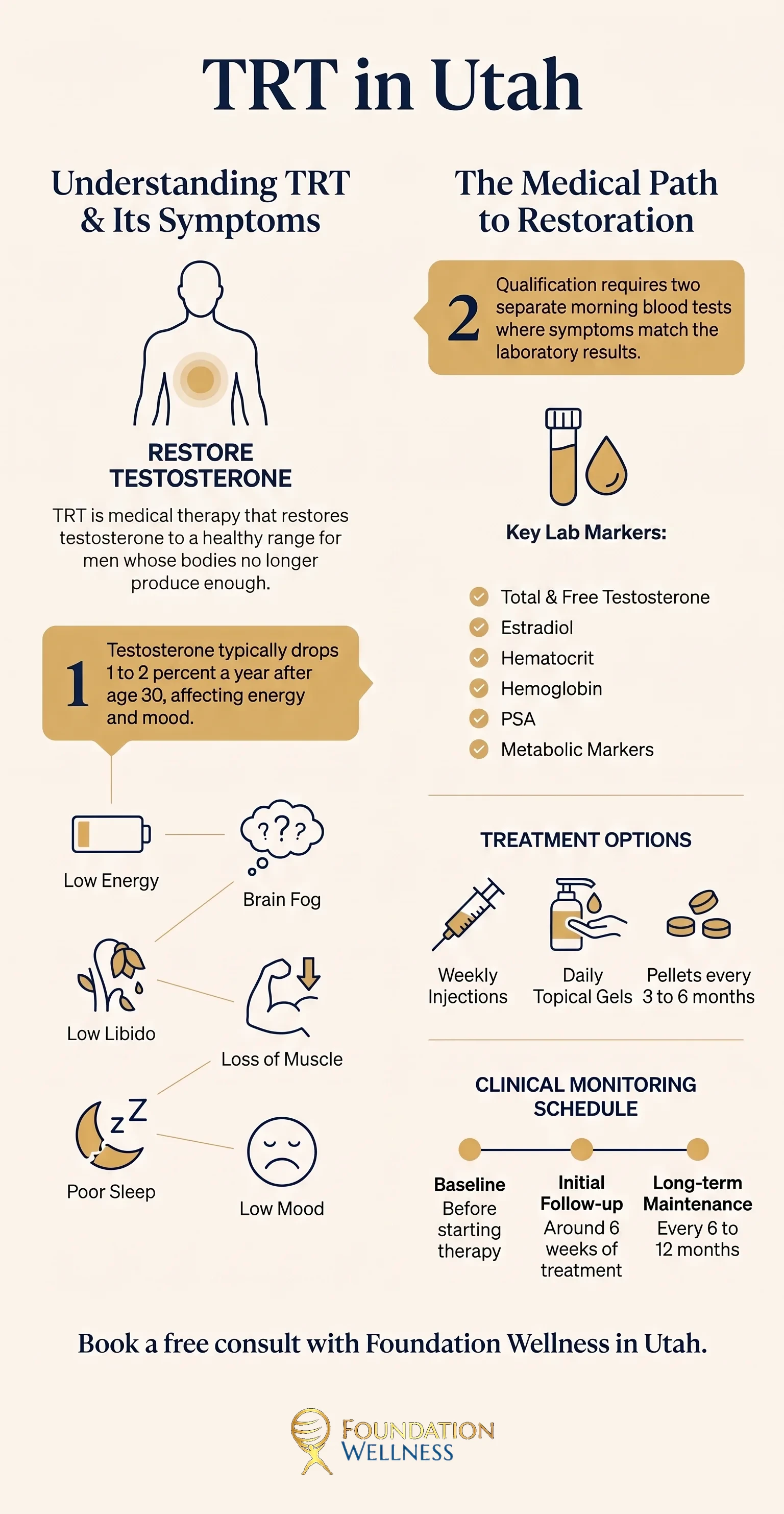
Men’s testosterone starts to drop around age 30. The usual pace is 1 to 2 percent a year. For some men it falls faster. When levels get low enough and symptoms show up, that’s called low T, or in medical terms, hypogonadism. According to Cleveland Clinic, low testosterone can hit your energy, mood, sex drive, and body shape all at once.
Adequate testosterone does more than drive libido. It supports bone density, red blood cell production, muscle mass, and steady mood. When the hormone runs low, hormone balance across the whole system shifts. That’s why one pill for one symptom rarely fixes anything.
TRT is not steroid abuse, and it’s not bodybuilding. Good therapy restores balanced testosterone in a healthy range for a man your age. Not juiced, just back where you should be.
In our American Fork office, the complaints that push most men toward a TRT clinic in Utah are pretty consistent. Our patients tend to open with some version of this list:
- Low energy that coffee doesn’t fix.
- Brain fog and trouble focusing through the afternoon.
- Falling libido, weaker erectile function, and slipping sexual performance.
- Reduced muscle mass, less strength, and stubborn belly fat.
- Poor sleep, mood swings, and less drive overall.
This is where real hormone optimization comes in. TRT is one tool in men’s health, not the whole toolbox. Your whole system working again is the goal, not one number on a page.
Who Qualifies for TRT in Utah?
Not every tired man needs testosterone. Any clinic handing it out after a quick online quiz is doing you a disservice. You qualify for treatment when two things line up: how you feel, and what your blood says.
According to the Endocrine Society, low testosterone should be confirmed with a morning blood test on at least two separate days. Levels peak in the morning and can swing day to day. That’s why careful lab testing matters so much.
In our experience, a fair share of the men who walk in sure they need testosterone turn out to have something else driving the symptoms, such as poor sleep, an untreated thyroid problem, heavy drinking, or a medication side effect. We rule those out first, because treating the wrong thing costs you months.
Here’s what a solid evaluation looks for:
- Real low testosterone on actual labs, not a guess. Total testosterone, free testosterone, SHBG, LH, and FSH are the minimum.
- Symptoms that match the numbers. Your bloodwork and how you feel should tell the same story.
- A full medical history. We ask about heart health, sleep, medications, and whether you still want kids. Testosterone therapy can suppress fertility, so that conversation happens before treatment starts.
- No red flags. Some conditions, such as untreated prostate cancer or severe sleep apnea, get handled first. A real TRT doctor screens for these before writing a prescription.
If you’ve been typing “TRT Utah” or “trt doctor near me” into Google, this is the part that separates a real TRT clinic from a pill mill. Testing before treating isn’t optional.
What Lab Results and Monitoring Does TRT Involve?

Getting a prescription is the easy part. Ongoing monitoring is what keeps testosterone therapy both safe and steady, and it’s where budget clinics tend to fall short.
We track these health markers on a schedule, not just once:
- Total and free testosterone, to confirm you’re in a healthy range.
- Estradiol, because some testosterone converts to estrogen, and too much brings its own problems.
- Hematocrit and hemoglobin, since testosterone can thicken your blood.
- PSA, as a prostate health safeguard.
- Metabolic and lipid markers, for your overall health.
At our American Fork clinic, blood gets drawn at baseline, again around 6 to 8 weeks, then every 6 to 12 months once you’re stable. Early on we recheck more often while your dose gets dialed in. We read the numbers, listen to how you feel, and adjust from there. That’s how customized treatment plans stay useful instead of going stale.
Our team puts each new panel next to the last one before touching a dose, because the trend says more than any single reading. Over the years we learned to slow down when the labs look fine but a man still feels flat, since that usually points to sleep, stress, or thyroid rather than the testosterone dose.
Ongoing care matters more than the first prescription. Your dose in month one is rarely your dose in year two. Weight shifts, sleep shifts, stress shifts, and a good treatment plan moves with all of it.
Personalized care isn’t a slogan here. Two men can walk in with the same complaint and very different TRT needs, because SHBG, body fat, and how fast they clear the medication all differ. For example, a man with high SHBG often does better on smaller doses given twice a week than on one larger weekly shot. Same number on paper, different therapy. One patient may sit steady on a single weekly injection, while another with nearly the same total testosterone does better with that dose split in two. “The lab value tells us where to start, not where to finish,” is how our clinical team frames it at the first visit.
TRT comes in a few forms. The right one depends on your labs, your schedule, and what you’ll actually keep up with. Here’s how the main options compare.
| TRT Method | How It Works | Typical Frequency | Good Fit For |
|---|---|---|---|
| Injections | Testosterone injected into muscle or under the skin | Weekly or twice weekly | Men who want steady levels and lower cost |
| Topical gel or cream | Absorbed through the skin daily | Every day | Men who dislike needles and want easy dosing |
| Pellets | Small pellets placed under the skin | Every 3 to 6 months | Men who want a low-maintenance option |
No single method suits every man. The one that works is the one you’ll stick with, and that holds your levels steady. We sort that out together, and our guide to injections vs pellets vs gel walks through the trade-offs in more detail.
How Much Does TRT Treatment Cost in Utah?
Most Utah clinics, ours included, price TRT therapy as a monthly membership rather than billing health insurance. Expect roughly $150 to $250 a month. That price usually bundles medication, labs, and provider visits into one number.
| What You Pay For | Typical Utah Range | In Our Membership |
|---|---|---|
| Initial blood panel | $150 to $300 | Included |
| Monthly medication | $50 to $120 | Included |
| Follow-up visits and dose changes | $100 to $200 each | Included |
| Repeat bloodwork every 6 months | $75 to $150 each | Included |
A free consultation comes first, so you’ll know the full price before anyone draws blood. No surprise fees show up later. Our patients tell us the flat monthly number is easier to plan around than insurance billing, where the bill tends to land weeks after the visit. Some men pay with an HSA or FSA card, and the full breakdown lives on our TRT cost in Utah page.
What Are the Benefits and Risks of TRT?
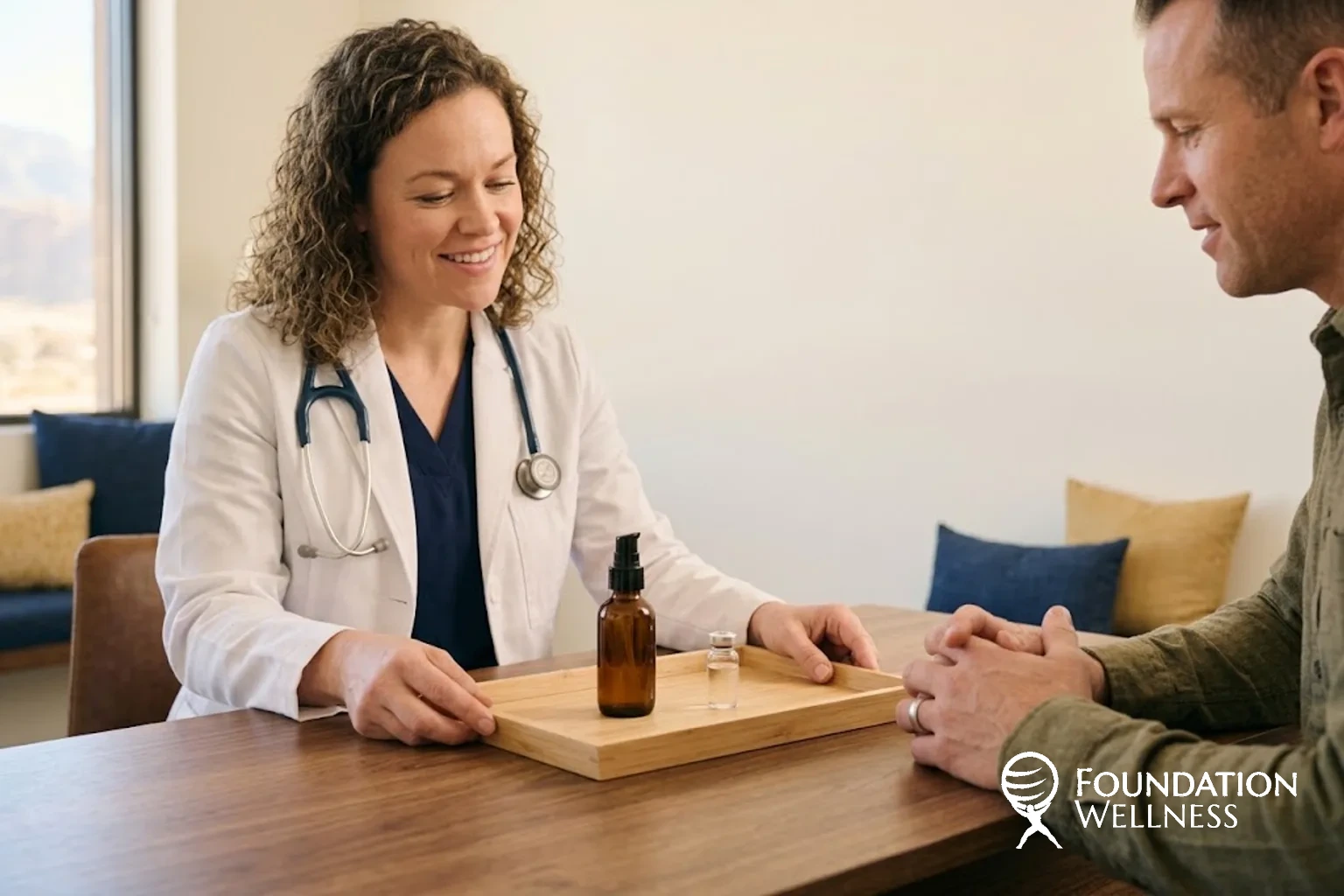
Done right, the changes are real. Most men report increased energy, sharper focus, steadier mood, and a return of drive in the first few weeks. Sexual function tends to come back in stages rather than all at once: libido first, then erectile function and better blood flow. Sexual health is usually the reason men book with us, though it’s rarely the whole story. Physical changes take the longest, and they need work in the gym and the kitchen too.
Here’s the pattern our patients describe most often.
| Time on TRT | What Most Men Notice |
|---|---|
| Weeks 1 to 3 | Better sleep, mood lifting a little |
| Weeks 3 to 6 | Increased energy, clearer thinking at work |
| Months 2 to 3 | Stronger libido and better sexual performance |
| Months 3 to 6 | Muscle mass up, body fat down, better overall vitality |
Real results come from consistency, not from chasing the highest number on a lab report. Men who show up for follow-ups do better than men who vanish after month two. For a fuller timeline, read how long TRT takes to work.
Risks stay manageable when treatment is monitored. Thicker blood, rising estrogen, and skin irritation from gels are the common ones. Each shows up in routine bloodwork before it turns into a problem, which is the whole reason we test on a schedule. Our TRT side effects guide covers the rest.
The danger isn’t TRT itself. The danger is unmonitored therapy, or doses pushed too high by someone chasing a look instead of your long-term health.
Is Long-Term Testosterone Therapy Safe?
For men with confirmed low testosterone who get monitored, testosterone therapy has a solid track record. The FDA reviews safety data on testosterone products and requires that information to appear on the label. We follow those same precautions with every patient. Skipping labs is what turns steady therapy into a gamble.
Three things need watching over the years of therapy. Hematocrit can climb, which thickens the blood, and a reading above 54 percent usually means lowering your dose or sending you to donate blood. Estradiol can rise if your dose runs high. And PSA belongs on the schedule for prostate health, especially past age 45. Our team reads those three together rather than one at a time, since a single number out of range rarely tells the whole story on its own.
Fertility deserves its own conversation. Outside testosterone tells your brain to stop signaling the testes, so sperm production drops. If you’re worried about having kids in the next few years, bring it up at your first visit. Men in that spot are often better served by a different treatment path, and we’d rather tell you that up front than after you’ve started.
Where to Start TRT in Utah: American Fork and Beyond
Foundation Wellness is a physician-led testosterone clinic in Utah. We’re in American Fork and serve men across Utah County, including Pleasant Grove, Lehi, Highland, Alpine, and Orem. Live farther out? Telehealth means most of Utah can work with us without a long drive.
Here’s how getting started works:
- Book a free consultation. We talk through your symptoms, medical history, and health goals. No pressure, no commitment.
- Get proper lab testing. The full panel goes in, so we’re working from facts instead of guesses.
- Review your lab results together. If TRT fits, your plan gets built around those numbers and your life. If it doesn’t fit, we say so and keep looking for the cause.
Low testosterone and extra weight feed each other. Body fat converts testosterone into estrogen, which drags your levels down further. That’s why weight management belongs in the same conversation as hormone health, not in a separate one. Our weight optimization program runs alongside therapy for men who need both.
Not sure TRT is even the issue? Start with our Mens Health and TRT services page to see how we approach low testosterone and hormone health. If you’re local, our TRT in American Fork page covers what to expect at the clinic itself.
Real therapy isn’t a podcast tip and an online order. It’s testing, a plan, and someone who actually follows up. That’s the whole job.
Key Takeaways
- TRT replaces low testosterone, confirmed by real bloodwork and managed by a doctor, not a quiz.
- You qualify when symptoms of low T match blood drawn in the morning on separate days.
- Monitoring is the difference between steady testosterone therapy and risky, unwatched dosing.
- Most men feel better in three to six weeks, with muscle and body changes taking a few months.
- Foundation Wellness serves all of Utah from American Fork, in person and by telehealth, starting with a free consult.
Sources
Dr. Paul Frandsen
July 7, 2026 · 10 min read