
TRT vs Natural Testosterone Boosters: What Studies Show
October 20, 2026
By Dr. Paul Frandsen, MD · October 20, 2026 · 11 min read
Medically reviewed by Dr. Paul Frandsen, MD

TRT vs natural testosterone boosters comes down to one question: do you have diagnosed low testosterone? If you do, testosterone replacement therapy is the treatment with real evidence behind it. It’s given with a prescription and regular monitoring. Natural testosterone boosters are supplements, and most fail to raise total testosterone in studies. Some carry risks of their own. And there’s a middle ground worth knowing about, with your physician.
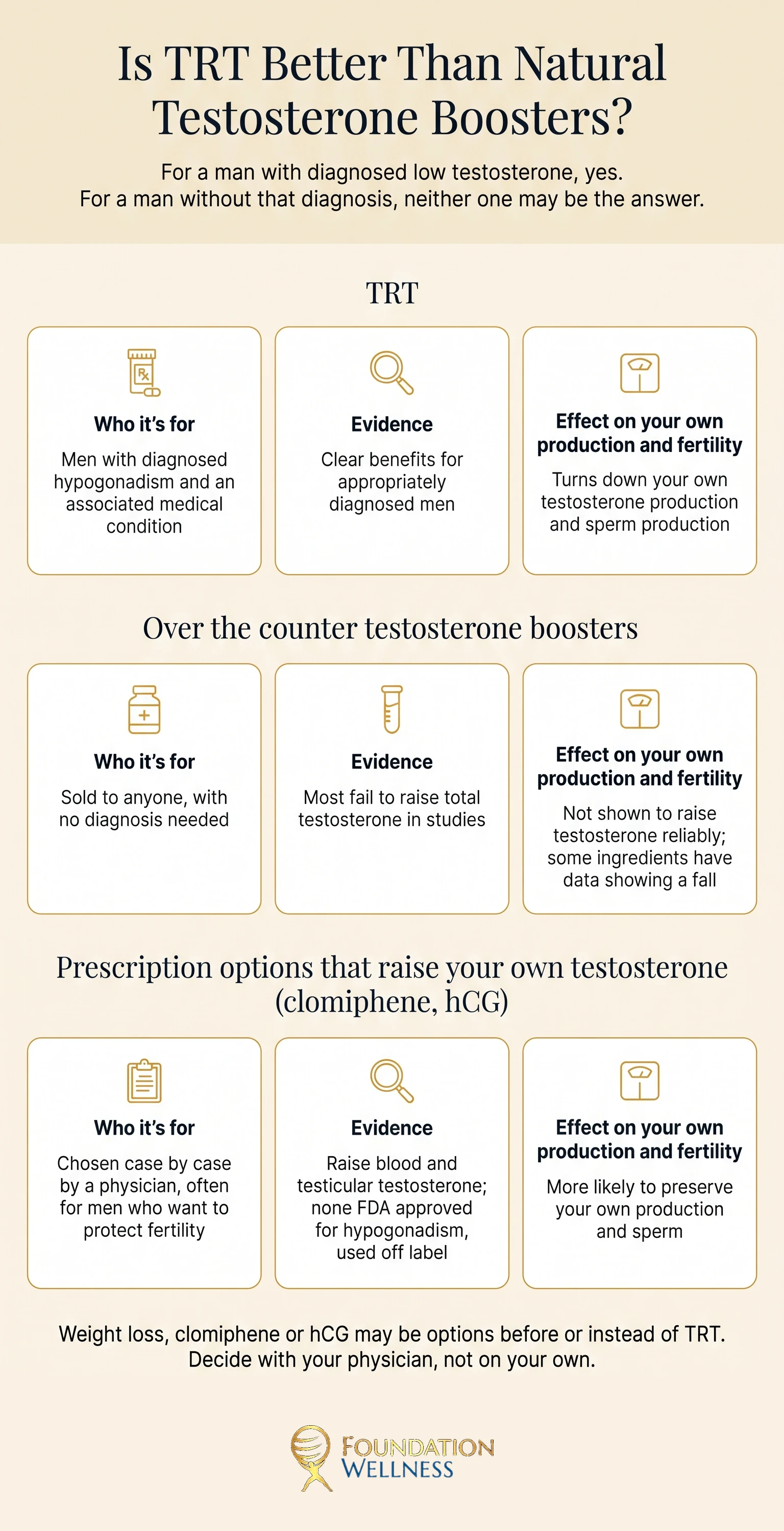
Is TRT Better Than Natural Testosterone Boosters?

For a man with diagnosed low testosterone, yes. For a man without that diagnosis, neither one may be the answer.
The diagnosis is the starting point. In a 2026 statement, the Endocrine Society says hypogonadism should be diagnosed based on symptoms plus at least two early-morning, fasting testosterone tests. A common clinical threshold is near 300 ng/dL. Symptoms alone don’t count. Low energy, libido and mood are common in aging men and have many causes. So a physician should first rule out things like obesity and certain medicines.
The Endocrine Society guideline and the American Urological Association guideline make the same point: testosterone deficiency care rests on accurate testosterone levels, symptoms and monitoring once treatment starts.
Supplements aren’t a treatment for diagnosed hypogonadism. A 2019 study of popular online boosters concluded that patients should be cautioned before considering them. Their reason? Highly effective FDA approved therapies exist. If you think your testosterone is low, our Men’s Health and TRT team in American Fork can start with the right tests.
What Is Testosterone Replacement Therapy (TRT)?
Testosterone replacement therapy is prescription testosterone. The FDA approves testosterone products only for men who lack or have low testosterone along with an associated medical condition. Think testicles that can’t make testosterone. Or problems with the hypothalamus or pituitary, the brain structures that control production. FDA approved forms include topical gel and a skin patch. There’s also a buccal system applied to the gum, and testosterone injections. The Endocrine Society also lists pellets and a nasal gel. Our TRT explainer covers what to know before starting.
TRT therapy works by supplying testosterone from outside the body, sometimes called synthetic testosterone. That has a catch, and it’s the part people miss. A 2020 review explains that this testosterone sends negative feedback to the brain and pituitary. That lowers LH, the signal that tells the testicles to make testosterone. The result is less testosterone made inside the testicles and impaired sperm production. That can cause infertility. So TRT raises your blood testosterone while turning down your own testosterone production. Our TRT and fertility guide covers this in detail.
What Are Natural Testosterone Boosters?
Natural testosterone boosters are over the counter dietary supplements sold with claims that they raise testosterone. No prescription needed.
They’re usually blends of vitamins, minerals, herbs and amino acids. A 2024 systematic review looked at ingredients including vitamin D, zinc and magnesium, Tribulus terrestris, creatine, Eurycoma longifolia, ashwagandha (Withania somnifera), D-aspartic acid and maca. A 2020 study of 50 booster products found 109 unique ingredients. That’s an average of 8.3 per product. Ninety percent of those testosterone supplements claimed to boost testosterone.
One thing to know about any supplement: according to the NCCIH, dietary supplements aren’t approved by the FDA before they’re sold to the public. And the rules for making them are less strict than the rules for drugs. A label claim isn’t proof. Natural boosters are a different category from prescription testosterone, not a gentler version of it.
TRT vs Testosterone Boosters vs Prescription Options: Side by Side
This comparison table puts the three paths together. Every cell comes from the sources listed at the end.
| TRT | Over the counter testosterone boosters | Prescription options that raise your own testosterone (clomiphene, hCG) | |
|---|---|---|---|
| What it is | Prescription testosterone as gel, patch, buccal system, injection or other forms | Dietary supplements with vitamins, minerals, herbs and amino acids | Prescription medicines that signal your body to make more testosterone |
| Who it’s for | Men with diagnosed hypogonadism and an associated medical condition | Sold to anyone, with no diagnosis needed | Chosen case by case by a physician, often for men who want to protect fertility |
| Evidence | Clear benefits for appropriately diagnosed men | Most fail to raise total testosterone in studies | Raise blood and testicular testosterone; none FDA approved for hypogonadism, used off label |
| Effect on your own production and fertility | Turns down your own testosterone production and sperm production | Not shown to raise testosterone reliably; some ingredients have data showing a fall | More likely to preserve your own production and sperm |
| Monitoring | Regular visits and blood tests | None built in | Physician follow-up |
Do Testosterone Boosters Actually Work?
For most products, the research says no. Honestly, it isn’t close. Here’s what the studies found.
- Most don’t raise testosterone. The 2024 review in the International Journal of Impotence Research covered 52 studies on 27 proposed testosterone boosters. Its finding: most fail to increase total testosterone. Only a few ingredients looked effective or possibly effective, and only in specific groups such as athletes.
- Most ingredients have no data. The 2020 study in the World Journal of Men’s Health checked published research on each ingredient. Only 24.8% had data showing an increase in testosterone. Another 10.1% had data showing a decrease, 18.3% showed no change, and 61.5% had no data at all.
- Popular products, thin evidence. The 2019 study in the Journal of Sexual Medicine reviewed the top 5 boosters on Amazon. Among 37 human studies of their most common ingredients, 30% found an increase in testosterone levels, 3% a decrease, 46% no effect, and 22% were indeterminate. The authors found no definitive evidence that these boosters work. Which is frustrating if you’ve already bought a few bottles.
- Some herbs show promise, with limits. A 2021 systematic review of herbs found that 9 of 32 trials showed significant increases in testosterone. Fenugreek seed extract and ashwagandha had positive effects. But half the studies used men under 40. Most were in healthy, nonclinical men. And the authors said more research is needed before firm conclusions.
- Ashwagandha specifically. The NCCIH says there’s some limited evidence that taking ashwagandha for 2 to 4 months may increase testosterone levels and sperm quality.
What about muscle mass and muscle growth? Fair question. These studies measured testosterone, not muscle. And the Endocrine Society notes that boosting testosterone isn’t FDA approved to improve strength, athletic performance or physical appearance.
Are Testosterone Boosters Safe?
Not automatically. “Natural” on a label doesn’t mean safe, and some products aren’t what they claim to be.
The FDA warns that many products sold for sexual enhancement or erectile dysfunction, including male enhancement supplements and male energy and stamina pills, are likely to be contaminated with dangerous hidden ingredients. That’s the scary part. Some are falsely advertised as dietary supplements or all-natural treatments.
Dose is another issue. In the 2020 study of 50 booster products, 13 went over the FDA upper tolerable intake level for zinc, vitamin B3 or magnesium. Many contained vitamins and minerals far above daily needs. And 10.1% had ingredients with data suggesting they lower testosterone.
Single herbs have their own cautions. The NCCIH says ashwagandha may be safe in the short term, up to 3 months, but long-term safety isn’t known. Rare cases of liver injury have been linked to it. It can interact with some medicines. And because it may increase testosterone levels, people with hormone-sensitive prostate cancer should avoid it.
If you take any supplement, tell your physician. Especially if you’re being checked for low testosterone. It can matter for your results and your safety. We ask about supplements for exactly that reason.
What Are the Benefits and Risks of Testosterone Therapy?
TRT has real benefits for the right patient, and real risks that need watching.
Benefits. The Endocrine Society’s 2026 statement says TRT at a dosage similar to what a man would typically make has clear benefits. That’s for men with appropriately diagnosed hypogonadism and a disease of the testes, pituitary or hypothalamus as the cause. Its patient page adds that improving testosterone levels can improve sexual concerns, bone health, muscle and anemia. Results vary from man to man. Our guide on how long TRT takes to work covers what to expect over time.
Risks. In 2025 the FDA required new labeling after studies confirmed an increase in blood pressure with all testosterone products. The Endocrine Society notes that the TRAVERSE trials, with more than 5,200 men, found no meaningful increase in heart attack and stroke over 1 to 4 years. But they also showed roughly a 50% relative increase in pulmonary embolism and more bone fractures in men on testosterone. Long-term safety, including for prostate cancer, remains unestablished. So screening and monitoring are needed.
Fertility. The Endocrine Society guideline recommends against testosterone therapy in men planning fertility in the near term.
That’s why testosterone replacement means ongoing care, not a one-time prescription. Our TRT side effects guide covers the full list.
Is TRT the Same as Anabolic Steroid Use?
No. Both involve testosterone, but prescribed TRT and anabolic steroid misuse have different goals.
TRT aims to bring a diagnosed man’s testosterone back toward what his body would typically make. The Endocrine Society describes the goals of treatment as improving symptoms of testosterone deficiency and maintaining male sex characteristics, with regular visits and blood tests.
Using testosterone to get bigger or stronger is a different thing. The Endocrine Society notes that boosting testosterone isn’t FDA approved to improve strength, athletic performance or physical appearance. Using it for those purposes may be harmful, too. It also lists anabolic steroid use as one of the causes of low testosterone. So the steroid route can end up creating the very problem TRT treats. Weird, but true.
Can You Raise Testosterone Without TRT?

Sometimes, yes, and for some men it’s the right first step.
Weight loss first, when weight is the cause. The Endocrine Society covers appropriately diagnosed hypogonadism due to being overweight or obese (BMI over 27) with no other identified cause. For those men, it says weight loss is typically the first-line therapy. Its patient page adds that testosterone levels can drop temporarily with too much exercise, poor nutrition, severe illness and certain medicines. Our guide to testosterone levels by age covers lifestyle factors that support natural testosterone.
Prescription options that raise your own testosterone. The 2020 review describes medicines that boost natural testosterone production instead of replacing it. They work on the brain and testicles:
- Clomiphene citrate, a selective estrogen receptor modulator (SERM), leads the pituitary to release more LH and FSH, the signals that drive testosterone and sperm production.
- hCG (human chorionic gonadotropin) mimics the body’s own signal and stimulates testosterone and sperm production. It’s given as an injection.
These options are more likely to preserve fertility than TRT. But none has FDA approval for treating hypogonadism, so they’re used off label. Aromatase inhibitors also come up online; the review says they aren’t suggested because long-term data are lacking.
None of these is something to start or switch on your own. Your physician can tell you whether your low testosterone levels fit one of them.
Low Testosterone Care at Foundation Wellness in American Fork
Foundation Wellness treats low testosterone at our clinic at 456 E State Street, Suite 1400, American Fork, UT 84003. We also offer telemedicine visits across Utah. We start with the right blood tests and your symptoms, look for other causes, and talk through your options, including whether TRT therapy makes sense for you or not. If you’re taking testosterone boosters now, bring the labels. Seriously, all of them. Learn more about TRT in Utah or our Men’s Health and TRT services.
Foundation Wellness accepts many insurance plans. Coverage depends on your plan, so check with our office first. Call us at (800) 983-1974.
Key Takeaways
- TRT vs natural testosterone boosters depends on diagnosis: symptoms plus at least two early-morning, fasting testosterone tests.
- Most testosterone boosters fail to raise total testosterone in studies, and many have no published data behind their claims.
- Some supplements contain hidden drug ingredients or exceed safe intake limits for nutrients like zinc.
- TRT has clear benefits for diagnosed men but turns down your own production and sperm, and needs monitoring for blood pressure, clots, prostate health and more.
- Weight loss, clomiphene or hCG may be options before or instead of TRT. Decide with your physician, not on your own.
Sources
- Endocrine Society, Statement on Testosterone Replacement Therapy (2026).
- Journal of Clinical Endocrinology and Metabolism, Testosterone Therapy in Men With Hypogonadism: An Endocrine Society Clinical Practice Guideline (PMID 29562364).
- Journal of Urology, Evaluation and Management of Testosterone Deficiency: AUA Guideline (PMID 29601923).
- FDA, FDA issues class-wide labeling changes for testosterone products (2025).
- FDA, Testosterone Information.
- F&S Reviews, Exogenous testosterone replacement therapy versus raising endogenous testosterone levels: current and future prospects (PMC7894643).
- World Journal of Men’s Health, ‘Testosterone Boosting’ Supplements Composition and Claims Are not Supported by the Academic Literature (PMID 31385468).
- Journal of Sexual Medicine, Testosterone Imposters: An Analysis of Popular Online Testosterone Boosting Supplements (PMID 30770069).
- International Journal of Impotence Research, Do “testosterone boosters” really increase serum total testosterone? A systematic review (PMID 37697053).
- Advances in Nutrition, Examining the Effects of Herbs on Testosterone Concentrations in Men: A Systematic Review (PMID 33150931).
- NCCIH, Ashwagandha: Usefulness and Safety.
- FDA, Sexual Enhancement and Energy Product Notifications.
- Endocrine Society, Hypogonadism in Men.
October 20, 2026 · 11 min read