
Why Most Weight Loss Programs Fail (And What Actually Works)
September 6, 2026
By Dr. Paul Frandsen · September 6, 2026 · 8 min read

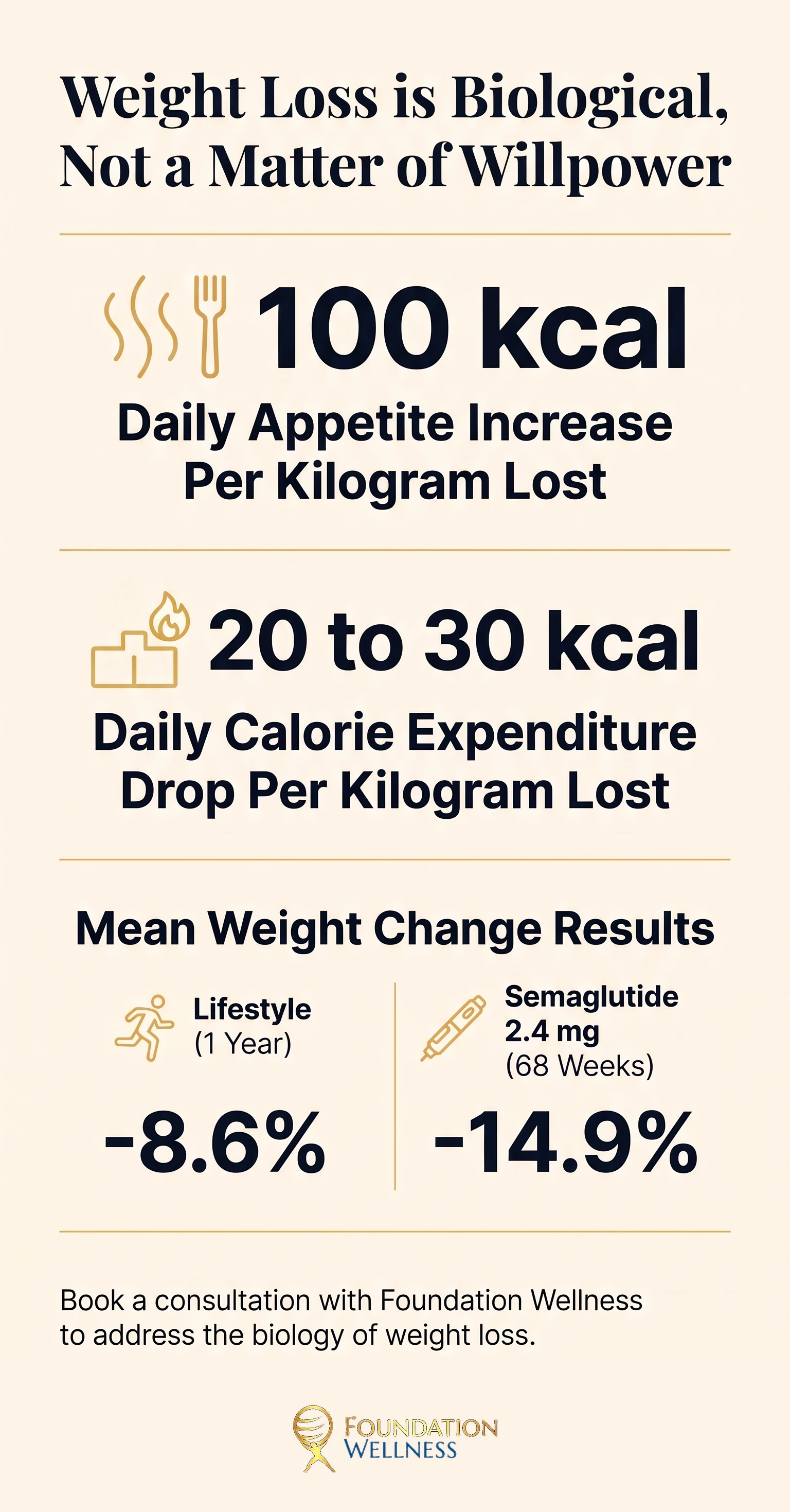
Most weight loss programs fail because they treat a biological problem as a willpower problem. Losing weight lowers your metabolic rate and raises your appetite at the same time, and both changes persist for years. Intensive lifestyle coaching averaged 8.6% of body weight at one year in the Look AHEAD trial. That’s real, and for many people it isn’t enough on its own.
You already know the pattern. Eight or twelve pounds come off, then the scale stops, then it creeps back. The frustrating part is that this is exactly what the physiology predicts.
Is the Calorie Math Actually Wrong?
Not wrong. Incomplete.
Calories still count. Treating your body as a spreadsheet is what fails, because the two sides of the equation move when you change either one.
Cut intake and your body responds. Resting metabolic rate falls, hunger signalling climbs, and energy efficiency improves in ways you cannot feel happening. The equation is not fixed while you are working on it.
Nobody tells you this before you start, which is why the plateau feels like a personal failing rather than a predictable event.
Why Does Your Metabolism Fight Back?
Because it treats weight loss as a threat, and it is stubborn about it.
The clearest measurement comes from a six-year follow-up of The Biggest Loser competitors. Participants lost an average of 58.3 kg during the 30-week competition. Six years later they had regained 41.0 kg. Here’s the part that startled the researchers: resting metabolic rate was suppressed by 610 kcal per day at the end of the competition, and by 704 kcal per day six years afterwards. The suppression did not fade with the weight regain. It got slightly worse.
Appetite moves in the opposite direction. A review in Nutrients describes an energy gap after weight loss, in which more energy is wanted than the body requires. Ghrelin, the hormone that drives hunger, rises and stays raised into the maintenance phase. Leptin, which signals fullness, falls further than body mass alone would predict.
Hall and Kahan put arithmetic on it. For each kilogram of lost weight, calorie expenditure drops by about 20 to 30 kcal per day, while appetite rises by roughly 100 kcal per day above the pre-loss level. Preventing regain, by their estimate, takes 300 to 500 kcal per day of sustained extra effort.
Read those two numbers together. Appetite pushes about four times harder than metabolism does. Most programs address neither.
Which Hormones Decide Where Fat Goes?
Four keep coming up in our clinic, and only one of them appears on a standard physical.
Insulin. It decides whether fat gets stored or released, and chronically raised levels keep the door pointed toward storage. A basic metabolic panel measures glucose, not insulin, so years of compensation can pass while the reported number looks fine.
Cortisol. Sustained stress hormone favours central fat and degrades sleep quality, and poor sleep then worsens insulin sensitivity. The loop closes on itself.
Thyroid hormones. These set the pace for metabolic rate generally. Subclinical thyroid changes, which sit inside standard reference ranges, are easy to overlook.
Sex hormones. Falling testosterone in men and shifting estrogen and progesterone in women both change body composition toward more fat and less muscle. Less muscle means a lower resting burn, which compounds quietly.
You are probably thinking that your doctor already checked and everything came back fine. That may be accurate for the tests that were run. Our piece on signs of hormone imbalance lists which ones usually are not.
What Do the Numbers Say About Each Approach?
Trial data gives a fairer picture than before-and-after photos. Every arm below included diet and activity counselling, so these are not drug-versus-lifestyle comparisons.

| Approach | Trial and length | Mean weight change | Control arm |
|---|---|---|---|
| Intensive lifestyle intervention | Look AHEAD, 1 year | -8.6% | -0.7% |
| Semaglutide 2.4 mg | Wegovy label, Study 2, 68 weeks | -14.9% | -2.4% |
| Tirzepatide 5 mg | Zepbound label, Study 1, 72 weeks | -15.0% | -3.1% |
| Tirzepatide 15 mg | Zepbound label, Study 1, 72 weeks | -20.9% | -3.1% |
Two caveats belong with that table. Look AHEAD enrolled adults who already had type 2 diabetes, a group that loses weight less readily. And the semaglutide and tirzepatide trials were separate studies with different participants, so placing them side by side is informative rather than decisive.
The Wegovy label also reports responder rates, which we find more useful than the average. In Study 2, 83.5% of patients lost at least 5% of body weight and 47.9% lost at least 15%, against 31.1% and 4.8% on placebo.
One correction worth making, because it circulates constantly. Tirzepatide is not simply a stronger GLP-1. It acts on GIP and GLP-1 receptors together, which is a different mechanism rather than a bigger dose of the same one. Our semaglutide versus tirzepatide comparison covers what that changes in practice.
What Happens When You Stop?
This is the question patients ask last and should ask first.
The STEP 1 trial extension followed 327 participants after treatment ended. The numbers are unambiguous.
| Time point | Semaglutide group | Placebo group |
|---|---|---|
| Week 68, end of treatment | -17.3% from baseline | -2.0% |
| Week 120, one year after withdrawal | -5.6% from baseline | -0.1% |
| Weight regained | 11.6 percentage points | 1.9 percentage points |
Roughly two-thirds of the loss returned within a year. Cardiometabolic improvements drifted back toward baseline alongside it.
One detail gets left out when this study is quoted. Lifestyle intervention stopped at week 68 as well, not just the injection. Patients lost the whole support structure at once, which is closer to what happens when insurance coverage lapses than to a planned taper.
The authors drew the obvious conclusion, and we agree with it. Obesity behaves as a chronic condition, and maintaining the result usually requires maintaining the treatment. Our page on GLP-1 cost in Utah exists partly because affordability over years matters more than affordability for three months.
What Does Medical Weight Loss Actually Involve?
It starts with bloodwork, not a meal plan.

The first round covers fasting insulin rather than glucose alone, a full thyroid panel including free T4, cortisol timing, sex hormones, and inflammatory markers. You cannot correct what nobody measured.
From there the plan gets built against what the labs show:
- Test before planning. Insulin sensitivity, thyroid function, and hormone status shape everything downstream.
- Fix sleep and stress early. Both move cortisol and insulin, and neither responds to a supplement.
- Correct the hormone problems you find. Doing this alone sometimes breaks a plateau that has held for years.
- Add medication when it fits. GLP-1 therapy in Utah suits some patients and not others.
- Protect muscle throughout. Adequate protein and resistance training limit the metabolic cost of the loss itself.
- Keep monitoring. Bodies change, and a plan that worked in March may need adjusting by September.
Point five deserves emphasis, since rapid loss takes muscle with fat, and lost muscle is what lowers your burn rate for good. The National Institute of Diabetes and Digestive and Kidney Diseases makes the same underlying point about medication: it works best alongside steady changes in eating and activity, not instead of them.
For a realistic sense of the numbers, our guide on how much weight you can lose on a GLP-1 sets expectations against the published trial data rather than social media.
So Where Does That Leave You?
If you’ve done the work and the scale stopped anyway, you’re not lacking discipline. Something measurable is happening, and most of it is measurable in a blood draw.
Patients tell us regularly that they wish someone had tested them years earlier, before a decade of restarting. That is the part we would change if we could.
At Foundation Wellness we see patients in American Fork and across Utah by telehealth. The plan gets built around your biology rather than a template.
Key Takeaways
- Weight loss lowers metabolic rate and raises appetite at once, and both changes persist for years.
- The Biggest Loser follow-up found resting metabolic rate suppressed by 610 kcal per day at competition end and 704 kcal per day six years later.
- Per kilogram lost, expenditure falls about 20 to 30 kcal per day while appetite rises roughly 100 kcal per day.
- Intensive lifestyle intervention averaged 8.6% at one year in Look AHEAD, against 14.9% for semaglutide 2.4 mg at 68 weeks.
- Tirzepatide is a dual GIP and GLP-1 agonist, reaching 20.9% at 15 mg over 72 weeks in its own trial.
- Stopping treatment returned about two-thirds of the lost weight within a year in the STEP 1 extension.
- Fasting insulin, free T4, and cortisol timing are the tests most often missing before a plan is written.
Sources
- Persistent metabolic adaptation 6 years after The Biggest Loser competition, Obesity 2016 - pmc.ncbi.nlm.nih.gov.
- Melby et al., attenuating the biologic drive for weight regain following weight loss, Nutrients 2017 - pmc.ncbi.nlm.nih.gov.
- Hall and Kahan, maintenance of lost weight and long-term management of obesity, Med Clin North Am 2018 - pmc.ncbi.nlm.nih.gov.
- Look AHEAD Research Group, one-year results, Archives of Internal Medicine 2009 - pmc.ncbi.nlm.nih.gov.
- Wilding et al., weight regain after withdrawal of semaglutide, the STEP 1 trial extension, 2022 - pmc.ncbi.nlm.nih.gov.
- U.S. Food and Drug Administration, Wegovy and Zepbound prescribing information, section 14 - dailymed.nlm.nih.gov.
- National Institute of Diabetes and Digestive and Kidney Diseases, prescription medications to treat overweight and obesity - niddk.nih.gov.
This page is general information rather than medical advice for your situation. Bring your history and any recent labs to a clinician who can review the whole picture.
Dr. Paul Frandsen
September 6, 2026 · 8 min read